
钌催化的可再生生物质衍生乙酰丙酸在水介质中的氢化反应的最新进展
Recent Advances in Ruthenium-Catalyzed Hydrogenation Reactions of Renewable Biomass-Derived Levulinic Acid in Aqueous Media.
作者信息
Seretis Aristeidis, Diamantopoulou Perikleia, Thanou Ioanna, Tzevelekidis Panagiotis, Fakas Christos, Lilas Panagiotis, Papadogianakis Georgios
机构信息
Industrial Chemistry Laboratory, Department of Chemistry, National and Kapodistrian University of Athens, Athens, Greece.
出版信息
Front Chem. 2020 Apr 21;8:221. doi: 10.3389/fchem.2020.00221. eCollection 2020.
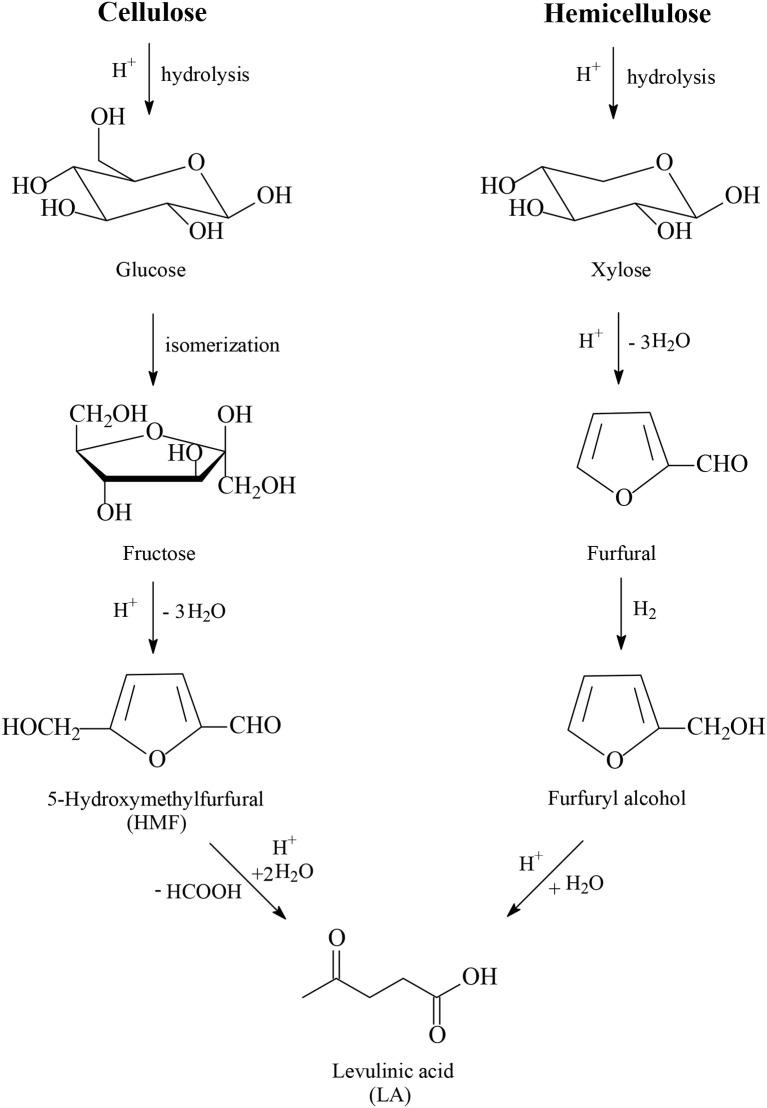
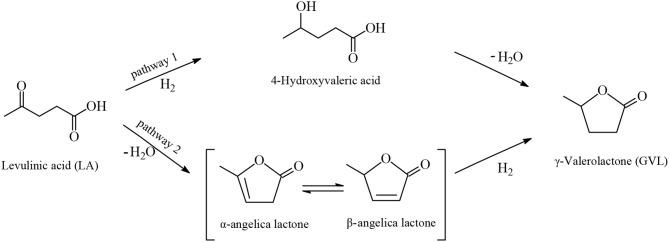
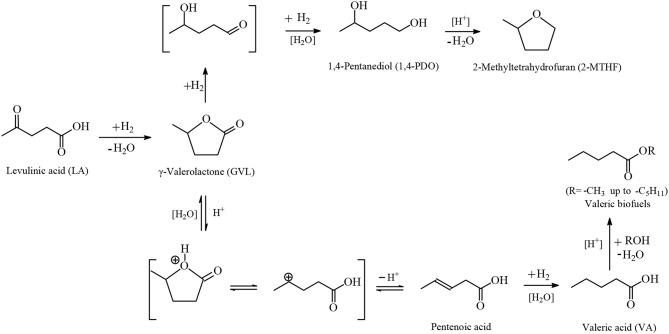
Levulinic acid (LA) is classified as a key platform chemical for the development of future biorefineries, owing to its broad spectrum of potential applications and because it is simply available from lignocellulosic biomass through inexpensive and high-yield production routes. Catalytic hydrogenation reactions of LA into the pivotal intermediate compound γ-valerolactone (GVL), and beyond GVL to yield valeric acid (VA), 1,4-pentanediol (1,4-PDO), and 2-methyltetrahydrofuran (2-MTHF) have gained considerable attention in the last decade. Among the various transition metals used as catalysts in LA hydrogenation reactions, ruthenium-based catalytic systems have been the most extensively applied by far, due to the inherent ability of ruthenium under mild conditions to hydrogenate the keto functionality of LA selectively into an alcohol group to form 4-hydroxyvaleric acid intermediate, which yields GVL spontaneously after dehydration and cyclization. This review focuses on recent advances in the field of aqueous-phase ruthenium-catalyzed hydrogenation reactions of LA toward GVL, VA, 1,4-PDO, 2-MTHF, 2-pentanol, and 2-butanol. It employs heterogeneous catalysts on solid supports, and heterogeneous water-dispersible catalytic nanoparticles or homogeneous water-soluble catalytic complexes with biphasic catalyst separation, for the production of advanced biofuels such as valeric biofuels and other classes of liquid transportation biofuels, value-added fine chemicals, solvents, additives to gasoline, and to food as well. The significance of the aqueous solvent to carry out catalytic hydrogenations of LA has been highlighted because the presence of water combines several advantages: (i) it is highly polar and thus an ideal medium to convert polar and hydrophilic substrates such as LA; (ii) water is involved as a byproduct; (iii) the presence of the aqueous solvent has a beneficial effect and enormously boosts hydrogenation rates. In sharp contrast, the use of various organic solvents gives rise to a dramatic drop in catalytic activities. The promotional effect of water was proven by numerous experimental investigations and several theoretical studies employing various types of catalytic systems; (iv) the large heat capacity of water renders it an excellent medium to perform large scale exothermic hydrogenations more safely and selectively; and (v) water is a non-toxic, safe, non-inflammable, abundantly available, ubiquitous, inexpensive, and green/sustainable solvent.
乙酰丙酸(LA)被归类为未来生物炼制发展的关键平台化学品,这是由于其具有广泛的潜在应用,并且可以通过廉价且高产的生产路线从木质纤维素生物质中简单地获得。在过去十年中,将LA催化加氢转化为关键中间化合物γ-戊内酯(GVL),以及从GVL进一步转化生成戊酸(VA)、1,4-戊二醇(1,4-PDO)和2-甲基四氢呋喃(2-MTHF)的反应受到了广泛关注。在LA加氢反应中用作催化剂的各种过渡金属中,基于钌的催化体系是迄今为止应用最广泛的,这是因为钌在温和条件下具有将LA的酮官能团选择性加氢成醇基以形成4-羟基戊酸中间体的内在能力,该中间体在脱水和环化后会自发生成GVL。本综述重点关注水相钌催化LA加氢生成GVL、VA、1,4-PDO、2-MTHF、2-戊醇和2-丁醇领域的最新进展。它采用固体载体上的多相催化剂、多相水分散性催化纳米颗粒或具有双相催化剂分离的均相水溶性催化配合物,用于生产高级生物燃料,如戊酸生物燃料和其他类别的液体运输生物燃料、增值精细化学品、溶剂、汽油添加剂以及食品添加剂等。水相溶剂对于进行LA的催化加氢的重要性已得到强调,因为水的存在具有多个优点:(i)它具有高极性,因此是转化极性和亲水性底物(如LA)的理想介质;(ii)水作为副产物参与反应;(iii)水相溶剂的存在具有有益效果,极大地提高了加氢速率。与之形成鲜明对比的是,使用各种有机溶剂会导致催化活性急剧下降。水的促进作用已通过众多实验研究以及采用各种类型催化体系的若干理论研究得到证实;(iv)水的大比热容使其成为更安全、更选择性地进行大规模放热加氢反应的理想介质;(v)水是一种无毒、安全、不可燃、大量可得、无处不在、廉价且绿色/可持续的溶剂。




 Zotero 插件