
长链非编码 RNA HOTAIR 通过海绵吸附 miR-449b-5p 促进 HSPA1A 表达从而增强乳腺癌的放射抵抗性。
LncRNA HOTAIR enhances breast cancer radioresistance through facilitating HSPA1A expression via sequestering miR-449b-5p.
机构信息
Tianjin Key Laboratory of Radiation Medicine and Molecular Nuclear Medicine, Institute of Radiation Medicine, Chinese Academy of Medical Sciences and Peking Union Medical College, Tianjin, China.
出版信息
Thorac Cancer. 2020 Jul;11(7):1801-1816. doi: 10.1111/1759-7714.13450. Epub 2020 May 6.
BACKGROUND
Breast cancer (BRCA) is the leading cause of cancer-related death in women worldwide. Pre- and postoperative radiotherapy play a pivotal role in BRCA treatment but its efficacy remains limited and plagued by the emergence of radiation resistance, which aggravates patient prognosis. The long noncoding RNA (lncRNA)-implicated mechanisms underlying radiation resistance are rarely reported. The aim of this study was to determine whether lncRNA HOX transcript antisense RNA (HOTAIR) modulated the radiosensitivity of breast cancer through HSPA1A.
METHODS
A Gammacell 40 Exactor was used for irradiation treatment. Bioinformatic tools and luciferase reporter assay were adopted to explore gene expression profile and demonstrate the interactions between lncRNA, miRNA and target mRNA 3'-untranslated region (3'-UTR). The expression levels of certain genes were determined by real-time PCR and western-blot analyses. in vitro and in vivo functional assays were conducted by cell viability and tumorigenicity assays.
RESULTS
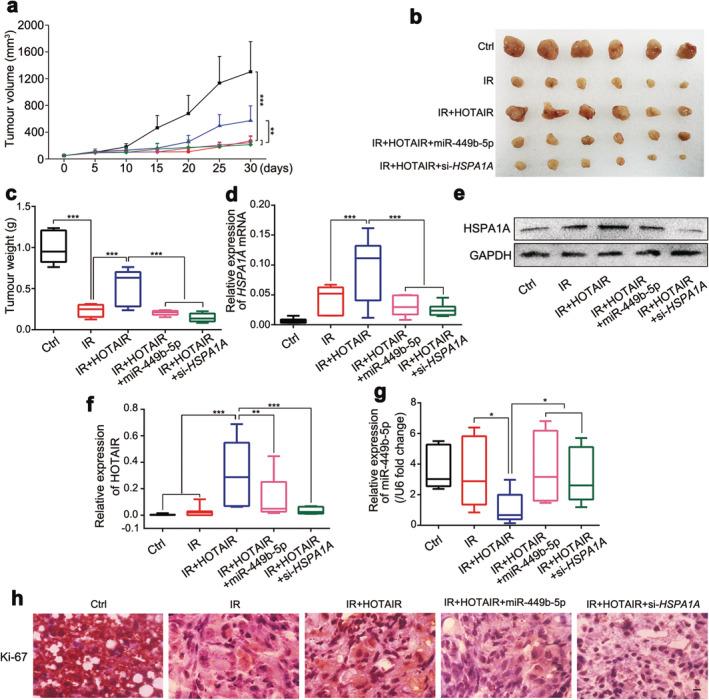
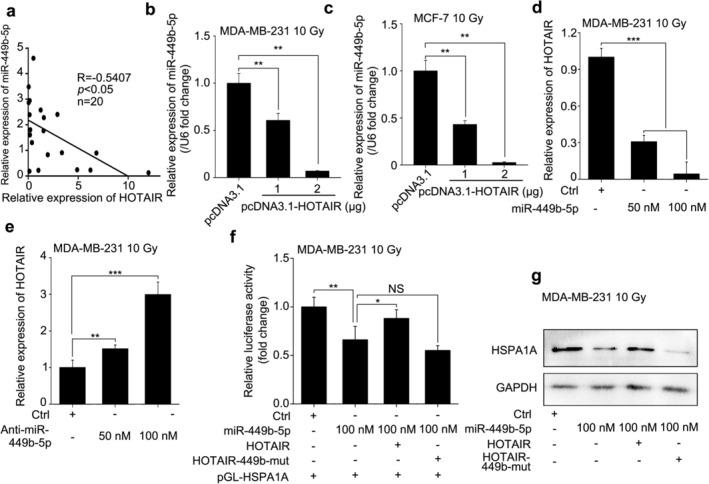
The levels of oncogenic lncRNA HOTAIR were positively correlated with the malignancy of BRCA but reversely correlated with the radiosensitivity of breast cancer cells. Moreover, the expression levels of HOTAIR were positively associated with those of heat shock protein family A (Hsp70) member 1A (HSPA1A) in clinical BRCA tissues and HOTAIR upregulated HSPA1A at the mRNA and protein levels in irradiated BRCA cells. Mechanistically, miR-449b-5p restrained HSPA1A expression through targeting the 3'-UTR of HSPA1A mRNA, whereas HOTAIR acted as a competing sponge to sequester miR-449b-5p and thereby relieved the miR-449b-5p-mediated HSPA1A repression. Functionally, HOTAIR conferred decreased radiosensitivity on BRCA cells, while miR-449b-5p overexpression or HSPA1A knockdown abrogated the HOTAIR-enhanced BRCA growth under the irradiation exposure both in vitro and in vivo.
CONCLUSIONS
LncRNA HOTAIR facilitates the expression of HSPA1A by sequestering miR-449b-5p post-transcriptionally and thereby endows BRCA with radiation resistance.
KEY POINTS
Therapeutically, HOTAIR and HSPA1A may be employed as potential targets for BRCA radiotherapy. Our findings shed new light into the mechanism by which lncRNAs modulate the radiosensitivity of tumors.
背景
乳腺癌(BRCA)是全球女性癌症相关死亡的主要原因。术前和术后放疗在 BRCA 治疗中起着关键作用,但疗效仍然有限,并受到放射抵抗的出现的困扰,这加剧了患者的预后。涉及长链非编码 RNA(lncRNA)的放射抵抗机制很少有报道。本研究旨在确定 lncRNA HOX 转录反义 RNA(HOTAIR)是否通过 HSPA1A 调节乳腺癌的放射敏感性。
方法
使用 Gam macell 40 Exactor 进行照射治疗。采用生物信息学工具和荧光素酶报告基因检测,探讨基因表达谱,并证明 lncRNA、miRNA 和靶 mRNA 3'非翻译区(3'UTR)之间的相互作用。通过实时 PCR 和 Western blot 分析测定某些基因的表达水平。通过细胞活力和肿瘤发生测定进行体外和体内功能测定。
结果
致癌 lncRNA HOTAIR 的水平与 BRCA 的恶性程度呈正相关,但与乳腺癌细胞的放射敏感性呈负相关。此外,临床 BRCA 组织中 HOTAIR 的表达水平与热休克蛋白家族 A(Hsp70)成员 1A(HSPA1A)的表达水平呈正相关,在照射的 BRCA 细胞中,HOTAIR 上调 HSPA1A 的 mRNA 和蛋白水平。机制上,miR-449b-5p 通过靶向 HSPA1A mRNA 的 3'UTR 来抑制 HSPA1A 的表达,而 HOTAIR 作为竞争性海绵来隔离 miR-449b-5p,从而缓解 miR-449b-5p 介导的 HSPA1A 抑制。功能上,HOTAIR 赋予 BRCA 细胞降低的放射敏感性,而 miR-449b-5p 过表达或 HSPA1A 敲低均可消除照射暴露下 HOTAIR 增强的 BRCA 生长,无论是在体外还是体内。
结论
lncRNA HOTAIR 通过在后转录水平隔离 miR-449b-5p 促进 HSPA1A 的表达,从而赋予 BRCA 放射抵抗性。
关键点
在治疗上,HOTAIR 和 HSPA1A 可作为 BRCA 放疗的潜在靶点。我们的研究结果为 lncRNA 调节肿瘤放射敏感性的机制提供了新的视角。



 Zotero 插件