
血管化人类皮质类器官(vOrganoids)模拟体内皮质发育。
Vascularized human cortical organoids (vOrganoids) model cortical development in vivo.
机构信息
State Key Laboratory of Brain and Cognitive Science, CAS Center for Excellence in Brain Science and Intelligence Technology, Institute of Brain-Intelligence Technology (Shanghai), Institute of Biophysics, Chinese Academy of Sciences, Beijing, China.
State Key Laboratory of Cognitive Neuroscience and Learning, Beijing Normal University, Beijing, China.
出版信息
PLoS Biol. 2020 May 13;18(5):e3000705. doi: 10.1371/journal.pbio.3000705. eCollection 2020 May.
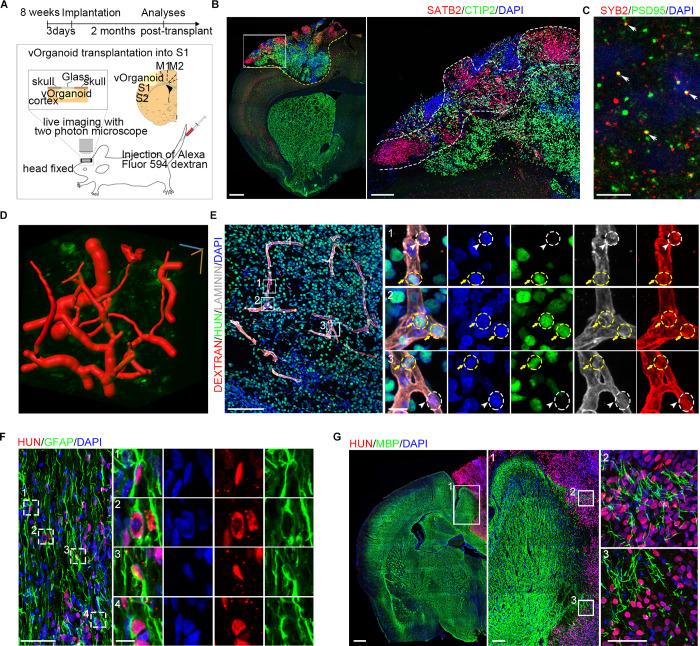
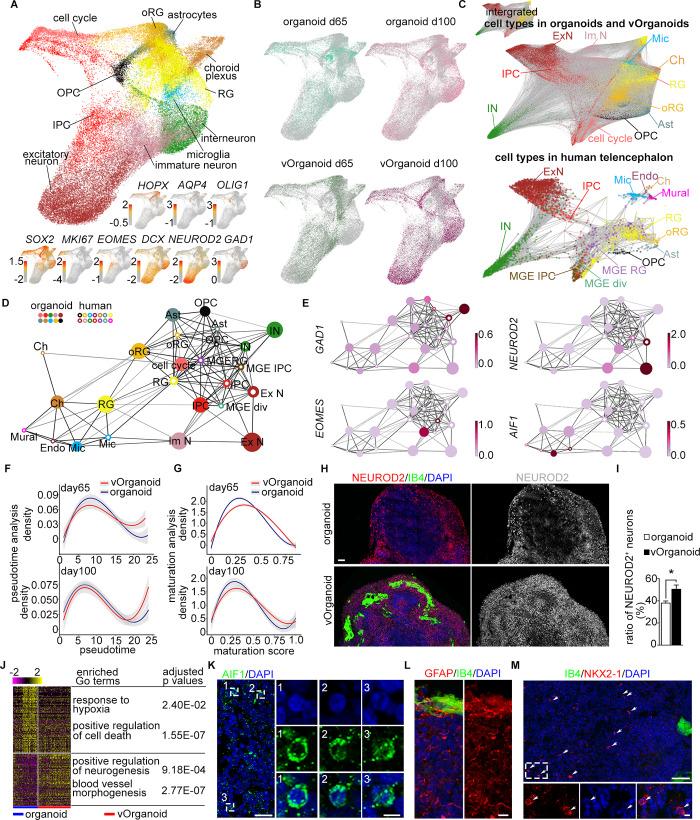
Modeling the processes of neuronal progenitor proliferation and differentiation to produce mature cortical neuron subtypes is essential for the study of human brain development and the search for potential cell therapies. We demonstrated a novel paradigm for the generation of vascularized organoids (vOrganoids) consisting of typical human cortical cell types and a vascular structure for over 200 days as a vascularized and functional brain organoid model. The observation of spontaneous excitatory postsynaptic currents (sEPSCs), spontaneous inhibitory postsynaptic currents (sIPSCs), and bidirectional electrical transmission indicated the presence of chemical and electrical synapses in vOrganoids. More importantly, single-cell RNA-sequencing analysis illustrated that vOrganoids exhibited robust neurogenesis and that cells of vOrganoids differentially expressed genes (DEGs) related to blood vessel morphogenesis. The transplantation of vOrganoids into the mouse S1 cortex resulted in the construction of functional human-mouse blood vessels in the grafts that promoted cell survival in the grafts. This vOrganoid culture method could not only serve as a model to study human cortical development and explore brain disease pathology but also provide potential prospects for new cell therapies for nervous system disorders and injury.
为了研究人类大脑发育和寻找潜在的细胞治疗方法,对神经祖细胞的增殖和分化过程进行建模以产生成熟的皮质神经元亚型是至关重要的。我们展示了一种新的血管化类器官(vOrganoids)生成范例,该范例由超过 200 天的典型人类皮质细胞类型和血管结构组成,是一种血管化和功能性的大脑类器官模型。自发兴奋性突触后电流(sEPSC)、自发抑制性突触后电流(sIPSC)和双向电传递的观察表明 vOrganoids 中存在化学和电突触。更重要的是,单细胞 RNA 测序分析表明 vOrganoids 表现出强大的神经发生,并且 vOrganoids 中的细胞差异表达与血管形态发生相关的基因(DEGs)。将 vOrganoids 移植到小鼠 S1 皮质中,导致移植物中构建了功能性的人-鼠血管,促进了移植物中细胞的存活。这种 vOrganoid 培养方法不仅可以作为研究人类皮质发育和探索脑部疾病病理学的模型,还为神经系统疾病和损伤的新细胞治疗提供了潜在的前景。


 Zotero 插件