
社区项目对 2 型糖尿病和多种合并症老年患者的有效性:一项实用随机对照试验。
Effectiveness of a community program for older adults with type 2 diabetes and multimorbidity: a pragmatic randomized controlled trial.
机构信息
Schmid College of Science and Technology, Chapman University, Orange, California, 92866, USA.
School of Pharmacy, Chapman University, Irvine, California, 92618, USA.
出版信息
BMC Geriatr. 2020 May 13;20(1):174. doi: 10.1186/s12877-020-01557-0.
BACKGROUND
Type II diabetes mellitus (T2DM) affects upwards of 25% of Canadian older adults and is associated with high comorbidity and burden. Studies show that lifestyle factors and self-management are associated with improved health outcomes, but many studies lack rigour or exclude older adults, particularly those with multimorbidity. More evidence is needed on the effectiveness of community-based self-management programs in older adults with T2DM and multimorbidity. The study purpose is to evaluate the effect of a community-based intervention versus usual care on physical functioning, mental health, depressive symptoms, anxiety, self-efficacy, self-management, and healthcare costs in older adults with T2DM and 2 or more comorbidities.
METHODS
Community-living older adults with T2DM and two or more chronic conditions were recruited from three Primary Care Networks (PCNs) in Alberta, Canada. Participants were randomly allocated to the intervention or control group in this pragmatic randomized controlled trial comparing the intervention to usual care. The intervention involved up to three in-home visits, a monthly group wellness program, monthly case conferencing, and care coordination. The primary outcome was physical functioning. Secondary outcomes included mental functioning, anxiety, depressive symptoms, self-efficacy, self-management, and the cost of healthcare service use. Intention-to-treat analysis was performed using ANCOVA modeling.
RESULTS
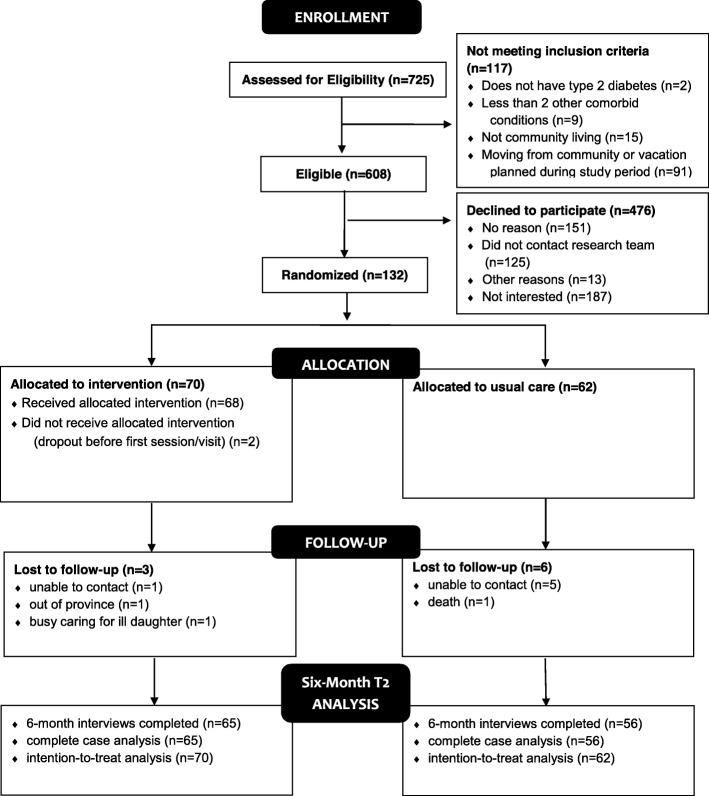
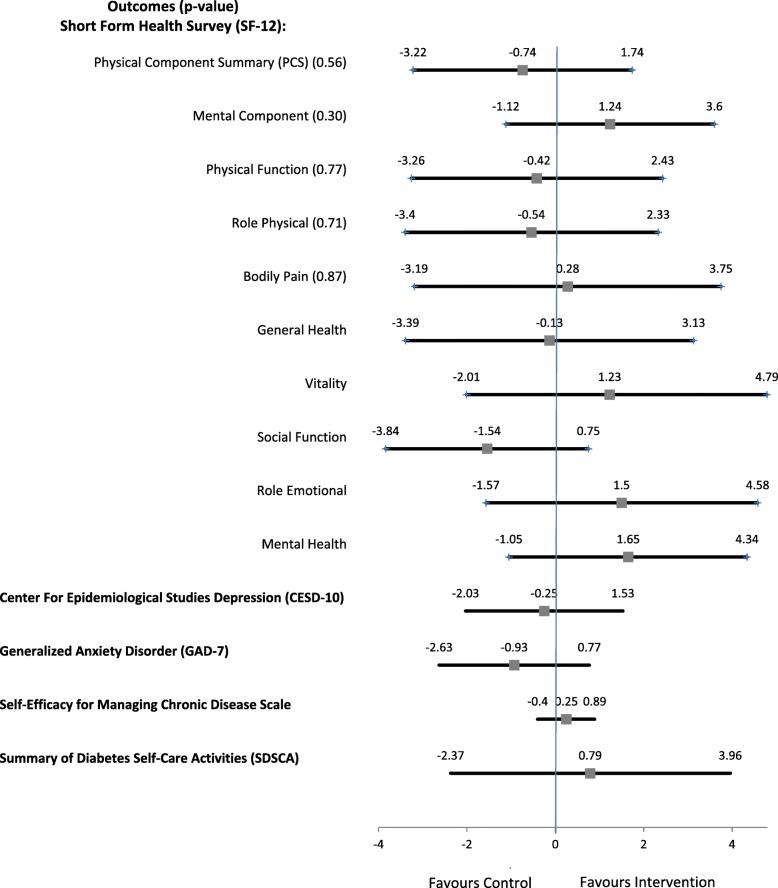
Of 132 enrolled participants (70-Intervention, 62-Control), 42% were 75 years or older, 55% were female, and over 75% had at least six chronic conditions (in addition to T2DM). No significant group differences were seen for the baseline to six-month change in physical functioning (mean difference: -0.74; 95% CI: - 3.22, 1.74; p-value: 0.56), mental functioning (mean difference: 1.24; 95% CI: - 1.12, 3.60; p-value: 0.30), or other secondary outcomes..
CONCLUSION
No significant group differences were seen for the primary outcome, physical functioning (PCS). Program implementation, baseline differences between study arms and chronic disease management services that are part of usual care may have contributed to the modest study results. Fruitful areas for future research include capturing clinical outcome measures and exploring the impact of varying the type and intensity of key intervention components such as exercise and diet.
TRIAL REGISTRATION
NCT02158741 Date of registration: June 9, 2014.
背景
II 型糖尿病(T2DM)影响了加拿大 25%以上的老年人,并且与高合并症和负担有关。研究表明,生活方式因素和自我管理与改善健康结果有关,但许多研究缺乏严谨性或排除了老年人,特别是那些有多发性疾病的老年人。需要更多关于社区为基础的自我管理计划在 T2DM 和多发性疾病的老年人中的有效性的证据。本研究的目的是评估社区为基础的干预与常规护理对 T2DM 和两种或两种以上合并症的老年人的身体功能、心理健康、抑郁症状、焦虑、自我效能、自我管理和医疗保健成本的影响。
方法
从加拿大艾伯塔省的三个初级保健网络(PCN)招募了患有 T2DM 和两种或两种以上慢性疾病的社区居住老年人。在这项比较干预与常规护理的实用随机对照试验中,参与者被随机分配到干预组或对照组。该干预措施包括最多三次家访、每月的团体健康计划、每月的病例会议和护理协调。主要结局是身体功能。次要结局包括心理功能、焦虑、抑郁症状、自我效能、自我管理和医疗保健服务使用的成本。采用 ANCOVA 模型进行意向治疗分析。
结果
在 132 名入组参与者(70 名干预组,62 名对照组)中,42%的参与者年龄在 75 岁或以上,55%为女性,超过 75%的参与者有至少六种慢性疾病(除 T2DM 外)。在从基线到六个月的身体功能变化方面,两组间无显著差异(平均差异:-0.74;95%CI:-3.22,1.74;p 值:0.56),心理功能(平均差异:1.24;95%CI:-1.12,3.60;p 值:0.30)或其他次要结局。
结论
在主要结局,身体功能(PCS)方面,两组间无显著差异。方案的实施、研究臂之间的基线差异以及作为常规护理一部分的慢性疾病管理服务可能导致了研究结果的适度。未来研究有成效的领域包括捕捉临床结果测量和探索改变关键干预成分(如运动和饮食)的类型和强度的影响。
试验注册
NCT02158741 注册日期:2014 年 6 月 9 日。

 Zotero 插件