
B 和 T 细胞驱动多发性硬化症:身份、机制和潜在触发因素。
B and T Cells Driving Multiple Sclerosis: Identity, Mechanisms and Potential Triggers.
机构信息
Department of Immunology, MS Center ErasMS, Erasmus MC, University Medical Center, Rotterdam, Netherlands.
Department of Neurology, MS Center ErasMS, Erasmus MC, University Medical Center, Rotterdam, Netherlands.
出版信息
Front Immunol. 2020 May 8;11:760. doi: 10.3389/fimmu.2020.00760. eCollection 2020.
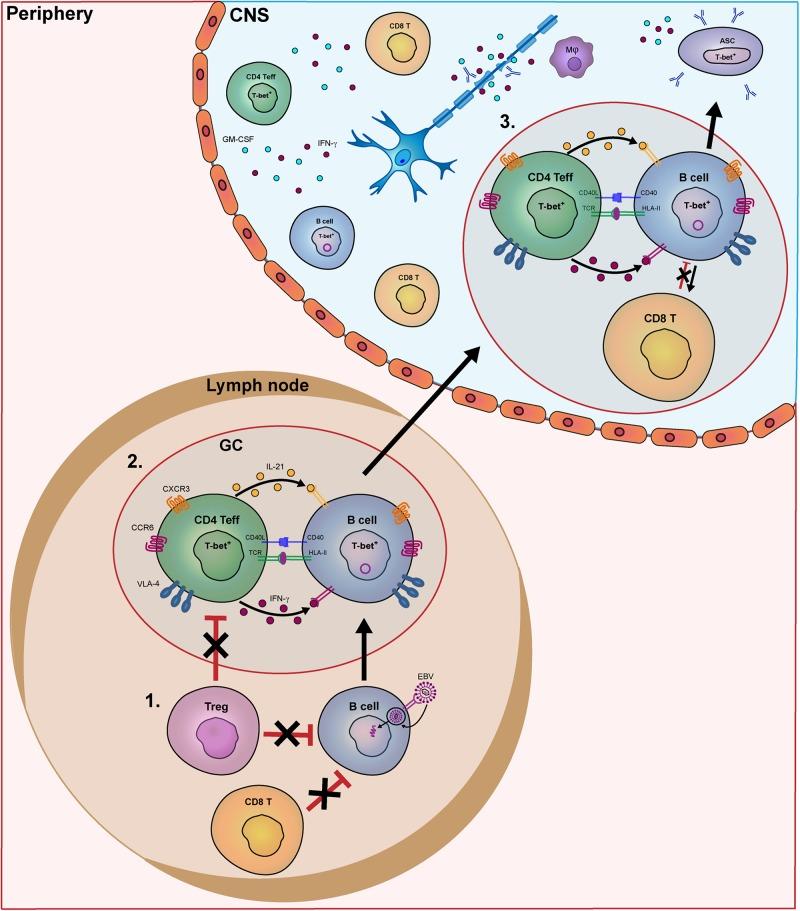
Historically, multiple sclerosis (MS) has been viewed as being primarily driven by T cells. However, the effective use of anti-CD20 treatment now also reveals an important role for B cells in MS patients. The results from this treatment put forward T-cell activation rather than antibody production by B cells as a driving force behind MS. The main question of how their interaction provokes both B and T cells to infiltrate the CNS and cause local pathology remains to be answered. In this review, we highlight key pathogenic events involving B and T cells that most likely contribute to the pathogenesis of MS. These include (1) peripheral escape of B cells from T cell-mediated control, (2) interaction of pathogenic B and T cells in secondary lymph nodes, and (3) reactivation of B and T cells accumulating in the CNS. We will focus on the functional programs of CNS-infiltrating lymphocyte subsets in MS patients and discuss how these are defined by mechanisms such as antigen presentation, co-stimulation and cytokine production in the periphery. Furthermore, the potential impact of genetic variants and viral triggers on candidate subsets will be debated in the context of MS.
从历史上看,多发性硬化症(MS)主要被认为是由 T 细胞驱动的。然而,抗 CD20 治疗的有效应用现在也揭示了 B 细胞在 MS 患者中的重要作用。这种治疗的结果提出了 T 细胞的激活,而不是 B 细胞产生的抗体,作为 MS 背后的驱动力。它们的相互作用如何引发 B 和 T 细胞渗透中枢神经系统并导致局部病理学的主要问题仍有待回答。在这篇综述中,我们强调了涉及 B 和 T 细胞的关键致病事件,这些事件很可能有助于 MS 的发病机制。这些包括:(1)B 细胞从 T 细胞介导的控制中外周逃逸;(2)致病性 B 和 T 细胞在次级淋巴器官中的相互作用;(3)在中枢神经系统中积累的 B 和 T 细胞的再激活。我们将重点讨论 MS 患者中枢神经系统浸润淋巴细胞亚群的功能程序,并讨论这些程序如何通过外周的抗原呈递、共刺激和细胞因子产生等机制来定义。此外,还将在 MS 的背景下讨论遗传变异和病毒触发对候选亚群的潜在影响。

 Zotero 插件