
人类癌症中沉默的端粒酶逆转录酶(TERT)等位基因普遍存在启动子高甲基化现象。
Pervasive promoter hypermethylation of silenced TERT alleles in human cancers.
作者信息
Esopi David, Graham Mindy Kim, Brosnan-Cashman Jacqueline A, Meyers Jennifer, Vaghasia Ajay, Gupta Anuj, Kumar Balasubramanian, Haffner Michael C, Heaphy Christopher M, De Marzo Angelo M, Meeker Alan K, Nelson William G, Wheelan Sarah J, Yegnasubramanian Srinivasan
机构信息
Sidney Kimmel Comprehensive Cancer Center, Johns Hopkins University School of Medicine, Baltimore, MD, USA.
Vertex Genetic Therapies, Watertown, MA, USA.
出版信息
Cell Oncol (Dordr). 2020 Oct;43(5):847-861. doi: 10.1007/s13402-020-00531-7. Epub 2020 May 28.
BACKGROUND
In cancers, maintenance of telomeres often occurs through activation of the catalytic subunit of telomerase, encoded by TERT. Yet, most cancers show only modest levels of TERT gene expression, even in the context of activating hotspot promoter mutations (C228T and C250T). The role of epigenetic mechanisms, including DNA methylation, in regulating TERT gene expression in cancer cells is as yet not fully understood.
METHODS
Here, we have carried out the most comprehensive characterization to date of TERT promoter methylation using ultra-deep bisulfite sequencing spanning the CpG island surrounding the core TERT promoter in 96 different human cell lines, including primary, immortalized and cancer cell types, as well as in control and reference samples.
RESULTS
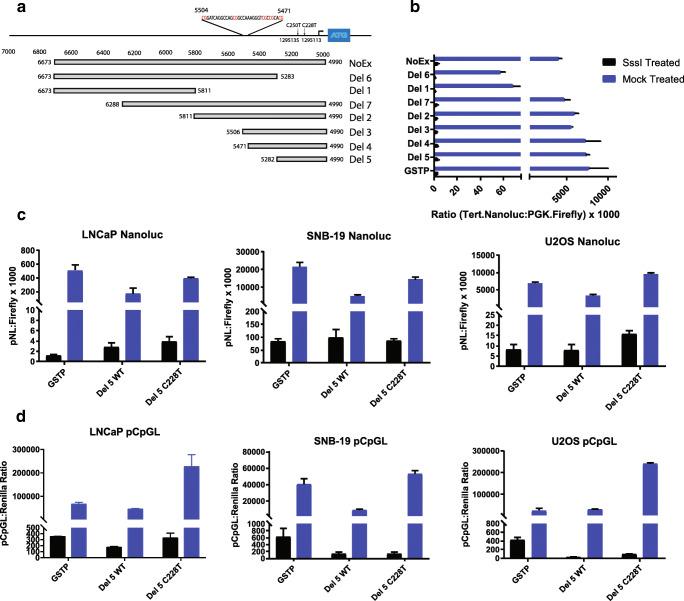
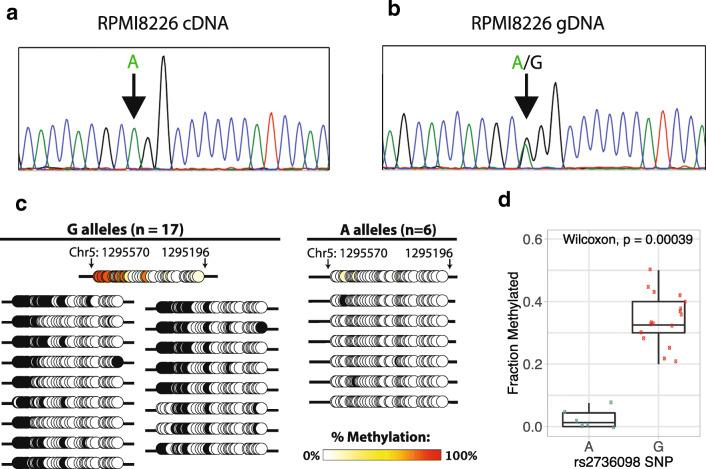
In general, we observed that immortalized and cancer cell lines were hypermethylated in a region upstream of the recurrent C228T and C250T TERT promoter mutations, while non-malignant primary cells were comparatively hypomethylated in this region. However, at the allele-level, we generally found that hypermethylation of promoter sequences in cancer cells is associated with repressed expression, and the remaining unmethylated alleles marked with open chromatin are largely responsible for the observed TERT expression in cancer cells.
CONCLUSIONS
Our findings suggest that hypermethylation of the TERT promoter alleles signals transcriptional repression of those alleles, leading to attenuation of TERT activation in cancer cells. This type of fine tuning of TERT expression may account for the modest activation of TERT expression in most cancers.
背景
在癌症中,端粒的维持通常通过激活由TERT编码的端粒酶催化亚基来实现。然而,即使在存在激活热点启动子突变(C228T和C250T)的情况下,大多数癌症中TERT基因的表达水平也仅处于中等水平。包括DNA甲基化在内的表观遗传机制在调节癌细胞中TERT基因表达方面的作用尚未完全明确。
方法
在此,我们利用超深度亚硫酸氢盐测序对TERT启动子甲基化进行了迄今为止最全面的表征,该测序涵盖了96种不同人类细胞系(包括原代细胞、永生化细胞和癌细胞类型)以及对照和参考样本中围绕核心TERT启动子的CpG岛。
结果
总体而言,我们观察到永生化细胞系和癌细胞系在TERT启动子复发性C228T和C250T突变上游的区域发生了高甲基化,而非恶性原代细胞在该区域的甲基化程度相对较低。然而,在等位基因水平上,我们通常发现癌细胞中启动子序列的高甲基化与表达受抑制相关,而其余标记为开放染色质的未甲基化等位基因在很大程度上决定了癌细胞中观察到的TERT表达。
结论
我们的研究结果表明,TERT启动子等位基因的高甲基化标志着这些等位基因的转录抑制,导致癌细胞中端粒酶激活减弱。这种对TERT表达的微调可能解释了大多数癌症中端粒酶表达的适度激活。


 Zotero 插件