
tRNA合成酶的交叉编辑使脊椎动物能够大量表达可错配的tRNA而不导致错误翻译。
Cross-editing by a tRNA synthetase allows vertebrates to abundantly express mischargeable tRNA without causing mistranslation.
作者信息
Chen Meirong, Kuhle Bernhard, Diedrich Jolene, Liu Ze, Moresco James J, Yates Iii John R, Pan Tao, Yang Xiang-Lei
机构信息
Department of Molecular Medicine, Scripps Research Institute, La Jolla, CA 92037, USA.
College of Food Science and Technology, Nanjing Agricultural University, Nanjing 210095, China.
出版信息
Nucleic Acids Res. 2020 Jul 9;48(12):6445-6457. doi: 10.1093/nar/gkaa469.
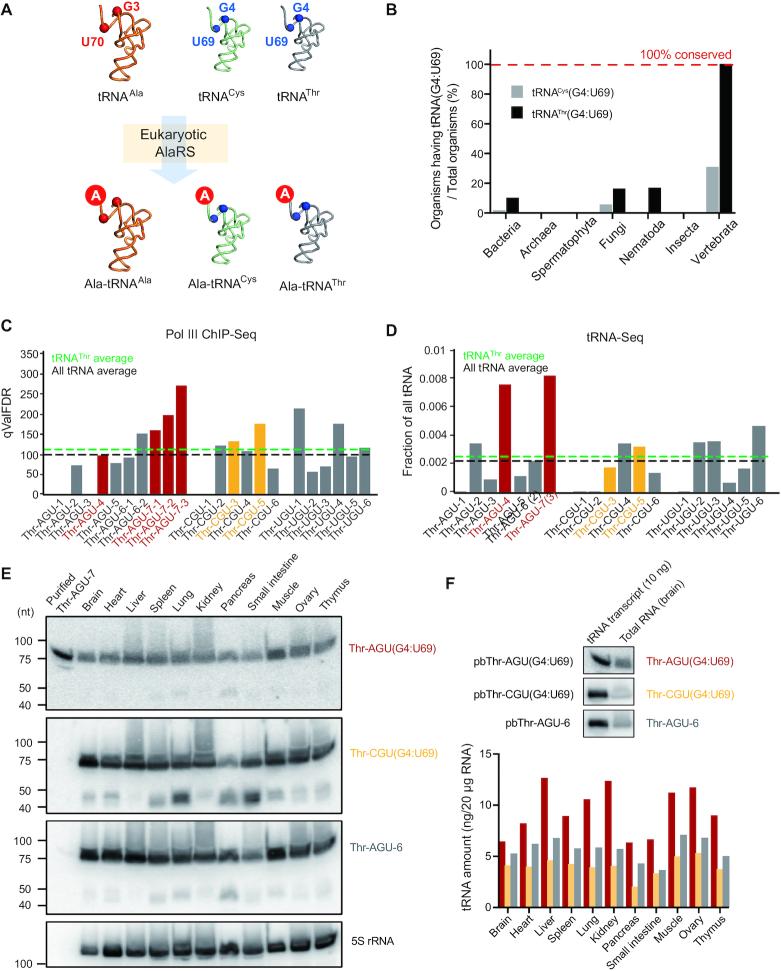
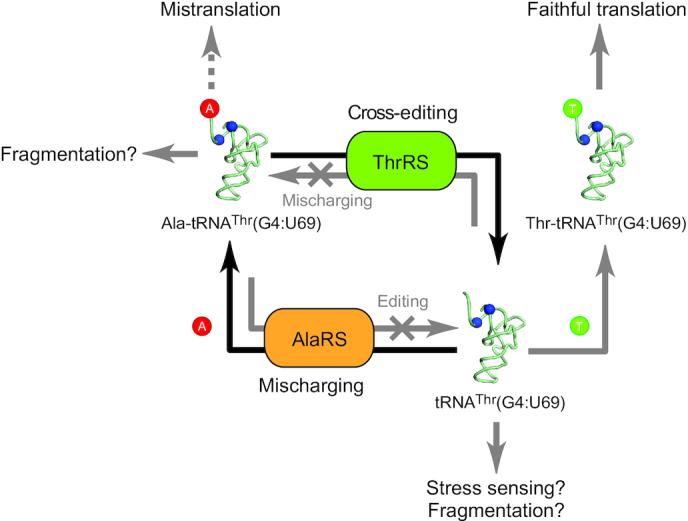
The accuracy in pairing tRNAs with correct amino acids by aminoacyl-tRNA synthetases (aaRSs) dictates the fidelity of translation. To ensure fidelity, multiple aaRSs developed editing functions that remove a wrong amino acid from tRNA before it reaches the ribosome. However, no specific mechanism within an aaRS is known to handle the scenario where a cognate amino acid is mischarged onto a wrong tRNA, as exemplified by AlaRS mischarging alanine to G4:U69-containing tRNAThr. Here, we report that the mischargeable G4:U69-containing tRNAThr are strictly conserved in vertebrates and are ubiquitously and abundantly expressed in mammalian cells and tissues. Although these tRNAs are efficiently mischarged, no corresponding Thr-to-Ala mistranslation is detectable. Mistranslation is prevented by a robust proofreading activity of ThrRS towards Ala-tRNAThr. Therefore, while wrong amino acids are corrected within an aaRS, a wrong tRNA is handled in trans by an aaRS cognate to the mischarged tRNA species. Interestingly, although Ala-tRNAThr mischarging is not known to occur in bacteria, Escherichia coli ThrRS also possesses robust cross-editing ability. We propose that the cross-editing activity of ThrRS is evolutionarily conserved and that this intrinsic activity allows G4:U69-containing tRNAThr to emerge and be preserved in vertebrates to have alternative functions without compromising translational fidelity.
氨酰 - tRNA合成酶(aaRSs)将tRNA与正确氨基酸配对的准确性决定了翻译的保真度。为确保保真度,多种aaRSs进化出了编辑功能,可在错误氨基酸到达核糖体之前将其从tRNA上去除。然而,目前尚不清楚aaRS内有何种特定机制来处理同源氨基酸错误加载到错误tRNA上的情况,比如丙氨酰 - tRNA合成酶(AlaRS)将丙氨酸错误加载到含有G4:U69的苏氨酸tRNA(tRNAThr)上。在此,我们报告称,含有可错误加载的G4:U69的tRNAThr在脊椎动物中严格保守,在哺乳动物细胞和组织中普遍且大量表达。尽管这些tRNA能高效地发生错误加载,但未检测到相应的苏氨酸到丙氨酸的错义翻译。苏氨酰 - tRNA合成酶(ThrRS)对丙氨酰 - tRNAThr具有强大的校对活性,从而防止了错义翻译。因此,虽然错误氨基酸在aaRS内得到纠正,但错误的tRNA则由与错误加载的tRNA种类同源的aaRS在反式作用中进行处理。有趣的是,虽然在细菌中尚不知丙氨酰 - tRNAThr错误加载是否会发生,但大肠杆菌的ThrRS也具有强大的交叉编辑能力。我们提出,ThrRS的交叉编辑活性在进化上是保守的,这种内在活性使得含有G4:U69的tRNAThr得以在脊椎动物中出现并保留,从而具有替代功能而不影响翻译保真度。



 Zotero 插件