
晚期糖基化终产物(AGEs)的积累与伴有 2 型糖尿病的主动脉瓣狭窄患者的严重程度相关。
Accumulation of advanced glycation end products (AGEs) is associated with the severity of aortic stenosis in patients with concomitant type 2 diabetes.
机构信息
John Paul II Hospital, Kraków, Poland.
Institute of Cardiology, Jagiellonian University Medical College, 80 Pradnicka St, 31-202, Kraków, Poland.
出版信息
Cardiovasc Diabetol. 2020 Jun 17;19(1):92. doi: 10.1186/s12933-020-01068-7.
BACKGROUND
Accumulation of advanced glycation end products (AGEs) leads to chronic glycation of proteins and tissue damage, particularly in patients with diabetes mellitus (DM). We aimed to evaluate whether increased accumulation of AGEs in patients with aortic stenosis (AS) and concomitant type 2 diabetes (DM) is associated with AS severity.
METHODS
We prospectively enrolled 76 patients with severe AS (47.1% males; nonDM), aged 68 [66-72] years, and 50 age-matched DM patients with a median blood glucose level of 7.5 [5.9-9.1] mM and glycated hemoglobin (HbA1c) of 6.8 [6.3-7.8]%, scheduled for aortic valve replacement. Valvular expression of AGEs, AGEs receptor (RAGE), interleukin-6 (IL-6), and reactive oxygen species (ROS) induction were evaluated ex vivo by immunostaining and calculated as the extent of positive immunoreactive areas/total sample area. Plasma levels of AGEs and soluble RAGE (sRAGE) were assessed by ELISAs.
RESULTS
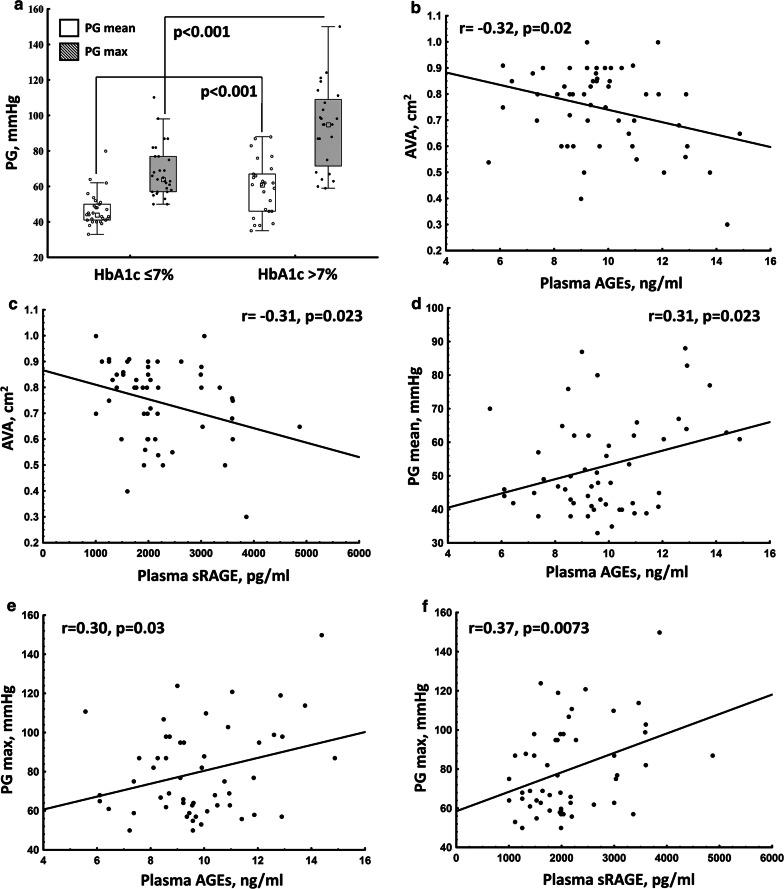
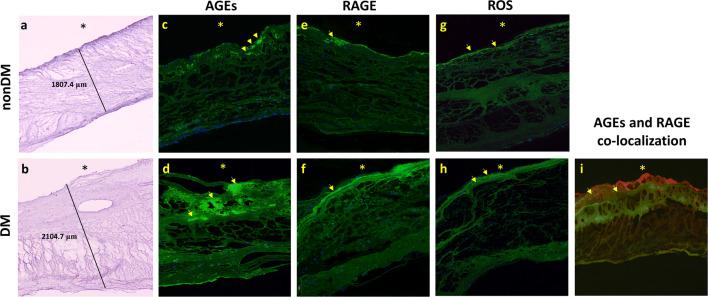
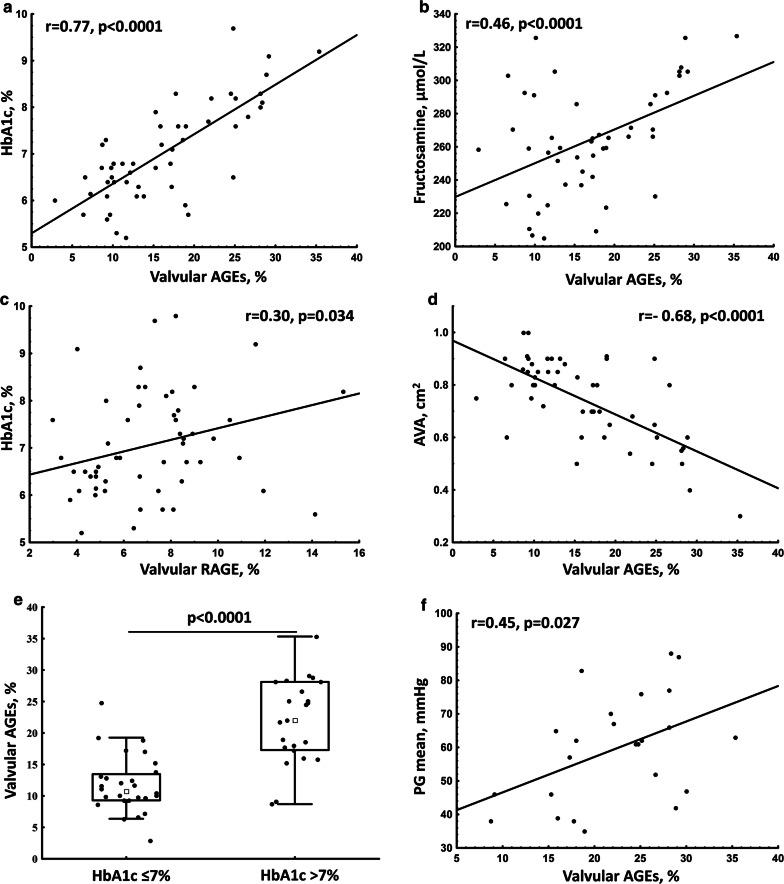
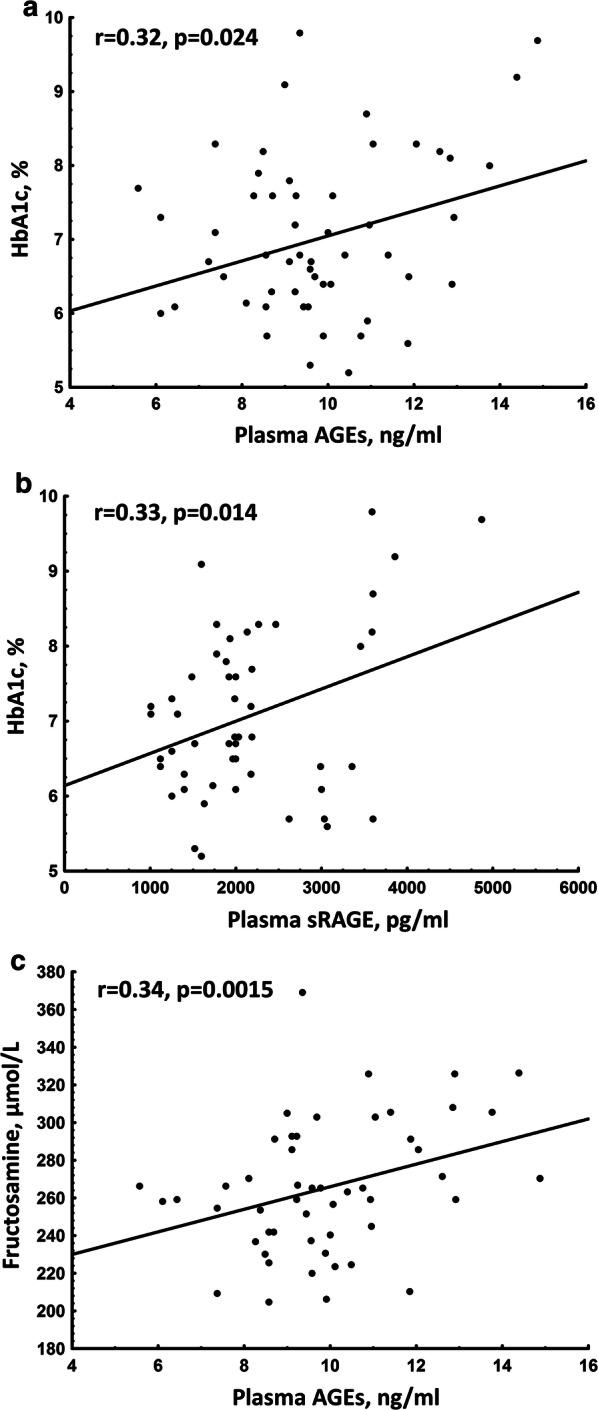
Subjects with DM had increased valvular expression of both AGEs (6.6-fold higher, 15.53 [9.96-23.28]%) and RAGE (1.8-fold higher, 6.8 [4.9-8.45]%) compared to nonDM patients (2.05 [1.21-2.58]% and 2.4 [1.56-3.02]%, respectively; both p < 0.001). Plasma levels of AGEs (12-fold higher) and sRAGE (1.3-fold higher) were elevated in DM patients, compared to nonDM (both p < 0.0001). The percentage of valvular ROS-positive (2.28 [1.6-3.09] vs. 1.15 [0.94-1.4]%, p < 0.0001) but not IL-6-positive areas was higher within DM, compared to nonDM valves. In DM patients, the percentage of valvular AGEs- and RAGE-positive areas correlated with HbA1c (r = 0.77, p < 0.0001 and r = 0.30, p = 0.034). Similarly, plasma AGEs and sRAGE levels were associated with HbA1c in the DM group (r = 0.32, p = 0.024 and r = 0.33, p = 0.014, respectively). In all DM patients, we found an association between the amount of valvular AGEs and the disease severity measured as aortic valve area (AVA; r = 0.68, p < 0.0001). Additionally, in DM patients with HbA1c > 7% (n = 24, 48%) we found that valvular expression of AGEs correlated with mean transvalvular pressure gradient (PG; r = 0.45, p = 0.027). Plasma AGEs levels in the whole DM group correlated with AVA (r = - 0.32, p = 0.02), PG (r = 0.31, p = 0.023), and PG (r = 0.30, p = 0.03).
CONCLUSIONS
Our study suggests that poorly-controlled diabetes leads to increased AGEs and RAGE valvular accumulation, which at least partially, might result in AS progression in DM patients.
背景
糖基化终产物(AGEs)的积累会导致蛋白质和组织的慢性糖化,尤其是在糖尿病(DM)患者中。我们旨在评估主动脉瓣狭窄(AS)合并 2 型糖尿病(DM)患者中 AGEs 的积累是否与 AS 严重程度相关。
方法
我们前瞻性地招募了 76 名严重 AS 患者(47.1%男性;非 DM),年龄 68 [66-72] 岁,和 50 名年龄匹配的 DM 患者,中位血糖水平为 7.5 [5.9-9.1] mM,糖化血红蛋白(HbA1c)为 6.8 [6.3-7.8]%,计划进行主动脉瓣置换。通过免疫染色评估瓣膜中 AGEs、AGEs 受体(RAGE)、白细胞介素-6(IL-6)和活性氧(ROS)的诱导表达,并计算为阳性免疫反应区/总样本面积的程度。通过 ELISA 评估血浆 AGEs 和可溶性 RAGE(sRAGE)水平。
结果
与非 DM 患者相比(2.05 [1.21-2.58]%和 2.4 [1.56-3.02]%,p<0.001),DM 患者的瓣膜 AGEs 和 RAGE 表达分别增加了 6.6 倍(15.53 [9.96-23.28]%)和 1.8 倍(6.8 [4.9-8.45]%)。DM 患者的血浆 AGEs(12 倍)和 sRAGE(1.3 倍)水平也高于非 DM 患者(均 p<0.0001)。与非 DM 瓣膜相比,DM 瓣膜中 ROS 阳性(2.28 [1.6-3.09]%对 1.15 [0.94-1.4]%,p<0.0001)但不是 IL-6 阳性区的百分比更高。在 DM 患者中,瓣膜中 AGEs 和 RAGE 阳性区与 HbA1c 呈正相关(r=0.77,p<0.0001 和 r=0.30,p=0.034)。同样,DM 组的血浆 AGEs 和 sRAGE 水平与 HbA1c 相关(r=0.32,p=0.024 和 r=0.33,p=0.014)。在所有 DM 患者中,我们发现瓣膜中 AGEs 的数量与作为主动脉瓣口面积(AVA)的疾病严重程度之间存在关联(r=0.68,p<0.0001)。此外,在 HbA1c>7%的 DM 患者中(n=24,48%),我们发现瓣膜中 AGEs 的表达与平均跨瓣压力梯度(PG)呈正相关(r=0.45,p=0.027)。整个 DM 组的血浆 AGEs 水平与 AVA(r=-0.32,p=0.02)、PG(r=0.31,p=0.023)和 PG(r=0.30,p=0.03)相关。
结论
我们的研究表明,控制不佳的糖尿病会导致 AGEs 和 RAGE 瓣膜积累增加,这至少部分导致了 DM 患者 AS 的进展。
 Zotero 插件