
长链非编码 RNA MALAT1 及其靶基因 miR-125b、miR-133、miR-146a 和 miR-203 对预测慢性阻塞性肺疾病患者疾病进展的临床价值。
The clinical value of lncRNA MALAT1 and its targets miR-125b, miR-133, miR-146a, and miR-203 for predicting disease progression in chronic obstructive pulmonary disease patients.
机构信息
Department of Respiratory and Critical Care Medicine, Affiliated Hospital of Jianghan University, Wuhan, China.
Department of Respiratory and Critical Care Medicine, Tianjin Medical University General Hospital, Tianjin, China.
出版信息
J Clin Lab Anal. 2020 Sep;34(9):e23410. doi: 10.1002/jcla.23410. Epub 2020 Jun 25.
OBJECTIVE
The study aimed to explore the correlations of long non-coding RNA MALAT1 (lncRNA MALAT1) and its targets microRNA (miR)-125b, miR-133, miR-146a, and miR-203 with acute exacerbation risk, inflammation, and disease severity of chronic obstructive pulmonary disease (COPD).
METHODS
Plasma samples were obtained from 120 acute exacerbation COPD (AECOPD) patients, 120 stable COPD patients, and 120 healthy controls (HCs). RT-qPCR was conducted to detect lncRNA MALAT1 expression and its target miRNAs, and ELISA was performed to detect the inflammatory cytokines.
RESULTS
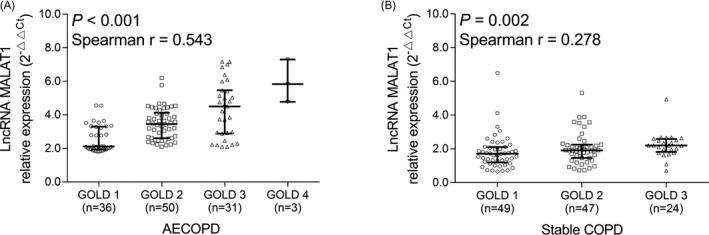
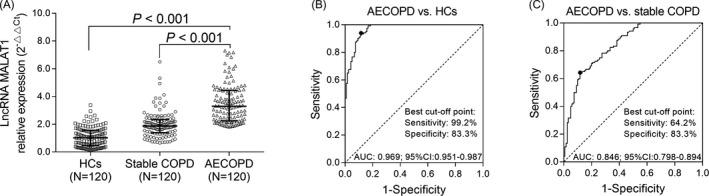
LncRNA MALAT1 was highest in AECOPD patients followed by stable COPD patients and then HCs, which distinguished AECOPD patients from HCs (AUC: 0.969, 95% CI: 0.951-0.987) and stable COPD patients (AUC: 0.846, 95% CI: 0.798-0.894). Furthermore, lncRNA MALAT1 positively correlated with GOLD stage in both AECOPD and stable COPD patients. Regarding inflammatory cytokines, lncRNA MALAT1 positively correlated with tumor necrosis factor-α (TNF-α), interleukin (IL)-1β, IL-6, IL-8, IL-17, and IL-23 in both AECOPD and stable COPD patients. Besides, lncRNA MALAT1 negatively correlated with miR-125b, miR-146a, and miR-203 in AECOPD patients and reversely correlated with miR-125b and miR-146a in stable COPD patients. Notably, miR-125b, miR-133, miR-146a, and miR-203 were the lowest in AECOPD patients, followed by stable COPD patients, and then HCs; miR-125b, miR-133, miR-146a, and miR-203 negatively correlated with inflammation and GOLD stage in AECOPD and stable COPD patients.
CONCLUSION
LncRNA MALAT1 exhibits clinical implications in acute exacerbation risk prediction and management of COPD via the inner-correlation with its targets miR-125b, miR-146a, and miR-203.
目的
本研究旨在探讨长链非编码 RNA MALAT1(lncRNA MALAT1)及其靶微小 RNA(miR)-125b、miR-133、miR-146a 和 miR-203 与慢性阻塞性肺疾病(COPD)急性加重风险、炎症和疾病严重程度的相关性。
方法
收集 120 例急性加重 COPD(AECOPD)患者、120 例稳定 COPD 患者和 120 例健康对照者(HCs)的血浆样本。采用 RT-qPCR 检测 lncRNA MALAT1 表达及其靶 miRNAs,ELISA 检测炎症细胞因子。
结果
AECOPD 患者的 lncRNA MALAT1 水平最高,其次是稳定 COPD 患者,最低的是 HCs,可将 AECOPD 患者与 HCs(AUC:0.969,95%CI:0.951-0.987)和稳定 COPD 患者(AUC:0.846,95%CI:0.798-0.894)区分开。此外,lncRNA MALAT1 与 AECOPD 和稳定 COPD 患者的 GOLD 分期均呈正相关。在 AECOPD 和稳定 COPD 患者中,lncRNA MALAT1 与肿瘤坏死因子-α(TNF-α)、白细胞介素(IL)-1β、IL-6、IL-8、IL-17 和 IL-23 呈正相关。此外,lncRNA MALAT1 与 AECOPD 患者的 miR-125b、miR-146a 和 miR-203 呈负相关,与稳定 COPD 患者的 miR-125b 和 miR-146a 呈负相关。值得注意的是,miR-125b、miR-133、miR-146a 和 miR-203 在 AECOPD 患者中最低,其次是稳定 COPD 患者,然后是 HCs;miR-125b、miR-133、miR-146a 和 miR-203 在 AECOPD 和稳定 COPD 患者中与炎症和 GOLD 分期呈负相关。
结论
lncRNA MALAT1 通过与其靶标 miR-125b、miR-146a 和 miR-203 的内在相关性,在 COPD 急性加重风险预测和管理中具有临床意义。
 Zotero 插件