
长链非编码 RNA MALAT1 及其靶 microRNA-125b 与冠心病的疾病风险、严重程度和主要不良心血管事件相关。
Long non-coding RNA MALAT1 and its target microRNA-125b associate with disease risk, severity, and major adverse cardiovascular event of coronary heart disease.
机构信息
Department of Cardiology, Daqing Fifth Hospital, Daqing, China.
Department of Cardiology, Daqing Oil Field General Hospital, Daqing, China.
出版信息
J Clin Lab Anal. 2021 Apr;35(4):e23593. doi: 10.1002/jcla.23593. Epub 2021 Mar 4.
BACKGROUND
This study aimed to explore the correlation of long non-coding RNA metastasis-associated lung adenocarcinoma transcript 1 (lncRNA MALAT1) with microRNA (miR)-125b and further investigated their associations with disease risk, severity, and prognosis of coronary heart disease (CHD).
METHODS
Totally, 230 patients who underwent diagnostic coronary angiography were recruited; meanwhile, 140 of them were diagnosed as CHD and the remaining 90 non-CHD patients served as controls. Plasma sample was collected from each participant for lncRNA MALAT1 and miR-125b mRNA expression detection by reverse transcription-quantitative polymerase chain reaction. The extent of coronary stenosis was evaluated by the Gensini score, and major adverse cardiovascular event (MACE) occurrence during the follow-up was documented in CHD patients.
RESULTS
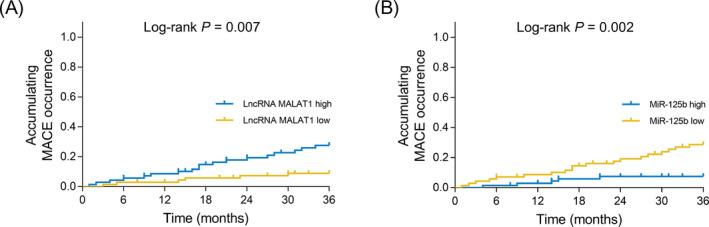
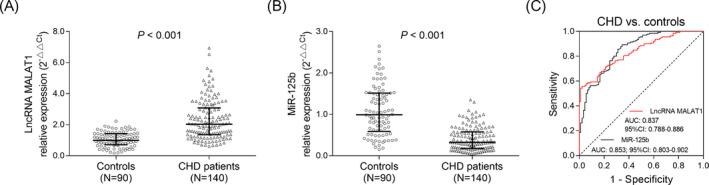
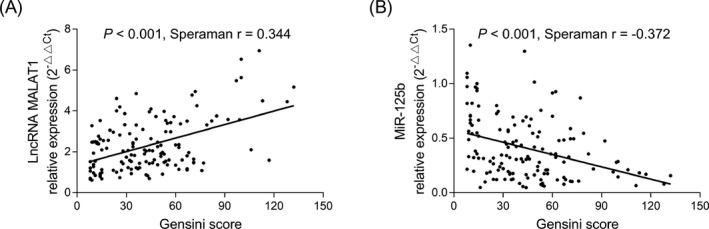
Long non-coding RNA metastasis-associated lung adenocarcinoma transcript 1 relative expression was increased, but miR-125b relative expression was decreased in CHD patients compared with controls. ROC curve exhibited that lncRNA MALAT1 and miR-125b were of good value in differentiating CHD patients from controls, and further logistic regression analysis verified their independent correlation with CHD risk. Furthermore, lncRNA MALAT1 presented a closely negative correlation with miR-125b in CHD patients, while it presented a weakly negative association with miR-125b in controls. In CHD patients, lncRNA MALAT1 was positively correlated with Gensini score, total cholesterol, low-density lipoprotein cholesterol, C-reactive protein, tumor necrosis factor α, interleukin (IL)-1β, IL-6, IL-17, and accumulating MACE occurrence; reversely, miR-125b presented a opposite trend.
CONCLUSION
Long non-coding RNA metastasis-associated lung adenocarcinoma transcript 1 might be associated with increased CHD risk, severity, and accumulating MACE incidence via negative interaction with miR-125b, suggesting their possible clinical application as biomarkers in the CHD screening and surveillance.
背景
本研究旨在探讨长链非编码 RNA 转移相关肺腺癌转录本 1(lncRNA MALAT1)与 microRNA(miR)-125b 的相关性,并进一步研究它们与冠心病(CHD)发病风险、严重程度和预后的关系。
方法
共招募 230 例接受诊断性冠状动脉造影的患者;其中 140 例诊断为 CHD,其余 90 例非 CHD 患者作为对照。收集每位参与者的血浆样本,通过逆转录定量聚合酶链反应检测 lncRNA MALAT1 和 miR-125b mRNA 的表达。通过 Gensini 评分评估冠状动脉狭窄程度,并记录 CHD 患者随访期间的主要不良心血管事件(MACE)发生情况。
结果
与对照组相比,CHD 患者 lncRNA MALAT1 相对表达增加,而 miR-125b 相对表达降低。ROC 曲线显示,lncRNA MALAT1 和 miR-125b 对区分 CHD 患者和对照组具有良好的价值,进一步的逻辑回归分析证实了它们与 CHD 风险的独立相关性。此外,在 CHD 患者中,lncRNA MALAT1 与 miR-125b 呈密切负相关,而在对照组中与 miR-125b 呈弱负相关。在 CHD 患者中,lncRNA MALAT1 与 Gensini 评分、总胆固醇、低密度脂蛋白胆固醇、C 反应蛋白、肿瘤坏死因子-α、白细胞介素(IL)-1β、IL-6、IL-17 呈正相关,与累积 MACE 发生率呈正相关;相反,miR-125b 呈相反趋势。
结论
lncRNA MALAT1 可能通过与 miR-125b 的负相互作用与 CHD 风险增加、严重程度增加和累积 MACE 发生率相关,提示其作为 CHD 筛查和监测的生物标志物具有潜在的临床应用价值。

 Zotero 插件