
12 个月短信传递式糖尿病支持干预中不同成年人的用户参与度:一项随机对照试验的结果。
User Engagement Among Diverse Adults in a 12-Month Text Message-Delivered Diabetes Support Intervention: Results from a Randomized Controlled Trial.
机构信息
Department of Medicine, Vanderbilt University Medical Center, Nashville, TN, United States.
Center for Health Behavior and Health Education, Vanderbilt University Medical Center, Nashville, TN, United States.
出版信息
JMIR Mhealth Uhealth. 2020 Jul 21;8(7):e17534. doi: 10.2196/17534.
BACKGROUND
Text message-delivered interventions are a feasible and scalable approach for improving chronic disease self-care and reducing health disparities; however, information on long-term user engagement with these interventions is limited.
OBJECTIVE
The aim of this study is to examine user engagement in a 12-month text message-delivered intervention supporting diabetes self-care, called REACH (Rapid Education/Encouragement And Communications for Health), among racially and socioeconomically diverse patients with type 2 diabetes (T2D). We explored time trends in engagement, associations between patient characteristics and engagement, and whether the addition of a human component or allowing patients to change their text frequency affected engagement. Qualitative data informed patients' subjective experience of their engagement.
METHODS
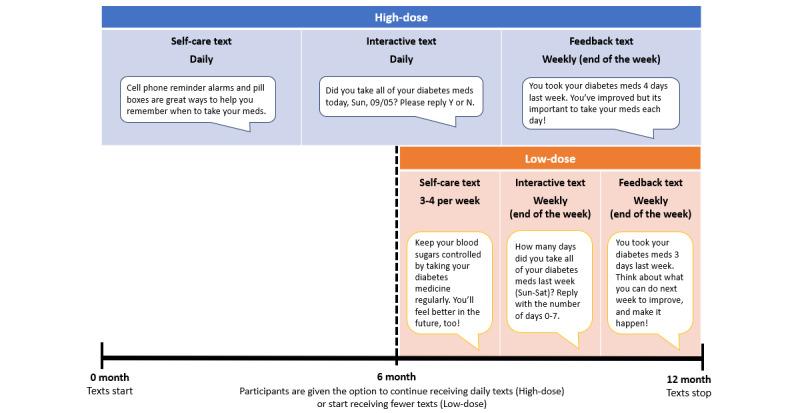
We recruited patients with T2D for a randomized trial evaluating mobile phone support relative to enhanced treatment as usual. This analysis was limited to participants assigned to the intervention. Participants completed a survey and hemoglobin A1c (HbA1c) test and received REACH text messages, including self-care promotion texts, interactive texts asking about medication adherence, and adherence feedback texts. For the first 6 months, texts were sent daily, and half of the participants also received monthly phone coaching. After 6 months, coaching stopped, and participants had the option to receive fewer texts for the subsequent 6 months. We defined engagement via responses to the interactive texts and responses to a follow-up interview. We used regression models to analyze associations with response rate and thematic and structural analysis to understand participants' reasons for responding to the texts and their preferred text frequency.
RESULTS
The participants were, on average, aged 55.8 (SD 9.8) years, 55.2% (137/248) female, and 52.0% (129/248) non-White; 40.7% (101/248) had ≤ a high school education, and 40.7% (101/248) had an annual household income <US $25,000. The median response rate to interactive texts was 91% (IQR 75%-97%) over 12 months. Engagement gradually declined throughout the intervention but remained high. Engagement did not differ by age, gender, education, income, diabetes duration, insulin status, health literacy, or numeracy. Black race and worse baseline medication adherence and HbA1c were each associated with lower engagement, although the effects were small. Nearly half of the participants chose to continue receiving daily texts for the last 6 months of the intervention. Participants who continued daily text messages said they wanted to continue experiencing benefits to their health, whereas those who chose fewer texts said that the daily texts had helped them create routines and they no longer needed them as often. Engagement was not impacted by receiving coaching or by participants' chosen text frequency.
CONCLUSIONS
Well-designed interactive text messages can engage diverse patients in a self-care intervention for at least 1 year. Variation in and reasons for frequency preference suggest that offering a frequency choice may be important to users' engagement.
背景
短信传递干预措施是改善慢性病自我护理和减少健康差距的可行且可扩展的方法;然而,有关这些干预措施长期用户参与度的信息有限。
目的
本研究旨在检查在一项名为 REACH(快速教育/鼓励和健康通讯)的 12 个月短信传递干预措施中,不同种族和社会经济背景的 2 型糖尿病(T2D)患者的用户参与度,该干预措施支持糖尿病自我护理。我们探讨了参与度的时间趋势、患者特征与参与度之间的关联,以及是否增加人工组件或允许患者更改短信频率会影响参与度。定性数据提供了患者对其参与度的主观体验。
方法
我们招募了 T2D 患者参加一项评估移动电话支持与强化常规治疗的随机试验。本分析仅限于分配到干预组的参与者。参与者完成了一项调查和血红蛋白 A1c(HbA1c)测试,并收到了 REACH 短信,包括自我护理促进短信、询问药物依从性的互动短信和依从性反馈短信。在前 6 个月,每天发送短信,一半的参与者还接受每月电话辅导。6 个月后,辅导停止,参与者可以选择在接下来的 6 个月内减少短信接收次数。我们通过对互动短信的回复和对后续访谈的回复来定义参与度。我们使用回归模型分析与回复率的关联,并使用主题和结构分析来了解参与者回复短信的原因以及他们对短信频率的偏好。
结果
参与者的平均年龄为 55.8(9.8)岁,55.2%(137/248)为女性,52.0%(129/248)为非白人;40.7%(101/248)仅受过高中教育,40.7%(101/248)家庭年收入<25,000 美元。12 个月内,互动短信的平均回复率为 91%(IQR 75%-97%)。参与度在整个干预过程中逐渐下降,但仍保持较高水平。参与度与年龄、性别、教育程度、收入、糖尿病病程、胰岛素状态、健康素养或计算能力无关。黑种人和较差的基线药物依从性和 HbA1c 与较低的参与度相关,尽管影响较小。近一半的参与者选择在干预的最后 6 个月继续每天接收短信。继续接收每日短信的参与者表示他们希望继续受益于他们的健康,而选择较少短信的参与者表示,每日短信帮助他们养成了习惯,他们不再需要那么频繁地接收短信。接受辅导或参与者选择的短信频率都不会影响参与度。
结论
精心设计的互动短信可以使不同种族的患者在自我护理干预措施中参与至少 1 年。频率偏好的变化和原因表明,提供频率选择可能对用户的参与度很重要。


 Zotero 插件