
一种新型移动健康资源应对粮食不安全问题的开发与可行性:混合方法队列研究
Development and Feasibility of a Novel mHealth Resource for Food Insecurity: Mixed Methods Cohort Study.
作者信息
Fritz Cristin Q, Xu Meng, Stassun Justine, Martinez Susana, Gottlieb Laura M, Heerman William J, Williams Derek J, Mayberry Lindsay S
机构信息
Department of Pediatrics, Vanderbilt University Medical Center, Office #118, 2141 Blakemore Avenue, Nashville, TN, 37212, United States, 1 615-936-9263, 1 615-875-4623.
Department of Biostatistics, Vanderbilt University Medical Center, Nashville, TN, United States.
出版信息
J Med Internet Res. 2025 Aug 26;27:e65852. doi: 10.2196/65852.
BACKGROUND
Pediatric clinical practice guidelines recommend identifying and addressing food insecurity (FI) as part of routine care. However, methods for health systems to connect families experiencing FI to community food resources are lacking. Confidential SMS text messaging can increase equity in resource delivery, is user-friendly, is aligned with caregiver preferences, and is feasible for health systems to implement. Despite the promise of this approach, SMS text messaging has not been widely tested in pediatric settings.
OBJECTIVE
This paper details (1) the process of developing a novel, mobile health intervention to help families access local food resources and (2) results on reach, engagement, usability, and acceptability of the intervention following a 1-year pilot.
METHODS
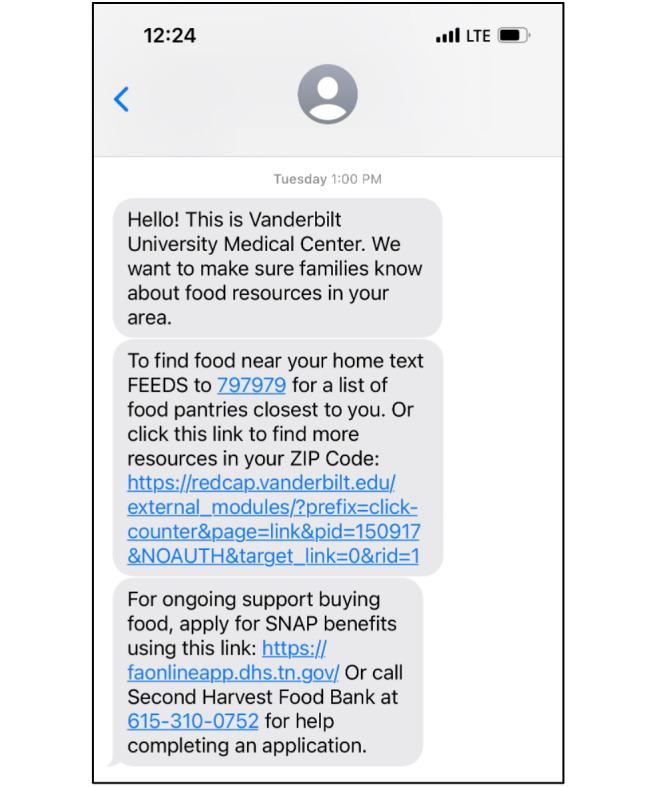
We designed and evaluated an automated SMS text messaging system that delivers geographically tailored food resource information to families with FI after hospital discharge at a single US children's hospital. English- and Spanish-speaking caregivers of hospitalized children with a positive FI screen documented during clinical care were included. Caregivers received a food resource text message 1 and 4 days postdischarge. In addition, 2 subsequent text messages asked about reach and engagement. We used system-reported (primary) and caregiver-reported (secondary) measures of reach and engagement and caregiver-reported resource connection as a preliminary measure of effectiveness. We assessed usability (Simplified System Usability Scale [SUS]; >75 indicates good usability), acceptability, and caregiver preferences for resource provision through semistructured interviews among a subset of caregivers (20 English-speaking and 11 Spanish-speaking caregivers).
RESULTS
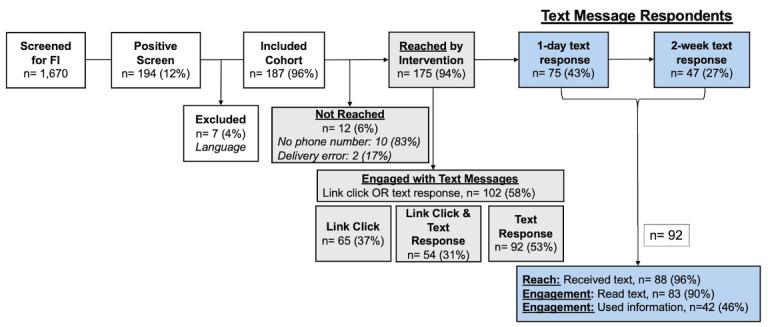
Of 194 patients with a positive FI screen during the study period, 187 (96%) spoke English or Spanish and were included in the cohort. Primary, system-reported measures indicated that the food resource message successfully reached 175 (94%) participants; of these, 102 (58%) engaged with the text messages in some way, with 65 (37%) clicking the link and 92 (53%) responding to a text message. Among the subset of text message respondents (n=92), 88 (96%) reported receiving the resource message, 83 (90%) read the message, and 42 (46%) used the information to search for food resources. Among the subset of interviewed caregivers (n=31), the median SUS score was 86.1 (IQR 66.7-91.7); 97% (30/31) of caregivers felt the intervention was acceptable. Caregivers preferred receiving food resource information via text message rather than paper handouts because it felt more accessible.
CONCLUSIONS
Providing automated, geographically tailored food resource information via text message to families with FI after hospital discharge was feasible, the information was usable, and the delivery mode was acceptable to families, with SMS text messaging preferred over paper handouts. SMS text messaging offers a promising low-intensity approach to social resource provision for health systems. Future research should assess effectiveness and strategies to increase uptake in clinical care contexts.
背景
儿科临床实践指南建议,将识别和解决粮食不安全问题(FI)作为常规护理的一部分。然而,卫生系统缺乏将经历粮食不安全的家庭与社区粮食资源联系起来的方法。保密的短信可以提高资源分配的公平性,用户友好,符合照顾者的偏好,并且卫生系统实施起来可行。尽管这种方法前景广阔,但短信在儿科环境中尚未得到广泛测试。
目的
本文详细介绍了(1)开发一种新型移动健康干预措施以帮助家庭获取当地粮食资源的过程,以及(2)在为期1年的试点之后该干预措施在覆盖范围、参与度、可用性和可接受性方面的结果。
方法
我们设计并评估了一个自动短信系统,该系统在美国一家儿童医院,在患儿出院后向有粮食不安全问题的家庭发送根据地理位置定制的粮食资源信息。纳入在临床护理期间粮食不安全筛查呈阳性的住院儿童的讲英语和西班牙语的照顾者。照顾者在出院后第1天和第4天收到一条粮食资源短信。此外,随后还有两条短信询问覆盖范围和参与度。我们使用系统报告的(主要)和照顾者报告的(次要)覆盖范围和参与度指标,以及照顾者报告的资源连接情况作为有效性的初步指标。我们通过对一部分照顾者(20名讲英语的照顾者和11名讲西班牙语的照顾者)进行半结构化访谈,评估了可用性(简化系统可用性量表[SUS];>75表示可用性良好)、可接受性以及照顾者对资源提供方式的偏好。
结果
在研究期间,194名粮食不安全筛查呈阳性的患者中,187名(96%)讲英语或西班牙语,被纳入该队列。主要的、系统报告的指标表明,粮食资源信息成功送达175名(94%)参与者;其中,102名(58%)以某种方式与短信互动,65名(37%)点击了链接,92名(53%)回复了短信。在短信回复者子集中(n = 92),88名(96%)报告收到了资源信息,83名(90%)阅读了信息,42名(46%)利用这些信息搜索粮食资源。在接受访谈的照顾者子集中(n = 31),SUS评分中位数为86.1(四分位间距66.7 - 91.7);97%(30/31)的照顾者认为该干预措施是可接受 的。照顾者更喜欢通过短信而不是纸质传单接收粮食资源信息,因为感觉更容易获取。
结论
出院后通过短信向有粮食不安全问题的家庭提供自动的、根据地理位置定制的粮食资源信息是可行的,信息是可用的,并且这种传递方式为家庭所接受,照顾者更喜欢短信而不是纸质传单。短信为卫生系统提供社会资源提供了一种有前景的低强度方法。未来的研究应评估其有效性以及在临床护理环境中提高接受度的策略。

 Zotero 插件