
基于转录组关联研究的概率性孟德尔随机化检验和控制水平遗传异质性。
Testing and controlling for horizontal pleiotropy with probabilistic Mendelian randomization in transcriptome-wide association studies.
机构信息
Department of Biostatistics, School of Public Health, Cheeloo College of Medicine, Shandong University, 250012, Jinan, Shandong, China.
Department of Biostatistics, University of Michigan, Ann Arbor, MI, 48109, USA.
出版信息
Nat Commun. 2020 Jul 31;11(1):3861. doi: 10.1038/s41467-020-17668-6.
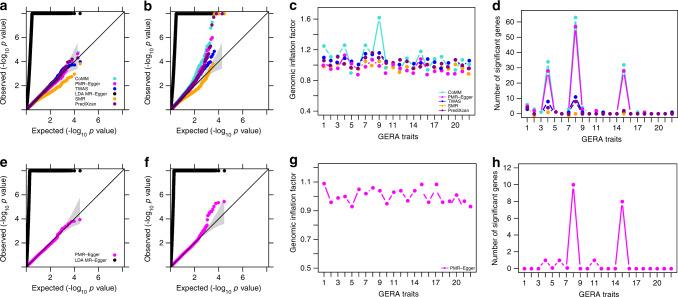
Integrating results from genome-wide association studies (GWASs) and gene expression studies through transcriptome-wide association study (TWAS) has the potential to shed light on the causal molecular mechanisms underlying disease etiology. Here, we present a probabilistic Mendelian randomization (MR) method, PMR-Egger, for TWAS applications. PMR-Egger relies on a MR likelihood framework that unifies many existing TWAS and MR methods, accommodates multiple correlated instruments, tests the causal effect of gene on trait in the presence of horizontal pleiotropy, and is scalable to hundreds of thousands of individuals. In simulations, PMR-Egger provides calibrated type I error control for causal effect testing in the presence of horizontal pleiotropic effects, is reasonably robust under various types of model misspecifications, is more powerful than existing TWAS/MR approaches, and can directly test for horizontal pleiotropy. We illustrate the benefits of PMR-Egger in applications to 39 diseases and complex traits obtained from three GWASs including the UK Biobank.
通过全转录组关联研究(TWAS)整合全基因组关联研究(GWAS)和基因表达研究的结果,有可能揭示疾病病因的因果分子机制。在这里,我们提出了一种概率性孟德尔随机化(MR)方法 PMR-Egger,用于 TWAS 应用。PMR-Egger 依赖于一个 MR 似然框架,该框架统一了许多现有的 TWAS 和 MR 方法,可容纳多个相关工具,在存在水平多效性的情况下测试基因对性状的因果效应,并且可扩展到数十万个体。在模拟中,PMR-Egger 在存在水平多效性效应的情况下为因果效应检验提供了校准的Ⅰ型错误控制,在各种类型的模型失拟下具有合理的稳健性,比现有的 TWAS/MR 方法更有效,并可以直接检测水平多效性。我们通过将 PMR-Egger 应用于从 UK Biobank 等三项 GWAS 中获得的 39 种疾病和复杂特征,说明了其优势。


 Zotero 插件