
针对 CD73 通路介导的 - 突变型非小细胞肺癌的免疫代谢靶向治疗:克服免疫耐药性的新希望。
Targeting Immunometabolism Mediated by CD73 Pathway in -Mutated Non-small Cell Lung Cancer: A New Hope for Overcoming Immune Resistance.
机构信息
Unit of Medical Oncology, Department of Onco-Hematology, Centro di Riferimento Oncologico della Basilicata (IRCCS-CROB), Rionero in Vulture, Italy.
Laboratory of Pre-clinical and Translational Research, Centro di Riferimento Oncologico della Basilicata (IRCCS-CROB), Rionero in Vulture, Italy.
出版信息
Front Immunol. 2020 Jul 14;11:1479. doi: 10.3389/fimmu.2020.01479. eCollection 2020.
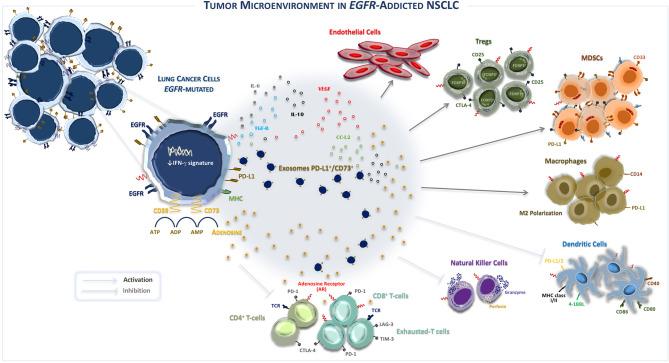
Despite the relevant antitumor efficacy of immunotherapy in advanced non-small cell lung cancer (NSCLC), the results in patients whose cancer harbors activating epidermal growth factor receptor () mutations are disappointing. The biological mechanisms underlying immune escape and both unresponsiveness and resistance to immunotherapy in -mutant NSCLC patients have been partially investigated. To this regard, lung cancer immune escape largely involves high amounts of adenosine within the tumor milieu with broad immunosuppressive effects. Indeed, besides immune checkpoint receptors and their ligands, other mechanisms inducing immunosuppression and including adenosine produced by ecto-nucleotidases CD39 and CD73 contribute to lung tumorigenesis and progression. Here, we review the clinical results of immune checkpoint inhibitors in -mutant NSCLC, focusing on the dynamic immune composition of -mutant tumor microenvironment. The adenosine pathway-mediated dysregulation of energy metabolism in tumor microenvironment is suggested as a potential mechanism involved in the immune escape process. Finally, we report the strong rationale for planning strategies of combination therapy with immune checkpoints blockade and adenosine signaling inhibition to overcome immune escape and immunotherapy resistance in -mutated NSCLC.
尽管免疫疗法在晚期非小细胞肺癌(NSCLC)中具有相关的抗肿瘤疗效,但在携带激活表皮生长因子受体()突变的癌症患者中的结果却令人失望。部分研究了导致 - 突变 NSCLC 患者免疫逃逸以及对免疫治疗无反应和耐药的生物学机制。在这方面,肺癌免疫逃逸在很大程度上涉及肿瘤微环境中大量的腺苷,具有广泛的免疫抑制作用。事实上,除了免疫检查点受体及其配体外,其他诱导免疫抑制的机制,包括外核苷酸酶 CD39 和 CD73 产生的腺苷,也有助于肺癌的发生和发展。在这里,我们回顾了免疫检查点抑制剂在 - 突变 NSCLC 中的临床结果,重点关注 - 突变肿瘤微环境的动态免疫组成。建议肿瘤微环境中腺苷途径介导的能量代谢失调是参与免疫逃逸过程的潜在机制。最后,我们报告了计划联合免疫检查点阻断和腺苷信号抑制治疗策略的强有力理由,以克服 - 突变 NSCLC 中的免疫逃逸和免疫治疗耐药性。
 Zotero 插件