
在子孢子中检测到 裂殖体颈蛋白复合物及其对唾液腺子孢子入侵的贡献。
Detection of the Rhoptry Neck Protein Complex in Sporozoites and Its Contribution to Sporozoite Invasion of Salivary Glands.
机构信息
Division of Molecular Parasitology, Proteo-Science Center, Ehime University, Matsuyama, Ehime, Japan.
Division of Malaria Research, Proteo-Science Center, Ehime University, Matsuyama, Ehime, Japan.
出版信息
mSphere. 2020 Aug 19;5(4):e00325-20. doi: 10.1128/mSphere.00325-20.
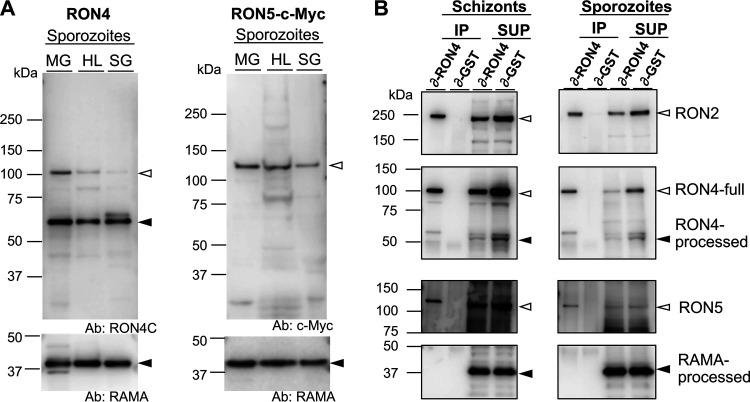
In the life cycle, two infectious stages of parasites, merozoites and sporozoites, share rhoptry and microneme apical structures. A crucial step during merozoite invasion of erythrocytes is the discharge to the host cell membrane of some rhoptry neck proteins as a complex, followed by the formation of a moving junction involving the parasite-secreted protein AMA1 on the parasite membrane. Components of the merozoite rhoptry neck protein complex are also expressed in sporozoites, namely, RON2, RON4, and RON5, suggesting that invasion mechanism elements might be conserved between these infective stages. Recently, we demonstrated that RON2 is required for sporozoite invasion of mosquito salivary gland cells and mammalian hepatocytes, using a sporozoite stage-specific gene knockdown strategy in the rodent malaria parasite model, Here, we use a coimmunoprecipitation assay and oocyst-derived sporozoite extracts to demonstrate that RON2, RON4, and RON5 also form a complex in sporozoites. The sporozoite stage-specific gene knockdown strategy revealed that both RON4 and RON5 have crucial roles during sporozoite invasion of salivary glands, including a significantly reduced attachment ability required for the onset of gliding. Further analyses indicated that RON2 and RON4 reciprocally affect trafficking to rhoptries in developing sporozoites, while RON5 is independently transported. These findings indicate that the interaction between RON2 and RON4 contributes to their stability and trafficking to rhoptries, in addition to involvement in sporozoite attachment. Sporozoites are the motile infectious stage that mediates malaria parasite transmission from mosquitoes to the mammalian host. This study addresses the question whether the rhoptry neck protein complex forms and functions in sporozoites, in addition to its role in merozoites. By applying coimmunoprecipitation and sporozoite stage-specific gene knockdown assays, it was demonstrated that RON2, RON4, and RON5 form a complex and are involved in sporozoite invasion of salivary glands via their attachment ability. These findings shed light on the conserved invasion mechanisms among apicomplexan infective stages. In addition, the sporozoite stage-specific gene knockdown system has revealed for the first time in that the RON2 and RON4 interaction reciprocally affects their stability and trafficking to rhoptries. Our study raises the possibility that the RON complex functions during sporozoite maturation as well as migration toward and invasion of target cells.
在寄生虫的生命周期中,两个感染阶段,裂殖子和子孢子,共享棒状体和微线体顶端结构。裂殖子侵入红细胞的关键步骤是将一些棒状体颈蛋白作为复合物排入宿主细胞膜,然后形成一个移动连接,涉及寄生虫膜上分泌的 AMA1 蛋白。裂殖子棒状体颈蛋白复合物的成分也在子孢子中表达,即 RON2、RON4 和 RON5,这表明这些感染阶段之间的入侵机制元素可能是保守的。最近,我们使用啮齿动物疟原虫模型中的子孢子阶段特异性基因敲低策略,证明 RON2 是子孢子侵入蚊子唾液腺细胞和哺乳动物肝细胞所必需的。在这里,我们使用免疫共沉淀测定和卵囊衍生的子孢子提取物来证明 RON2、RON4 和 RON5 也在子孢子中形成复合物。子孢子阶段特异性基因敲低策略表明,RON4 和 RON5 在子孢子侵入唾液腺中都具有重要作用,包括滑行开始所需的附着能力显著降低。进一步的分析表明,RON2 和 RON4 相互影响发育中子孢子棒状体的运输,而 RON5 则独立运输。这些发现表明,RON2 和 RON4 之间的相互作用除了参与子孢子附着外,还有助于它们的稳定性和向棒状体的运输。子孢子是介导疟原虫从蚊子传播到哺乳动物宿主的运动感染阶段。本研究探讨了棒状体颈蛋白复合物是否在子孢子中形成和发挥作用,以及其在裂殖子中的作用。通过应用免疫共沉淀和子孢子阶段特异性基因敲低测定,证明 RON2、RON4 和 RON5 形成复合物,并通过其附着能力参与子孢子侵入唾液腺。这些发现揭示了顶复门感染阶段之间保守的入侵机制。此外,子孢子阶段特异性基因敲低系统首次揭示,RON2 和 RON4 之间的相互作用相互影响它们的稳定性和向棒状体的运输。我们的研究提出了这样一种可能性,即 RON 复合物在子孢子成熟过程中以及在向靶细胞迁移和入侵过程中发挥作用。



 Zotero 插件