
利用多重序列比对技术共识推断印度 SARS-CoV-2 基因组中的遗传变异。
Inferring the genetic variability in Indian SARS-CoV-2 genomes using consensus of multiple sequence alignment techniques.
机构信息
Department of Computer Science and Engineering, National Institute of Technical Teachers' Training and Research, Kolkata, West Bengal, India.
Department of Computer Science and Information Technology, Institute of Technical Education and Research, Siksha 'O' Anusandhan (Deemed to be University), Bhubaneswar, Odisha, India.
出版信息
Infect Genet Evol. 2020 Nov;85:104522. doi: 10.1016/j.meegid.2020.104522. Epub 2020 Sep 1.
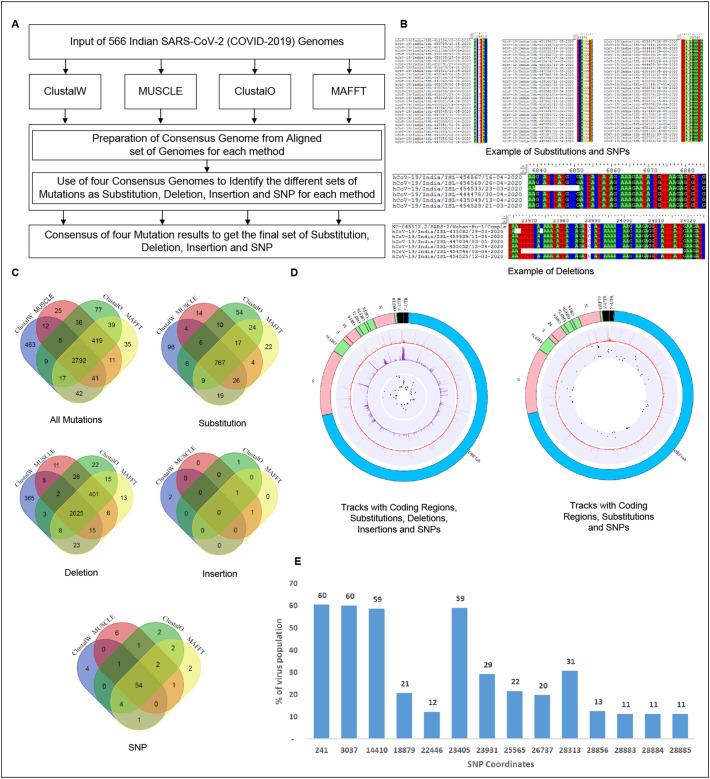
Severe Acute Respiratory Syndrome Coronavirus-2 (SARS-CoV-2) is a threat to the human population and has created a worldwide pandemic. Daily thousands of people are getting affected by the SARS-CoV-2 virus; India being no exception. In this situation, there is no doubt that vaccine is the primary prevention strategy to contain the wave of COVID-19 pandemic. In this regard, genome-wide analysis of SARS-CoV-2 is important to understand its genetic variability. This has motivated us to analyse 566 Indian SARS-CoV-2 sequences using multiple sequence alignment techniques viz. ClustalW, MUSCLE, ClustalO and MAFFT to align and subsequently identify the lists of mutations as substitution, deletion, insertion and SNP. Thereafter, a consensus of these results, called as Consensus Multiple Sequence Alignment (CMSA), is prepared to have the final list of mutations so that the advantages of all four alignment techniques can be preserved. The analysis shows 767, 2025 and 54 unique substitutions, deletions and SNPs in Indian SARS-CoV-2 genomes. More precisely, out of 54 SNPs, 4 SNPs are present close to the 60% of the virus population. The results of this experiment can be useful for virus classification, designing and defining the dose of vaccine for the Indian population.
严重急性呼吸系统综合症冠状病毒 2 型(SARS-CoV-2)对人类构成威胁,并已在全球范围内引发大流行。每天都有成千上万的人受到 SARS-CoV-2 病毒的影响;印度也不例外。在这种情况下,疫苗无疑是遏制 COVID-19 大流行浪潮的主要预防策略。在这方面,对 SARS-CoV-2 的全基因组分析对于了解其遗传变异性很重要。这促使我们使用多种序列比对技术(如 ClustalW、MUSCLE、ClustalO 和 MAFFT)对 566 个印度 SARS-CoV-2 序列进行分析,以对齐并随后确定替换、缺失、插入和单核苷酸多态性(SNP)等突变列表。此后,准备这些结果的共识,称为共识多重序列比对(CMSA),以获得最终的突变列表,从而保留所有四种比对技术的优势。分析表明,印度 SARS-CoV-2 基因组中有 767、2025 和 54 个独特的替换、缺失和 SNP。更准确地说,在 54 个 SNP 中,有 4 个 SNP 接近病毒群体的 60%。该实验的结果可用于病毒分类、设计和确定印度人群的疫苗剂量。
 Zotero 插件