
基于机器学习分析小鼠脆弱性的年龄和预期寿命时钟。
Age and life expectancy clocks based on machine learning analysis of mouse frailty.
机构信息
Blavatnik Institute, Department of Genetics, Paul F. Glenn Center for Biology of Aging Research at Harvard Medical School, Boston, MA, USA.
Charles Perkins Centre, The University of Sydney, Sydney, NSW, Australia.
出版信息
Nat Commun. 2020 Sep 15;11(1):4618. doi: 10.1038/s41467-020-18446-0.
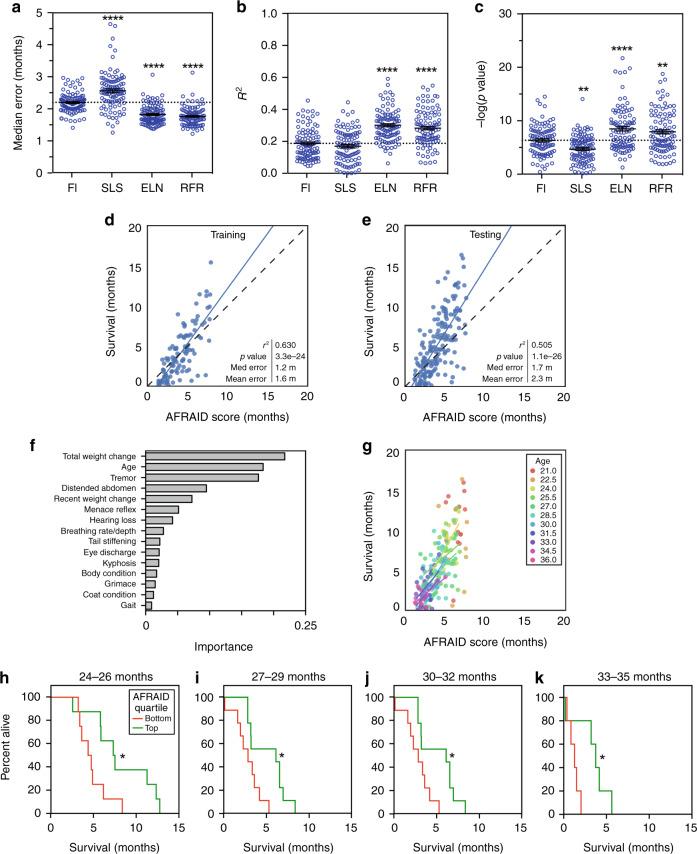
The identification of genes and interventions that slow or reverse aging is hampered by the lack of non-invasive metrics that can predict the life expectancy of pre-clinical models. Frailty Indices (FIs) in mice are composite measures of health that are cost-effective and non-invasive, but whether they can accurately predict health and lifespan is not known. Here, mouse FIs are scored longitudinally until death and machine learning is employed to develop two clocks. A random forest regression is trained on FI components for chronological age to generate the FRIGHT (Frailty Inferred Geriatric Health Timeline) clock, a strong predictor of chronological age. A second model is trained on remaining lifespan to generate the AFRAID (Analysis of Frailty and Death) clock, which accurately predicts life expectancy and the efficacy of a lifespan-extending intervention up to a year in advance. Adoption of these clocks should accelerate the identification of longevity genes and aging interventions.
衰老的基因和干预措施的鉴定受到缺乏非侵入性指标的阻碍,这些指标可以预测临床前模型的预期寿命。小鼠的脆弱性指数(FI)是一种健康的综合衡量标准,具有成本效益和非侵入性,但它们是否能准确预测健康和寿命尚不清楚。在这里,对老鼠的 FI 进行了纵向评分,直到死亡,并使用机器学习开发了两种时钟。一个随机森林回归模型是基于 FI 成分进行训练的,以生成 FRIGHT(脆弱性推断老年健康时间表)时钟,该时钟是预测年龄的有力指标。第二个模型是基于剩余寿命进行训练的,以生成 AFRAID(脆弱性和死亡分析)时钟,该时钟可以准确预测预期寿命和寿命延长干预措施的效果,提前一年。采用这些时钟应该可以加速长寿基因和衰老干预措施的鉴定。


 Zotero 插件