
禽类肠道噬菌体多样性的新见解。
New insights into the biodiversity of coliphages in the intestine of poultry.
机构信息
Department of Pathology, Bacteriology and Poultry Diseases, Ghent University, Merelbeke, Belgium.
Department of Biomedical Sciences, Ross University School of Veterinary Medicine, Basseterre, Saint Kitts and Nevis.
出版信息
Sci Rep. 2020 Sep 16;10(1):15220. doi: 10.1038/s41598-020-72177-2.
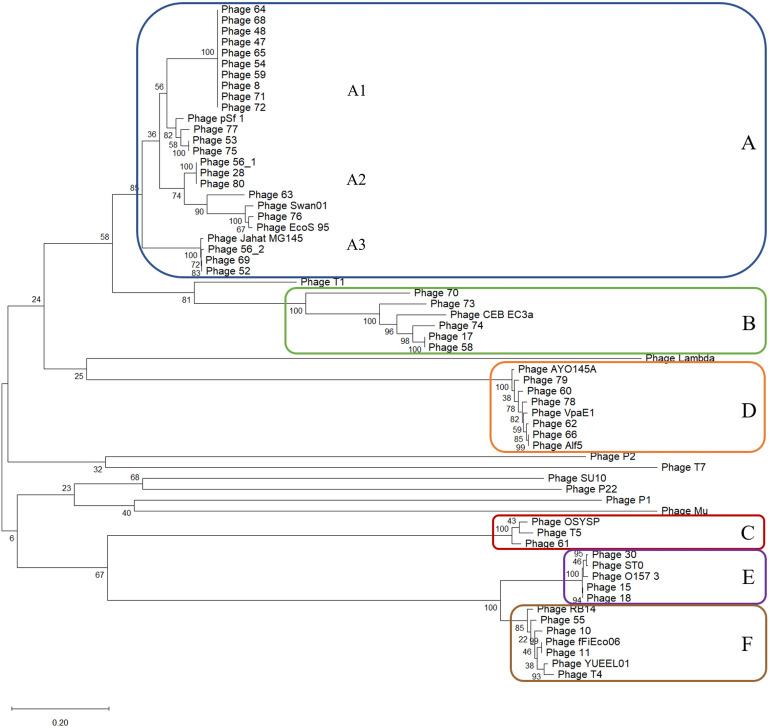
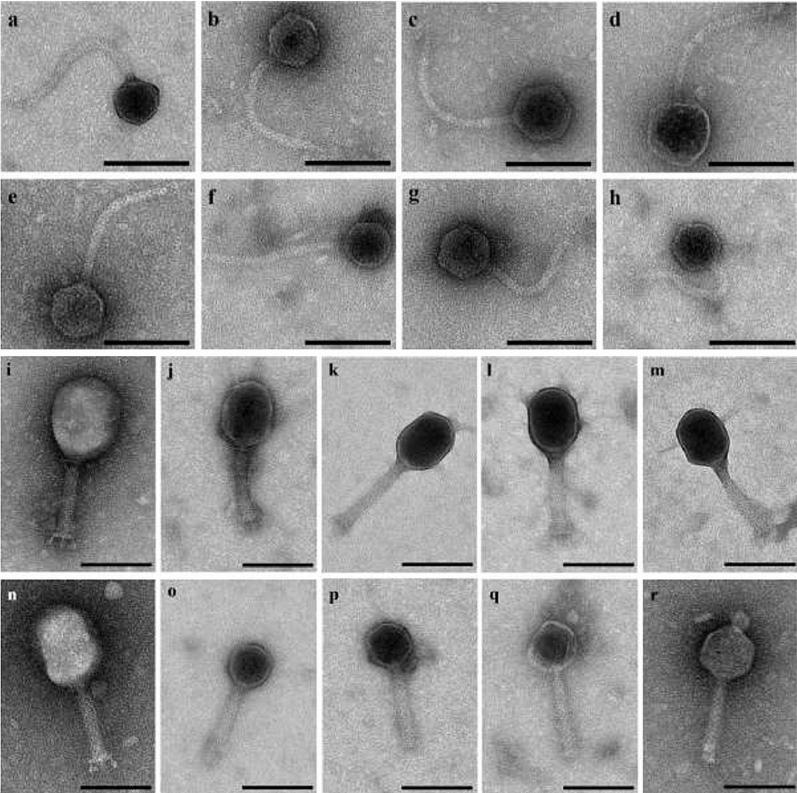
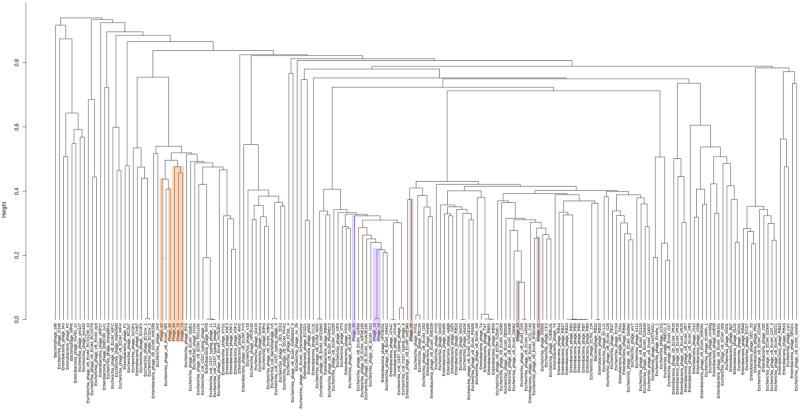
Despite phages' ubiquitous presence and great importance in shaping microbial communities, little is known about the diversity of specific phages in different ecological niches. Here, we isolated, sequenced, and characterized 38 Escherichia coli-infecting phages (coliphages) from poultry faeces to gain a better understanding of the coliphage diversity in the poultry intestine. All phages belonged to either the Siphoviridae or Myoviridae family and their genomes ranged between 44,324 and 173,384 bp, with a G+C content between 35.5 and 46.4%. Phylogenetic analysis was performed based on single "marker" genes; the terminase large subunit, portal protein, and exonucleases, as well as the full draft genomes. Single gene analysis resulted in six distinct clusters. Only minor differences were observed between the different phylogenetic analyses, including branch lengths and additional duplicate or triplicate subclustering. Cluster formation was according to genome size, G+C content and phage subfamily. Phylogenetic analysis based on the full genomes supported these clusters. Moreover, several of our Siphoviridae phages might represent a novel unclassified phage genus. This study allowed for identification of several novel coliphages and provides new insights to the coliphage diversity in the intestine of poultry. Great diversity was observed amongst the phages, while they were isolated from an otherwise similar ecosystem.
尽管噬菌体在塑造微生物群落方面无处不在且具有重要意义,但人们对不同生态位中特定噬菌体的多样性知之甚少。在这里,我们从禽粪中分离、测序并表征了 38 株感染大肠杆菌的噬菌体(噬肠菌),以更好地了解禽肠中的噬肠菌多样性。所有噬菌体均属于肌尾噬菌体科或长尾噬菌体科,其基因组大小在 44,324bp 到 173,384bp 之间,GC 含量在 35.5%到 46.4%之间。基于单一“标记”基因(末端酶大亚基、门户蛋白和核酸外切酶)以及完整的基因组草图进行了系统发育分析。单基因分析产生了六个不同的聚类。不同的系统发育分析之间仅观察到微小差异,包括分支长度以及额外的重复或三重聚类。聚类形成是根据基因组大小、GC 含量和噬菌体亚科。基于全基因组的系统发育分析支持这些聚类。此外,我们的一些肌尾噬菌体可能代表了一种新的未分类噬菌体属。本研究鉴定了几种新型噬肠菌,为禽类肠道中的噬肠菌多样性提供了新的见解。尽管它们是从类似的生态系统中分离出来的,但噬菌体之间存在很大的多样性。

 Zotero 插件