
IBS-D 不同证型的肠道菌群特征。
The characteristics of intestinal flora of IBS-D with different syndromes.
机构信息
Department of General practice, Sir Run Run Shaw Hospital, Zhejiang University, Hangzhou, Zhejiang, China.
Department of Gastroenterology, The First Affiliated Hospital, Zhejiang Chinese Medical University, Hangzhou, Zhejiang, China.
出版信息
Immun Inflamm Dis. 2020 Dec;8(4):615-628. doi: 10.1002/iid3.348. Epub 2020 Sep 17.
OBJECTIVE
To study the distribution of fecal microbiota in diarrhea-predominant irritable bowel syndrome (IBS-D) patients of spleen-kidney-yang deficiency and liver depression and spleen deficiency, to make an objective foundation for dialectics of different type of IBS-D. And to provide the clinical doctors an experimental basis for medication by regulating dysbacteriosis.
METHODS
We collected feces from the control group, spleen-kidney-yang deficiency IBS-D group, and liver-depression and spleen-deficiency IBS-D group. After the extraction of fecal DNA, global DNA was isolated from every sample, and 16S ribosomal RNA was sequenced, and then we analyzed the results for bacteria such as Alpha diversity, community composition, LEfSe, and partial least squares discriminant analysis.
RESULTS
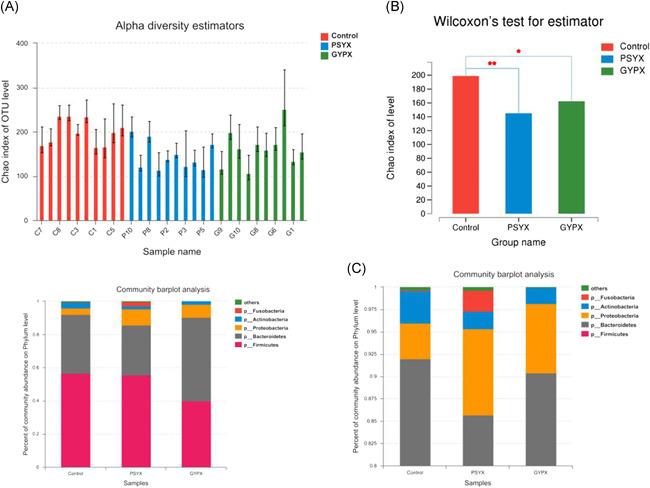
We compared the changes among the fecal bacteria in the intestine of the IBS-D patients and healthy controls and found the specificity of spleen-kidney-yang deficiency syndrome and liver-depression and spleen-deficiency syndrome. The control group has the highest flora diversity (control group > liver-depression and spleen-deficiency > spleen-kidney-yang deficiency group). The control group, spleen-kidney-yang deficiency group, and liver-depression and spleen-deficiency group are different in phylum (Actinobacteria, Fusobacteria), class (Actinobacteria, Fusobacteria), order (Enterobacteriales, Bifidobacteriales, Fusobacteriales), and family (Bifidobacteriaceae, Ruminococcaceae, Enterobacteriaceae, Acidaminococcaceae, Veillonellaceae, Fusobacteriaceae). Bifidobacteriaceae and Ruminococcaceae in the control group, Enterobacteriales, Fusobacteriales, Acidaminococcaceae, and Phascolarctobacterium in the spleen-kidney-yang deficiency group, and streptococcus are the specific bacteria in the liver-depression and spleen-deficiency group. Intestinal flora disturbance is closely related to IBS-D.
CONCLUSIONS
There is a correlation between traditional Chinese medicine syndrome type and intestinal flora. The control group, the spleen-kidney-yang deficiency group, and the liver-depression and spleen-deficiency group have specific bacteria.
目的
研究腹泻型肠易激综合征(IBS-D)脾肾阳虚证和肝郁脾虚证患者粪便微生物群的分布,为不同类型 IBS-D 的辨证提供客观依据,并为通过调节肠道菌群失调进行临床用药提供实验依据。
方法
收集对照组、脾肾阳虚证 IBS-D 组和肝郁脾虚证 IBS-D 组患者的粪便。提取粪便 DNA 后,从每个样本中分离出总 DNA,进行 16S 核糖体 RNA 测序,然后分析细菌的 alpha 多样性、群落组成、LEfSe 和偏最小二乘判别分析等结果。
结果
比较 IBS-D 患者和健康对照者肠道内粪便细菌的变化,发现脾肾阳虚证和肝郁脾虚证的特异性。对照组的菌群多样性最高(对照组>肝郁脾虚证>脾肾阳虚证)。对照组、脾肾阳虚证组和肝郁脾虚证组在门(放线菌门、梭杆菌门)、纲(放线菌纲、梭杆菌纲)、目(肠杆菌目、双歧杆菌目、梭菌目)和科(双歧杆菌科、瘤胃球菌科、肠杆菌科、拟杆菌科、韦荣球菌科、梭杆菌科)上存在差异。对照组的双歧杆菌科和瘤胃球菌科、脾肾阳虚证组的肠杆菌目、梭菌目、拟杆菌科和 Phascolarctobacterium 科、肝郁脾虚证组的链球菌是特定细菌。肠道菌群紊乱与 IBS-D 密切相关。
结论
中医证型与肠道菌群存在相关性。对照组、脾肾阳虚证组和肝郁脾虚证组均存在特定细菌。



 Zotero 插件