
壳聚糖纳米粒包裹的猪抗菌肽与白细胞介素-4/6融合基因对小鼠免疫应答及抗感染能力的增强作用
Enhancement of Immune Response and Anti-Infection of Mice by Porcine Antimicrobial Peptides and Interleukin-4/6 Fusion Gene Encapsulated in Chitosan Nanoparticles.
作者信息
Peng Junjie, Xiao Yongle, Wan Xiaoping, Chen Qian, Wang Huan, Li Jiangling, Chen Jianlin, Gao Rong
机构信息
College of Life Science, Sichuan University, Chengdu 610065, China.
Sichuan Animal Science Academy, Chengdu 610066, China.
出版信息
Vaccines (Basel). 2020 Sep 21;8(3):552. doi: 10.3390/vaccines8030552.
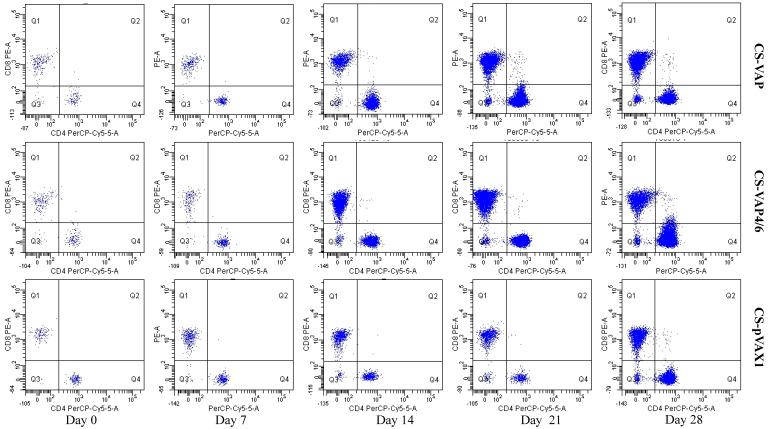
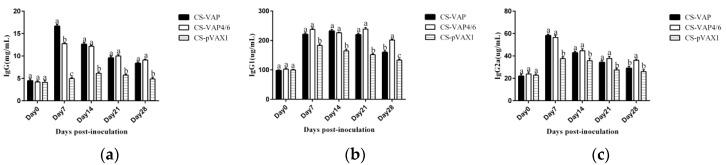
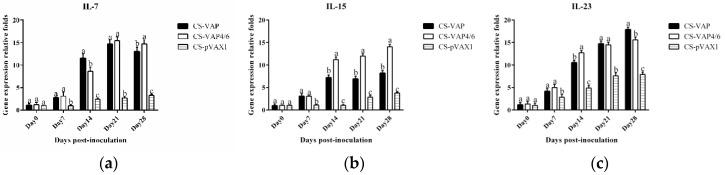
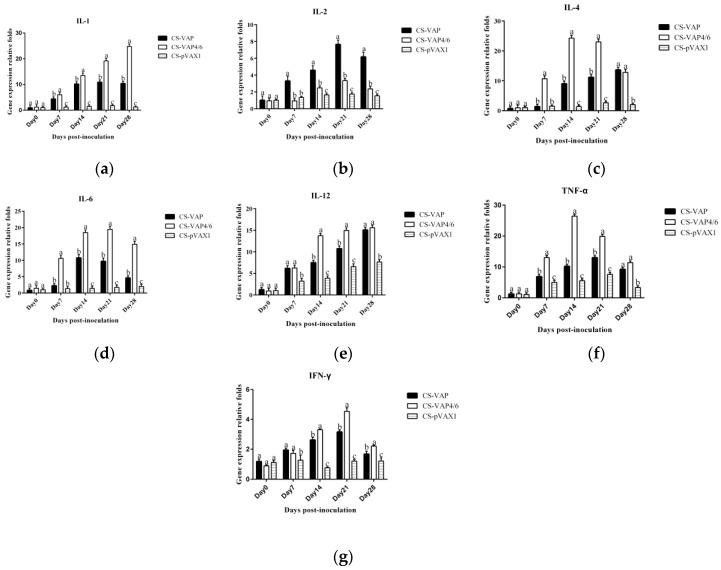
In order to develop a novel and effective immunoregulator to enhance both the immune response and antimicrobial function, a recombinant eukaryotic expression plasmid-pVAX1 co-expressing fusion cathelicidin antimicrobial peptides (CAMPs) and fusion porcine interleukin-4/6 gene (IL-4/6) was constructed and encapsulated in chitosan nanoparticles (CS-VAP4/6), prepared by the ionotropic gelation method. Four-week-old female Kunming mice were divided into three groups and intramuscularly injected, respectively, with CS-VAP, CS-VAP4/6, and CS-pVAX1. On 28 days post-inoculation, the mice were challenged by intraperitoneal injection with (ATCC 25923) and (ATCC 25922); IgG, IgG1 and IgG2a, CD4+, and CD8+ T cells increased significantly in the VAP- and VAP4/6- treated mice, detected by ELISA and flow cytometry, correspondingly ( 0.05). As analyzed by qPCR, expression levels of Toll-like receptor (TLR) 1, TLR4, TLR6, TLR9, IL-1, IL-2, IL-4, IL-6, IL-7, IL-12, IL-15, IL-23, Tumor Necrosis Factor (TNF)-α, and Interferon-gamma (IFN-γ) genes were also significantly up-regulated in comparison with those of the control mice ( 0.05). Their immunological markers were elevated significantly to different degrees in CS-VAP4/6-treated mice compared with CS-VAP in different days post-inoculation ( 0.05). After challenge with and , most of the VAP- and VAP4/6- treated mice survived, and no symptoms of bacterial infection were observed. In contrast, 80% of control mice died of infection. Among the treated groups, VAP4/6 had a stronger resistance against challenge with infection. These results demonstrated that the fusion gene of antimicrobial peptide and interleukin-4/6 has the promising potential as a safe and effective immunomodulator for the control of bacterial infections.
为了开发一种新型有效的免疫调节剂以增强免疫反应和抗菌功能,构建了一种共表达融合猫爪草抗菌肽(CAMP)和融合猪白细胞介素-4/6基因(IL-4/6)的重组真核表达质粒-pVAX1,并将其包裹在通过离子凝胶法制备的壳聚糖纳米颗粒(CS-VAP4/6)中。将四周龄雌性昆明小鼠分为三组,分别肌肉注射CS-VAP、CS-VAP4/6和CS-pVAX1。接种后28天,通过腹腔注射用金黄色葡萄球菌(ATCC 25923)和大肠杆菌(ATCC 25922)对小鼠进行攻毒;通过ELISA和流式细胞术检测发现,VAP和VAP4/6处理组小鼠的IgG、IgG1和IgG2a、CD4+和CD8+T细胞显著增加(P<0.05)。通过qPCR分析,与对照小鼠相比,Toll样受体(TLR)1、TLR4、TLR6、TLR9、IL-1、IL-2、IL-4、IL-6、IL-7、IL-12、IL-15、IL-23、肿瘤坏死因子(TNF)-α和干扰素-γ(IFN-γ)基因的表达水平也显著上调(P<0.05)。在接种后不同天数,与CS-VAP处理组相比,CS-VAP4/6处理组小鼠的免疫标志物在不同程度上显著升高(P<0.05)。在用金黄色葡萄球菌和大肠杆菌攻毒后,大多数VAP和VAP4/6处理组小鼠存活,未观察到细菌感染症状。相比之下,80%的对照小鼠死于感染。在处理组中,VAP4/6对金黄色葡萄球菌感染攻毒具有更强的抵抗力。这些结果表明,抗菌肽与白细胞介素-4/6的融合基因作为一种安全有效的免疫调节剂用于控制细菌感染具有广阔的潜力。






 Zotero 插件