
一种从基于细胞的异质筛选中定义抗疟药物作用的机器学习方法。
A machine learning approach to define antimalarial drug action from heterogeneous cell-based screens.
机构信息
Department of Life Sciences, Imperial College London, London, UK.
Google Research, Applied Science Team.
出版信息
Sci Adv. 2020 Sep 25;6(39). doi: 10.1126/sciadv.aba9338. Print 2020 Sep.
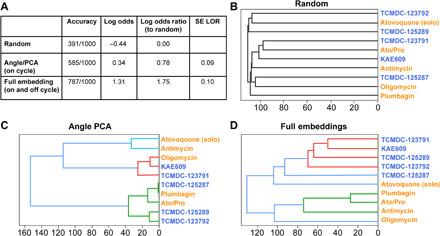
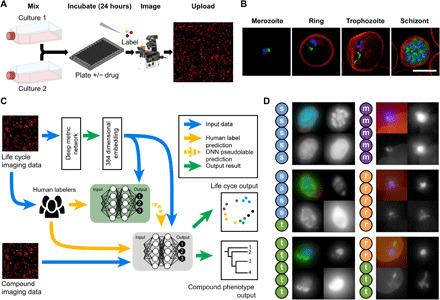
Drug resistance threatens the effective prevention and treatment of an ever-increasing range of human infections. This highlights an urgent need for new and improved drugs with novel mechanisms of action to avoid cross-resistance. Current cell-based drug screens are, however, restricted to binary live/dead readouts with no provision for mechanism of action prediction. Machine learning methods are increasingly being used to improve information extraction from imaging data. These methods, however, work poorly with heterogeneous cellular phenotypes and generally require time-consuming human-led training. We have developed a semi-supervised machine learning approach, combining human- and machine-labeled training data from mixed human malaria parasite cultures. Designed for high-throughput and high-resolution screening, our semi-supervised approach is robust to natural parasite morphological heterogeneity and correctly orders parasite developmental stages. Our approach also reproducibly detects and clusters drug-induced morphological outliers by mechanism of action, demonstrating the potential power of machine learning for accelerating cell-based drug discovery.
耐药性威胁着对不断增加的各种人类感染的有效预防和治疗。这凸显了对具有新型作用机制的新药和改进药物的迫切需求,以避免交叉耐药性。然而,目前基于细胞的药物筛选仅限于二进制死活读数,无法预测作用机制。机器学习方法越来越多地被用于从成像数据中提取更多信息。然而,这些方法在处理异质细胞表型时效果不佳,通常需要耗时的人工主导培训。我们开发了一种半监督机器学习方法,结合了来自混合人类疟疾寄生虫培养物的人工和机器标记的训练数据。我们的方法专为高通量和高分辨率筛选而设计,对天然寄生虫形态异质性具有鲁棒性,并正确地对寄生虫发育阶段进行排序。我们的方法还通过作用机制重现性地检测和聚类药物诱导的形态异常,证明了机器学习在加速基于细胞的药物发现方面的潜在力量。


 Zotero 插件