
一种灭活的严重急性呼吸综合征冠状病毒 2 疫苗(BBIBP-CorV)的安全性和免疫原性:一项随机、双盲、安慰剂对照、1/2 期临床试验。
Safety and immunogenicity of an inactivated SARS-CoV-2 vaccine, BBIBP-CorV: a randomised, double-blind, placebo-controlled, phase 1/2 trial.
机构信息
Henan Provincial Center for Disease Control and Prevention, Henan, China.
Beijing Institute of Biological Products, Beijing, China.
出版信息
Lancet Infect Dis. 2021 Jan;21(1):39-51. doi: 10.1016/S1473-3099(20)30831-8. Epub 2020 Oct 15.
BACKGROUND
The ongoing COVID-19 pandemic warrants accelerated efforts to test vaccine candidates. We aimed to assess the safety and immunogenicity of an inactivated severe acute respiratory syndrome coronavirus 2 (SARS-CoV-2) vaccine candidate, BBIBP-CorV, in humans.
METHODS
We did a randomised, double-blind, placebo-controlled, phase 1/2 trial at Shangqiu City Liangyuan District Center for Disease Control and Prevention in Henan Province, China. In phase 1, healthy people aged 18-80 years, who were negative for serum-specific IgM/IgG antibodies against SARS-CoV-2 at the time of screening, were separated into two age groups (18-59 years and ≥60 years) and randomly assigned to receive vaccine or placebo in a two-dose schedule of 2 μg, 4 μg, or 8 μg on days 0 and 28. In phase 2, healthy adults (aged 18-59 years) were randomly assigned (1:1:1:1) to receive vaccine or placebo on a single-dose schedule of 8 μg on day 0 or on a two-dose schedule of 4 μg on days 0 and 14, 0 and 21, or 0 and 28. Participants within each cohort were randomly assigned by stratified block randomisation (block size eight) and allocated (3:1) to receive vaccine or placebo. Group allocation was concealed from participants, investigators, and outcome assessors. The primary outcomes were safety and tolerability. The secondary outcome was immunogenicity, assessed as the neutralising antibody responses against infectious SARS-CoV-2. This study is registered with www.chictr.org.cn, ChiCTR2000032459.
FINDINGS
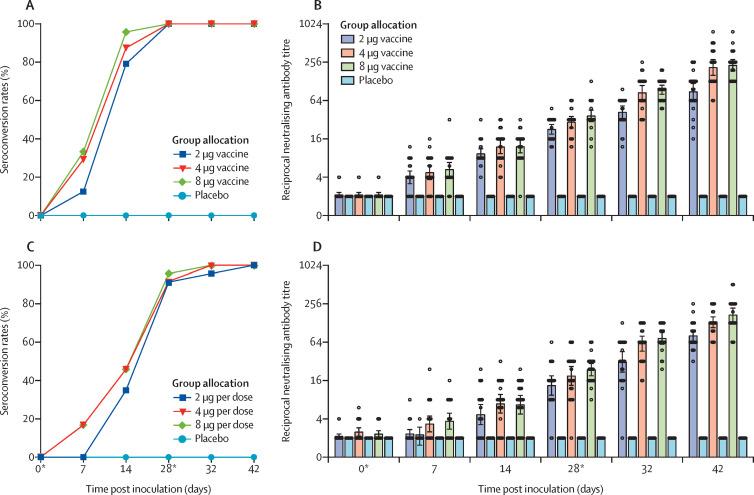
In phase 1, 192 participants were enrolled (mean age 53·7 years [SD 15·6]) and were randomly assigned to receive vaccine (2 μg [n=24], 4 μg [n=24], or 8 μg [n=24] for both age groups [18-59 years and ≥60 years]) or placebo (n=24). At least one adverse reaction was reported within the first 7 days of inoculation in 42 (29%) of 144 vaccine recipients. The most common systematic adverse reaction was fever (18-59 years, one [4%] in the 2 μg group, one [4%] in the 4 μg group, and two [8%] in the 8 μg group; ≥60 years, one [4%] in the 8 μg group). All adverse reactions were mild or moderate in severity. No serious adverse event was reported within 28 days post vaccination. Neutralising antibody geometric mean titres were higher at day 42 in the group aged 18-59 years (87·7 [95% CI 64·9-118·6], 2 μg group; 211·2 [158·9-280·6], 4 μg group; and 228·7 [186·1-281·1], 8 μg group) and the group aged 60 years and older (80·7 [65·4-99·6], 2 μg group; 131·5 [108·2-159·7], 4 μg group; and 170·87 [133·0-219·5], 8 μg group) compared with the placebo group (2·0 [2·0-2·0]). In phase 2, 448 participants were enrolled (mean age 41·7 years [SD 9·9]) and were randomly assigned to receive the vaccine (8 μg on day 0 [n=84] or 4 μg on days 0 and 14 [n=84], days 0 and 21 [n=84], or days 0 and 28 [n=84]) or placebo on the same schedules (n=112). At least one adverse reaction within the first 7 days was reported in 76 (23%) of 336 vaccine recipients (33 [39%], 8 μg day 0; 18 [21%], 4 μg days 0 and 14; 15 [18%], 4 μg days 0 and 21; and ten [12%], 4 μg days 0 and 28). One placebo recipient in the 4 μg days 0 and 21 group reported grade 3 fever, but was self-limited and recovered. All other adverse reactions were mild or moderate in severity. The most common systematic adverse reaction was fever (one [1%], 8 μg day 0; one [1%], 4 μg days 0 and 14; three [4%], 4 μg days 0 and 21; two [2%], 4 μg days 0 and 28). The vaccine-elicited neutralising antibody titres on day 28 were significantly greater in the 4 μg days 0 and 14 (169·5, 95% CI 132·2-217·1), days 0 and 21 (282·7, 221·2-361·4), and days 0 and 28 (218·0, 181·8-261·3) schedules than the 8 μg day 0 schedule (14·7, 11·6-18·8; all p<0·001).
INTERPRETATION
The inactivated SARS-CoV-2 vaccine, BBIBP-CorV, is safe and well tolerated at all tested doses in two age groups. Humoral responses against SARS-CoV-2 were induced in all vaccine recipients on day 42. Two-dose immunisation with 4 μg vaccine on days 0 and 21 or days 0 and 28 achieved higher neutralising antibody titres than the single 8 μg dose or 4 μg dose on days 0 and 14.
FUNDING
National Program on Key Research Project of China, National Mega projects of China for Major Infectious Diseases, National Mega Projects of China for New Drug Creation, and Beijing Science and Technology Plan.
背景
持续的 COVID-19 大流行需要加速测试候选疫苗。我们旨在评估一种灭活的严重急性呼吸系统综合征冠状病毒 2(SARS-CoV-2)候选疫苗 BBIBP-CorV 在人类中的安全性和免疫原性。
方法
我们在中国河南省商丘市梁园区疾病预防控制中心进行了一项随机、双盲、安慰剂对照、1/2 期试验。在 1 期,在筛查时血清特异性 SARS-CoV-2 IgM/IgG 抗体呈阴性的 18-80 岁健康人群被分为两个年龄组(18-59 岁和≥60 岁),并随机接受 2μg、4μg 或 8μg 的两剂方案,分别在第 0 天和第 28 天接种。在 2 期,健康成年人(18-59 岁)按 1:1:1:1 的比例随机接受 8μg 单剂方案或 4μg 的两剂方案,分别在第 0 天和第 14 天、第 0 天和第 21 天或第 0 天和第 28 天接种。每个队列中的参与者均通过分层块随机化(块大小为 8)和分配(3:1)接受疫苗或安慰剂。参与者、研究者和结果评估者对分组情况均不知情。主要结局为安全性和耐受性。次要结局为免疫原性,评估为针对传染性 SARS-CoV-2 的中和抗体反应。本研究在中国临床试验注册中心(ChiCTR)注册,注册号为 ChiCTR2000032459。
结果
1 期共纳入 192 名参与者(平均年龄 53.7 岁[标准差 15.6]),并随机接受疫苗(2μg[24 名]、4μg[24 名]或 8μg[24 名],适用于两个年龄组[18-59 岁和≥60 岁])或安慰剂(24 名)。接种后 7 天内,至少有 1 名疫苗接种者报告了 1 项不良事件。18-59 岁年龄组最常见的系统不良反应为发热(2μg 组 1 例[4%],4μg 组 1 例[4%],8μg 组 2 例[8%]);≥60 岁年龄组 1 例[4%])。所有不良反应均为轻度或中度。接种后 28 天内未报告严重不良事件。18-59 岁年龄组第 42 天的中和抗体几何平均滴度较高(2μg 组 87.7[95%CI 64.9-118.6],4μg 组 211.2[158.9-280.6],8μg 组 228.7[186.1-281.1])和 60 岁及以上年龄组(2μg 组 80.7[65.4-99.6],4μg 组 131.5[108.2-159.7],8μg 组 170.87[133.0-219.5]),与安慰剂组(2.0[2.0-2.0])相比。在 2 期,共纳入 448 名参与者(平均年龄 41.7 岁[标准差 9.9]),并随机接受疫苗(第 0 天 8μg[84 名]或第 0 天和第 14 天 4μg[84 名]、第 0 天和第 21 天 4μg[84 名]或第 0 天和第 28 天 4μg[84 名])或安慰剂(112 名)。在 336 名接种疫苗的接种者中,接种后 7 天内至少有 1 名接种者报告了 1 项不良反应(33 例[39%],8μg 第 0 天;18 例[21%],4μg 第 0 天和第 14 天;15 例[18%],4μg 第 0 天和第 21 天;10 例[12%],4μg 第 0 天和第 28 天)。4μg 第 0 天和第 21 天组中 1 名安慰剂接种者报告了 3 级发热,但为自限性并已恢复。所有其他不良反应均为轻度或中度。最常见的系统不良反应为发热(第 0 天 1 例[1%],4μg 第 0 天和第 14 天 1 例[1%],4μg 第 0 天和第 21 天 3 例[4%],4μg 第 0 天和第 28 天 2 例[2%])。第 4μg 第 0 天和第 14 天、第 0 天和第 21 天和第 0 天和第 28 天方案的疫苗诱导的中和抗体滴度在第 28 天明显高于第 8μg 第 0 天方案(169.5,95%CI 132.2-217.1),均有统计学意义(p<0.001)。
结论
在两个年龄组中,所有测试剂量的 SARS-CoV-2 灭活疫苗 BBIBP-CorV 均安全且耐受良好。所有疫苗接种者在第 42 天均诱导出针对 SARS-CoV-2 的体液免疫反应。与第 8μg 单剂方案或 4μg 第 0 天和第 14 天方案相比,第 4μg 两剂方案(第 0 天和第 21 天或第 0 天和第 28 天)可诱导更高的中和抗体滴度。
资金
国家重点研发计划重大项目、中国重大传染病防治科技重大专项、中国新药创制重大专项和北京市科技计划。


 Zotero 插件