
一项在健康儿童和青少年中进行的灭活 SARS-CoV-2 疫苗(科兴疫苗)的安全性、耐受性和免疫原性的双盲、随机、对照、1/2 期临床试验。
Safety, tolerability, and immunogenicity of an inactivated SARS-CoV-2 vaccine (CoronaVac) in healthy children and adolescents: a double-blind, randomised, controlled, phase 1/2 clinical trial.
机构信息
Hebei Provincial Center for Disease Control and Prevention, Shijiazhuang, Hebei Province, China.
Sinovac Biotech, Beijing, China.
出版信息
Lancet Infect Dis. 2021 Dec;21(12):1645-1653. doi: 10.1016/S1473-3099(21)00319-4. Epub 2021 Jun 28.
BACKGROUND
A vaccine against SARS-CoV-2 for children and adolescents will play an important role in curbing the COVID-19 pandemic. Here we aimed to assess the safety, tolerability, and immunogenicity of a candidate COVID-19 vaccine, CoronaVac, containing inactivated SARS-CoV-2, in children and adolescents aged 3-17 years.
METHODS
We did a double-blind, randomised, controlled, phase 1/2 clinical trial of CoronaVac in healthy children and adolescents aged 3-17 years old at Hebei Provincial Center for Disease Control and Prevention in Zanhuang (Hebei, China). Individuals with SARS-CoV-2 exposure or infection history were excluded. Vaccine (in 0·5 mL aluminum hydroxide adjuvant) or aluminum hydroxide only (alum only, control) was given by intramuscular injection in two doses (day 0 and day 28). We did a phase 1 trial in 72 participants with an age de-escalation in three groups and dose-escalation in two blocks (1·5 μg or 3·0 μg per injection). Within each block, participants were randomly assigned (3:1) by means of block randomisation to receive CoronaVac or alum only. In phase 2, participants were randomly assigned (2:2:1) by means of block randomisation to receive either CoronaVac at 1·5 μg or 3·0 μg per dose, or alum only. All participants, investigators, and laboratory staff were masked to group allocation. The primary safety endpoint was adverse reactions within 28 days after each injection in all participants who received at least one dose. The primary immunogenicity endpoint assessed in the per-protocol population was seroconversion rate of neutralising antibody to live SARS-CoV-2 at 28 days after the second injection. This study is ongoing and is registered with ClinicalTrials.gov, NCT04551547.
FINDINGS
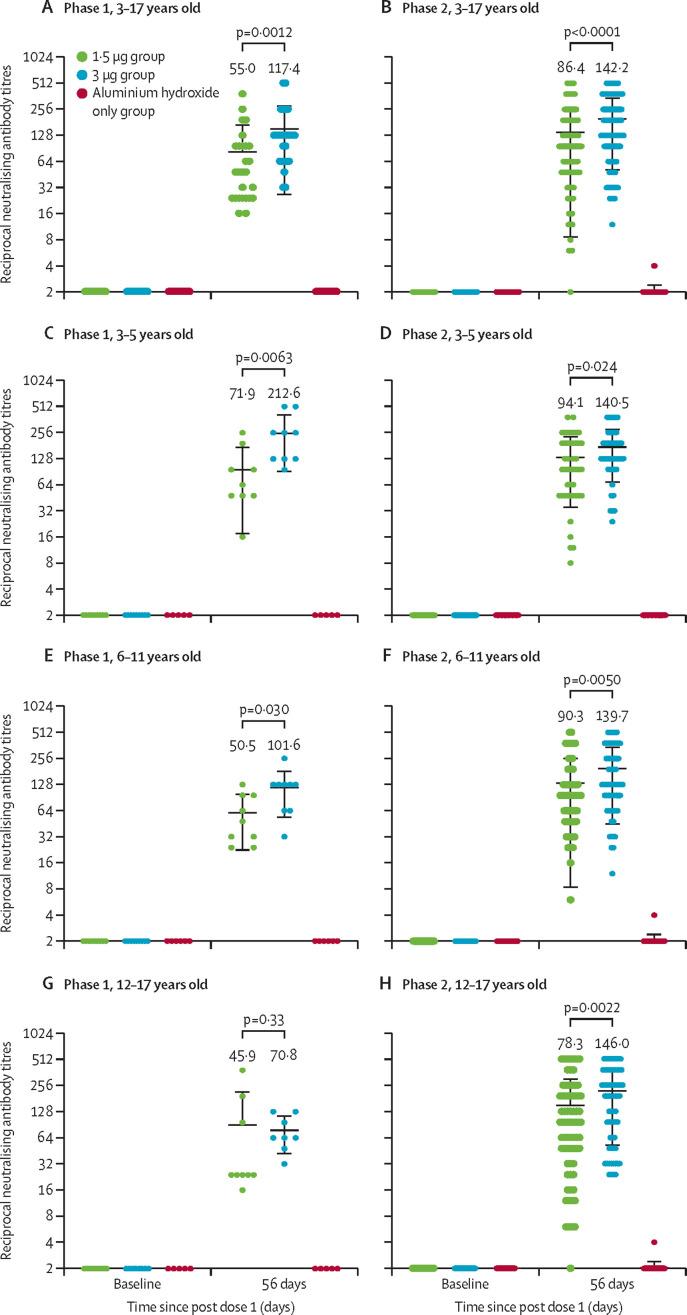
Between Oct 31, 2020, and Dec 2, 2020, 72 participants were enrolled in phase 1, and between Dec 12, 2020, and Dec 30, 2020, 480 participants were enrolled in phase 2. 550 participants received at least one dose of vaccine or alum only (n=71 for phase 1 and n=479 for phase 2; safety population). In the combined safety profile of phase 1 and phase 2, any adverse reactions within 28 days after injection occurred in 56 (26%) of 219 participants in the 1·5 μg group, 63 (29%) of 217 in the 3·0 μg group, and 27 (24%) of 114 in the alum-only group, without significant difference (p=0·55). Most adverse reactions were mild and moderate in severity. Injection site pain was the most frequently reported event (73 [13%] of 550 participants), occurring in 36 (16%) of 219 participants in the 1·5 μg group, 35 (16%) of 217 in the 3·0 μg group, and two (2%) in the alum-only group. As of June 12, 2021, only one serious adverse event of pneumonia has been reported in the alum-only group, which was considered unrelated to vaccination. In phase 1, seroconversion of neutralising antibody after the second dose was observed in 27 of 27 participants (100·0% [95% CI 87·2-100·0]) in the 1·5 μg group and 26 of 26 participants (100·0% [86·8-100·0]) in the 3·0 μg group, with the geometric mean titres of 55·0 (95% CI 38·9-77·9) and 117·4 (87·8-157·0). In phase 2, seroconversion was seen in 180 of 186 participants (96·8% [93·1-98·8]) in the 1·5 μg group and 180 of 180 participants (100·0% [98·0-100·0]) in the 3·0 μg group, with the geometric mean titres of 86·4 (73·9-101·0) and 142·2 (124·7-162·1). There were no detectable antibody responses in the alum-only groups.
INTERPRETATION
CoronaVac was well tolerated and safe and induced humoral responses in children and adolescents aged 3-17 years. Neutralising antibody titres induced by the 3·0 μg dose were higher than those of the 1·5 μg dose. The results support the use of 3·0 μg dose with a two-immunisation schedule for further studies in children and adolescents.
FUNDING
The Chinese National Key Research and Development Program and the Beijing Science and Technology Program.
背景
针对儿童和青少年的 SARS-CoV-2 疫苗将在遏制 COVID-19 大流行方面发挥重要作用。在此,我们旨在评估科兴公司研发的含灭活 SARS-CoV-2 的候选 COVID-19 疫苗 CoronaVac 在 3-17 岁儿童和青少年中的安全性、耐受性和免疫原性。
方法
我们在河北省疾病预防控制中心(中国赞皇)进行了一项针对 3-17 岁健康儿童和青少年的科兴 CoronaVac 双盲、随机、对照、1/2 期临床试验。排除有 SARS-CoV-2 暴露或感染史的个体。疫苗(0.5 mL 氢氧化铝佐剂)或仅用氢氧化铝(对照, alum only)以 28 天的间隔进行 2 次肌肉注射。我们在 72 名参与者中进行了 1 期试验,分为 3 个年龄组和 2 个剂量组(每组 1.5μg 或 3.0μg)。在每个剂量组内,参与者按区组随机(3:1)分组,接受 CoronaVac 或仅 alum。在 2 期试验中,参与者按区组随机(2:2:1)分组,接受 1.5μg 或 3.0μg 剂量的 CoronaVac 或仅 alum。所有参与者、研究者和实验室工作人员对分组情况均不知情。主要安全性终点为所有至少接受一剂疫苗的参与者在每次注射后 28 天内的不良反应。主要免疫原性终点为第 2 次注射后 28 天中和活 SARS-CoV-2 的抗体血清转化率,在方案人群中进行评估。该研究正在进行中,并在 ClinicalTrials.gov 注册,编号为 NCT04551547。
结果
2020 年 10 月 31 日至 12 月 2 日,72 名参与者入组 1 期试验,2020 年 12 月 12 日至 12 月 30 日,480 名参与者入组 2 期试验。550 名参与者至少接受了一剂疫苗或仅 alum(1 期试验 71 名,2 期试验 479 名;安全性人群)。在 1 期和 2 期的联合安全性概况中,注射后 28 天内任何不良反应在 1.5μg 组的 219 名参与者中发生 56 例(26%),在 3.0μg 组的 217 名参与者中发生 63 例(29%),在仅 alum 组的 114 名参与者中发生 27 例(24%),差异无统计学意义(p=0.55)。大多数不良反应为轻度和中度。注射部位疼痛是最常报告的事件(550 名参与者中有 73 例[13%]),1.5μg 组的 219 名参与者中有 36 例(16%),3.0μg 组的 217 名参与者中有 35 例(16%),仅 alum 组的 2 名参与者(2%)。截至 2021 年 6 月 12 日,仅在 alum 组报告了 1 例肺炎严重不良事件,被认为与疫苗接种无关。在 1 期试验中,第二次注射后中和抗体的血清转化率在 1.5μg 组的 27 名参与者(100.0%[95%CI 87.2-100.0%])和 3.0μg 组的 26 名参与者(100.0%[86.8-100.0%])中观察到,几何平均滴度分别为 55.0(95%CI 38.9-77.9)和 117.4(87.8-157.0)。在 2 期试验中,1.5μg 组的 186 名参与者中有 180 名(96.8%[93.1-98.8%])和 3.0μg 组的 180 名参与者(100.0%[98.0-100.0%])血清转化率,几何平均滴度分别为 86.4(73.9-101.0)和 142.2(124.7-162.1)。在仅 alum 组未检测到抗体反应。
结论
科兴 CoronaVac 具有良好的耐受性和安全性,可诱导 3-17 岁儿童和青少年产生体液免疫反应。3.0μg 剂量诱导的中和抗体滴度高于 1.5μg 剂量。这些结果支持在儿童和青少年中使用 3.0μg 剂量和两剂接种方案进行进一步研究。
资助
中国国家重点研发计划和北京市科技计划。

 Zotero 插件