
鼻病毒和甲型流感病毒的相互干扰:临床数据分析和实验感染研究。
Interference between rhinovirus and influenza A virus: a clinical data analysis and experimental infection study.
机构信息
Department of Laboratory Medicine (A Wu BSE, V T Mihaylova PhD, Prof M L Landry MD, Prof E F Foxman MD), Department of Internal Medicine (Prof M L Landry), and Department of Immunobiology (A Wu, Prof E F Foxman), Yale University School of Medicine, New Haven, CT, USA.
出版信息
Lancet Microbe. 2020 Oct;1(6):e254-e262. doi: 10.1016/s2666-5247(20)30114-2. Epub 2020 Sep 5.
BACKGROUND
During the 2009 pandemic of an emerging influenza A virus (IAV; H1N1pdm09), data from several European countries indicated that the spread of the virus might have been interrupted by the annual autumn rhinovirus epidemic. We aimed to investigate viral interference between rhinovirus and IAV with use of clinical data and an experimental model.
METHODS
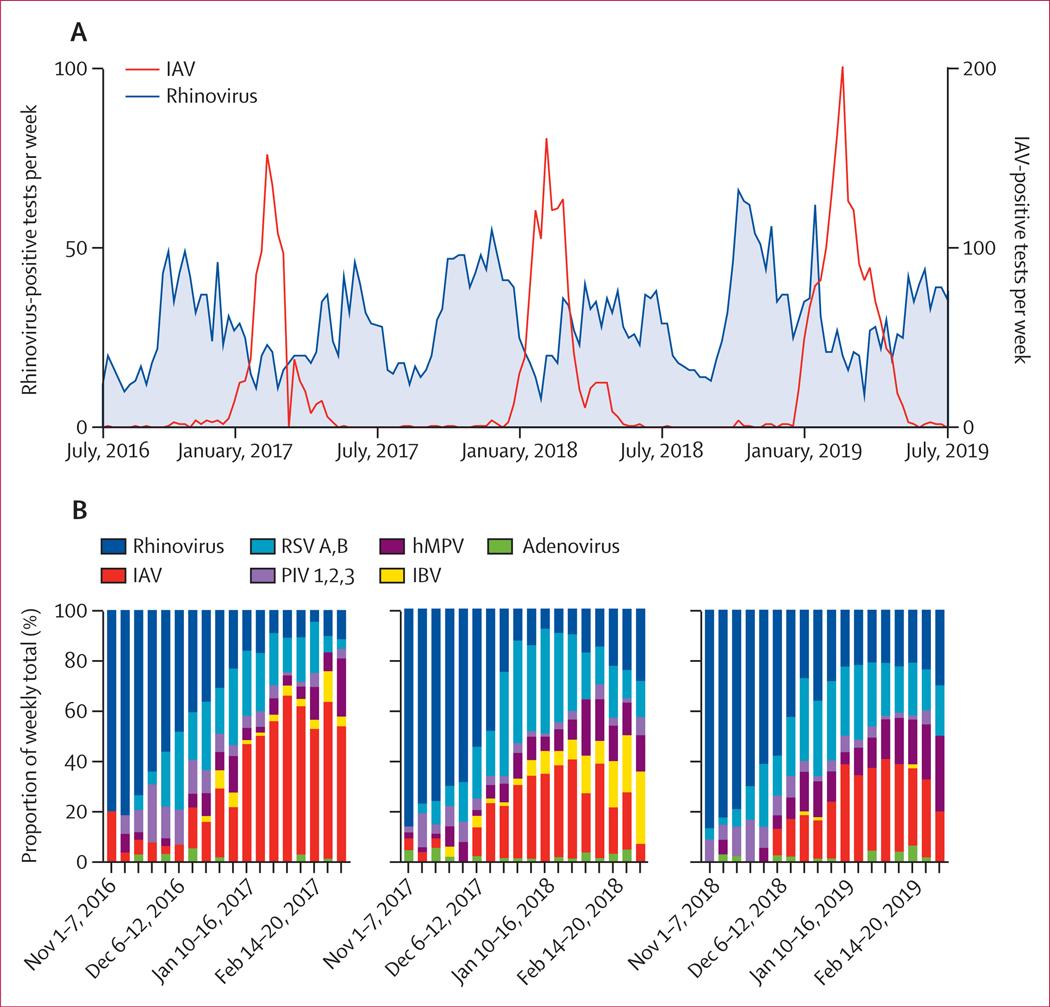
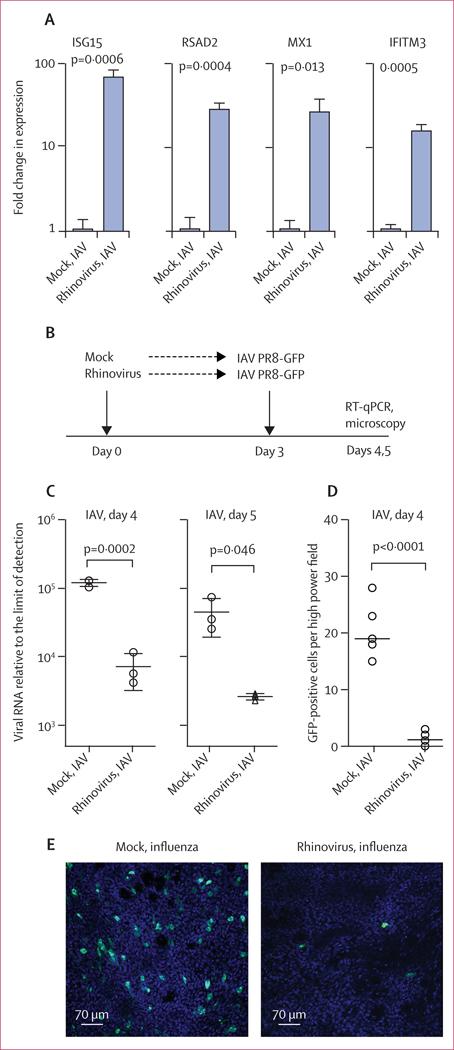
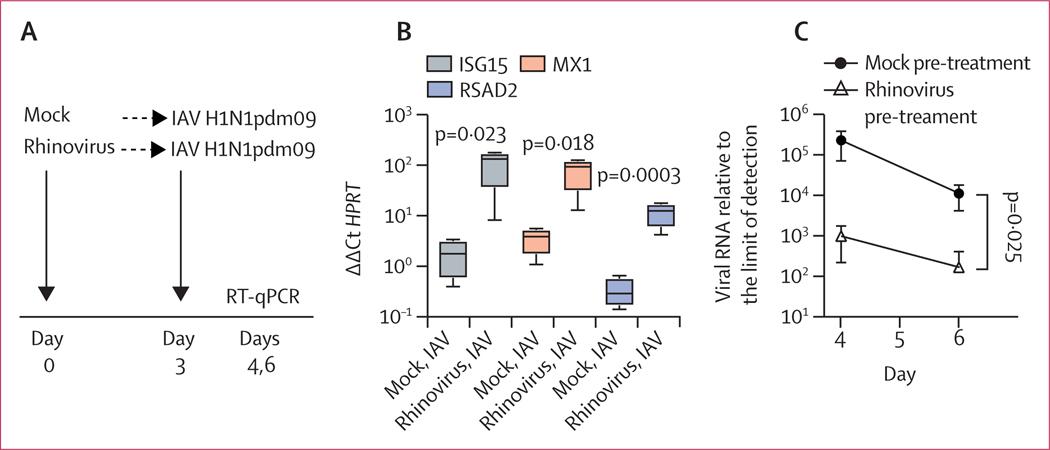
We did a clinical data analysis and experimental infection study to investigate the co-occurrence of rhinovirus and IAV in respiratory specimens from adults (≥21 years) tested with a multiplex PCR panel at Yale-New Haven Hospital (CT, USA) over three consecutive winter seasons (Nov 1 to March 1, 2016-17, 2017-18, and 2018-19). We compared observed versus expected co-detections using data extracted from the Epic Systems electronic medical record system. To assess how rhinovirus infection affects subsequent IAV infection, we inoculated differentiated primary human airway epithelial cultures with rhinovirus (HRV-01A; multiplicity of infection [MOI] 0·1) or did mock infection. On day 3 post-infection, we inoculated the same cultures with IAV (H1N1 green fluorescent protein [GFP] reporter virus or H1N1pdm09; MOI 0·1). We used reverse transcription quantitative PCR or microscopy to quantify host cell mRNAs for interferon-stimulated genes (ISGs) on day 3 after rhinovirus or mock infection and IAV RNA on days 4, 5, or 6 after rhinovirus or mock infection. We also did sequential infection studies in the presence of BX795 (6 μM), to inhibit the interferon response. We compared ISG expression and IAV RNA and expression of GFP by IAV reporter virus.
FINDINGS
Between July 1, 2016, and June 30, 2019, examination of 8284 respiratory samples positive for either rhinovirus (n=3821) or IAV (n=4463) by any test method was used to establish Nov 1 to March 1 as the period of peak virus co-circulation. After filtering for samples within this time frame meeting the inclusion criteria (n=13 707), there were 989 (7·2%) rhinovirus and 922 (6·7%) IAV detections, with a significantly lower than expected odds of co-detection (odds ratio 0·16, 95% CI 0·09-0·28). Rhinovirus infection of cell cultures induced ISG expression and protected against IAV infection 3 days later, resulting in an approximate 50 000-fold decrease in IAV H1N1pdm09 viral RNA on day 5 post-rhinovirus inoculation. Blocking the interferon response restored IAV replication following rhinovirus infection.
INTERPRETATION
These findings show that one respiratory virus can block infection with another through stimulation of antiviral defences in the airway mucosa, supporting the idea that interference from rhinovirus disrupted the 2009 IAV pandemic in Europe. These results indicate that viral interference can potentially affect the course of an epidemic, and this possibility should be considered when designing interventions for seasonal influenza epidemics and the ongoing COVID-19 pandemic.
FUNDING
National Institutes of Health, National Institute of General Medical Sciences, and the Yale Department of Laboratory Medicine.
背景
在 2009 年新兴甲型流感病毒(IAV;H1N1pdm09)大流行期间,来自几个欧洲国家的数据表明,病毒的传播可能被每年秋季鼻病毒流行所中断。我们旨在使用临床数据和实验模型研究鼻病毒和 IAV 之间的病毒干扰。
方法
我们进行了临床数据分析和实验感染研究,以调查在耶鲁-纽黑文医院(美国 CT)进行的多重 PCR 检测的成年(≥21 岁)呼吸道标本中,三种连续冬季(2016-17 年、2017-18 年和 2018-19 年 11 月 1 日至 3 月 1 日)期间鼻病毒和 IAV 的共同检出情况。我们使用从 Epic Systems 电子病历系统中提取的数据比较了观察到的共同检出与预期的共同检出。为了评估鼻病毒感染如何影响随后的 IAV 感染,我们用鼻病毒(HRV-01A;感染复数 [MOI] 0·1)或模拟感染接种分化的原代人气道上皮培养物。在感染后第 3 天,我们用 IAV(H1N1 绿色荧光蛋白 [GFP] 报告病毒或 H1N1pdm09;MOI 0·1)接种相同的培养物。我们使用逆转录定量 PCR 或显微镜在鼻病毒或模拟感染后第 3 天和鼻病毒或模拟感染后第 4、5 或 6 天检测宿主细胞干扰素刺激基因(ISG)的 mRNA。我们还在存在 BX795(6 μM)的情况下进行了连续感染研究,以抑制干扰素反应。我们比较了 ISG 表达和 IAV RNA 以及 IAV 报告病毒的 GFP 表达。
发现
2016 年 7 月 1 日至 2019 年 6 月 30 日期间,通过任何测试方法对 8284 份呼吸道样本进行检测,结果显示 11 月 1 日至 3 月 1 日为病毒共同循环的高峰期。在对符合纳入标准的该时间段内的样本(n=13707)进行过滤后(n=13707),有 989 例(7.2%)鼻病毒和 922 例(6.7%)IAV 检测,共同检出的可能性显著低于预期(比值比 0·16,95%CI 0·09-0·28)。鼻病毒感染细胞培养物诱导 ISG 表达,并在 3 天后对 IAV 感染产生保护作用,导致鼻病毒接种后第 5 天 IAV H1N1pdm09 病毒 RNA 降低约 50000 倍。阻断干扰素反应恢复了鼻病毒感染后的 IAV 复制。
解释
这些发现表明,一种呼吸道病毒可以通过气道黏膜中抗病毒防御的刺激来阻止另一种病毒的感染,支持鼻病毒干扰了 2009 年欧洲 IAV 大流行的观点。这些结果表明,病毒干扰可能会影响传染病的进程,在设计季节性流感大流行和当前 COVID-19 大流行的干预措施时,应考虑到这种可能性。
资金
美国国立卫生研究院、国立普通医学科学研究所和耶鲁大学检验科。

 Zotero 插件