
强调急性髓系白血病危险因素中可测量残留疾病的预后重要性。
Highlighting the Prognostic Importance of Measurable Residual Disease Among Acute Myeloid Leukemia Risk Factors.
机构信息
Ankara City Hospital, Clinic of Hematology, Ankara, Turkey
Medicana International Ankara Hospital, Clinic of Hematology, Ankara, Turkey
出版信息
Turk J Haematol. 2021 Jun 1;38(2):111-118. doi: 10.4274/tjh.galenos.2020.2020.0157. Epub 2020 Oct 28.
OBJECTIVE
The optimal timing of measurable residual disease (MRD) evaluation in acute myeloid leukemia (AML) patients has not been well defined yet. We aimed to investigate the impact of MRD in pre- and post-allogeneic hematopoietic stem cell transplantation (AHSCT) periods on prognostic parameters.
MATERIALS AND METHODS
Seventy-seven AML patients who underwent AHSCT in complete morphological remission were included. MRD analyses were performed by 10-color MFC and 10 was defined as positive. Relapse risk and survival outcomes were assessed based on pre- and post-AHSCT MRD positivity.
RESULTS
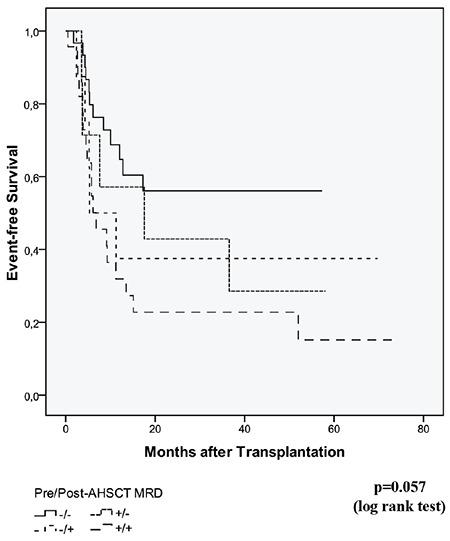
The median age of the patients was 46 (range: 18-71) years, and 41 (53.2%) were male while 36 (46.8%) were female. The median follow-up after AHSCT was 12.2 months (range: 0.2-73.0). The 2-year overall survival (OS) in the entire cohort was 37.0%, with a significant difference between patients who were MRD-negative and MRD-positive before AHSCT, estimated as 63.0% versus 16.0%, respectively (p=0.005). MRD positivity at +28 days after AHSCT was also associated with significantly inferior 2-year OS when compared to MRD negativity (p=0.03). The risk of relapse at 1 year was 2.4 times higher (95% confidence interval: 1.1-5.6; p=0.04) in the pre-AHSCT MRD-positive group when compared to the MRD-negative group regardless of other transplant-related factors, including pre-AHSCT disease status (i.e., complete remission 1 and 2). Event-free survival (EFS) was significantly shorter in patients who were pre-AHSCT MRD-positive (p=0.016). Post-AHSCT MRD positivity was also related to an increased relapse risk. OS and EFS were significantly inferior among MRD-positive patients at +28 days after AHSCT (p=0.03 and p=0.019).
CONCLUSION
Our results indicate the importance of MRD before and after AHSCT independently of other factors.
目的
急性髓系白血病(AML)患者的可测量残留疾病(MRD)评估的最佳时机尚未得到很好的定义。我们旨在研究移植前和移植后期间的 MRD 对预后参数的影响。
材料和方法
纳入了 77 例在完全形态学缓解后接受同种异体造血干细胞移植(AHSCT)的 AML 患者。通过 10 色 MFC 进行 MRD 分析,将 10 定义为阳性。根据移植前和移植后 MRD 阳性,评估复发风险和生存结果。
结果
患者的中位年龄为 46 岁(范围:18-71 岁),41 例(53.2%)为男性,36 例(46.8%)为女性。AHSCT 后中位随访时间为 12.2 个月(范围:0.2-73.0)。整个队列的 2 年总生存率(OS)为 37.0%,移植前 MRD 阴性和阳性患者之间存在显著差异,估计分别为 63.0%和 16.0%(p=0.005)。与 MRD 阴性相比,+28 天时的 MRD 阳性也与明显较差的 2 年 OS 相关(p=0.03)。与 MRD 阴性组相比,移植前 MRD 阳性组 1 年时的复发风险高 2.4 倍(95%置信区间:1.1-5.6;p=0.04),而其他与移植相关的因素(例如,完全缓解 1 和 2)。与 MRD 阴性患者相比,移植前 MRD 阳性患者的无事件生存(EFS)明显更短(p=0.016)。移植后 MRD 阳性也与复发风险增加相关。与 +28 天时的 MRD 阳性患者相比,OS 和 EFS 明显较差(p=0.03 和 p=0.019)。
结论
我们的结果表明,MRD 在移植前后的重要性独立于其他因素。


 Zotero 插件