
用于隐孢子虫研究的基于肠道类器官/肠小体的模型
Intestinal organoid/enteroid-based models for Cryptosporidium.
作者信息
Bhalchandra Seema, Lamisere Hymlaire, Ward Honorine
机构信息
Tufts Medical Center, Tufts University School of Medicine, Boston, MA, USA.
Tufts University Graduate School of Biomedical Sciences, Boston, MA, USA.
出版信息
Curr Opin Microbiol. 2020 Dec;58:124-129. doi: 10.1016/j.mib.2020.10.002. Epub 2020 Oct 25.
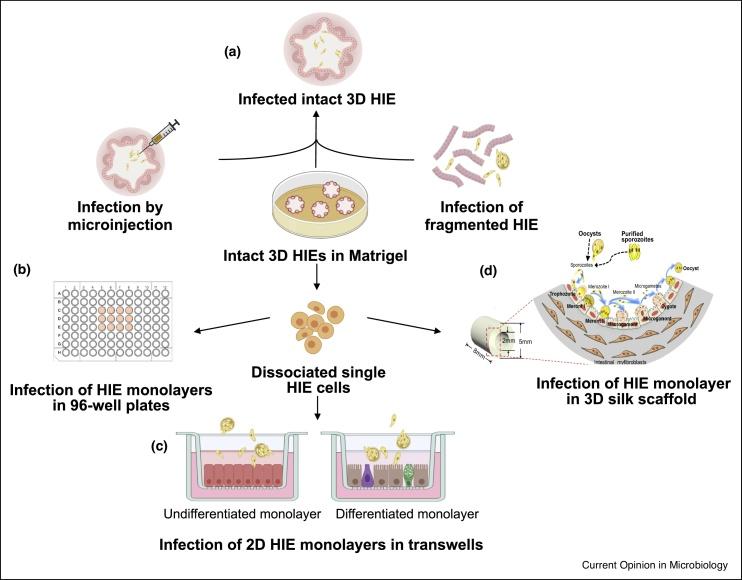
Cryptosporidium is a leading cause of diarrhea and death in young children and untreated AIDS patients in resource-poor settings, and of waterborne outbreaks of disease in developed countries. However, there is no consistently effective treatment for vulnerable populations. Progress towards development of therapeutics for cryptosporidiosis has been hampered by lack of optimal culture systems to study it. New advances in organoid/enteroid technology have contributed to improved platforms to culture and propagate Cryptosporidium. Here we discuss recent breakthroughs in the field and highlight different models for functional ex vivo organoid or enteroidderived culture systems. These systems will lead to a better understanding of the mechanisms of host-parasite interactions in vivo.
隐孢子虫是资源匮乏地区幼儿和未经治疗的艾滋病患者腹泻和死亡的主要原因,也是发达国家水源性疾病暴发的原因。然而,对于弱势群体并没有始终有效的治疗方法。由于缺乏用于研究隐孢子虫病的最佳培养系统,治疗隐孢子虫病的治疗方法开发进展受到阻碍。类器官/肠类器官技术的新进展有助于改进培养和繁殖隐孢子虫的平台。在这里,我们讨论该领域的最新突破,并重点介绍功能性离体类器官或肠类器官衍生培养系统的不同模型。这些系统将有助于更好地理解体内宿主-寄生虫相互作用的机制。
 Zotero 插件