
神经递质在 感染 中的保护作用。
The Role of Neurotransmitters in the Protection of for Infection by .
机构信息
Engineering Research Center of Health Food Design & Nutrition Regulation, School of Chemical Engineering and Energy Technology, Dongguan University of Technology, Dongguan, China.
Guelph Research and Development Center, Agriculture and Agri-Food Canada, Guelph, ON, Canada.
出版信息
Front Cell Infect Microbiol. 2020 Sep 29;10:554052. doi: 10.3389/fcimb.2020.554052. eCollection 2020.
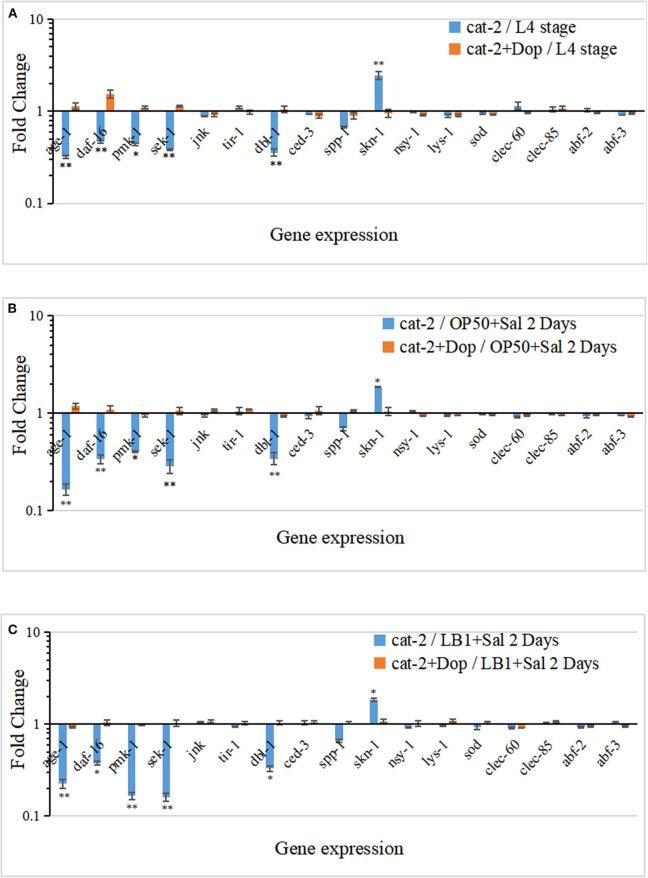
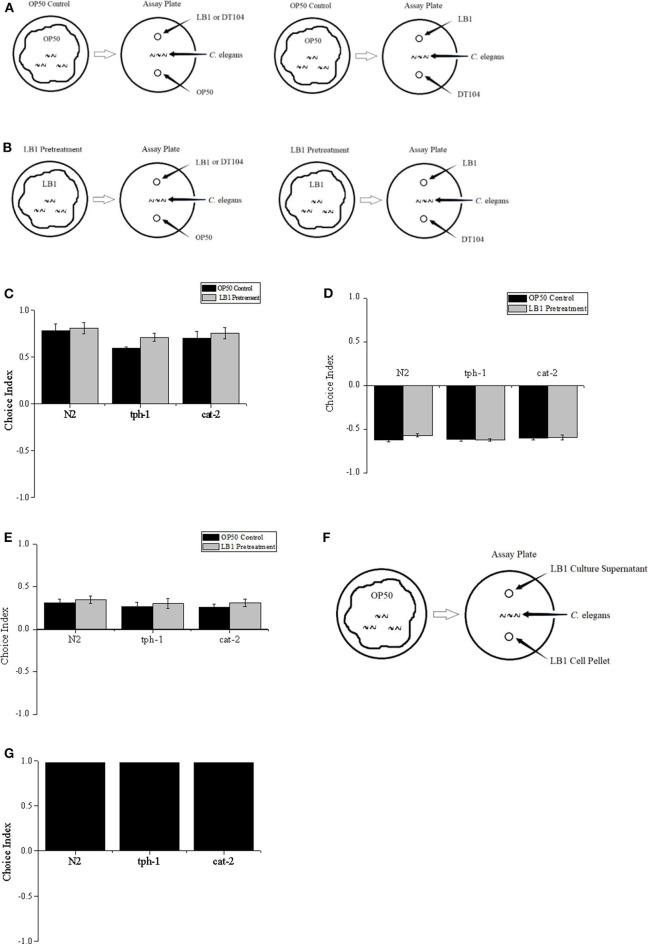
Salmonellosis is a common foodborne disease. We previously reported the protection of from Typhimurium DT104 infection by LB1. However, the mechanism is not fully understood. exhibits behavior plasticity when presented with diverse pathogenic or commensal bacteria. Whether it can exert approach avoidance to . Typhimurium through altering its neurological activity remains to be determined. In the current study, both the wild type and mutants defective in serotonin or dopamine production of were used to investigate olfactory preference of the nematode to LB1, DT104, and OP50 by choice assays, and its resistance to DT104 infection and the protection offered by LB1 using a life-span assay. The expression of target genes in was also examined by real-time quantitative PCR. Results showed that pre-exposure to LB1 did not elicit aversive olfactory behavior of the nematode toward DT104. Both mutants and succumbed faster than the wild type when infected with DT104. While pre-exposure to LB1 significantly increased the survival of both the wild type and mutant , it provided no protection to mutant . Supplementation of dopamine resulted in both the resistance of mutant to . Typhimurium infection and the protection from LB1 to the same mutant. Gene expression data also supported the observations in the life-span assay. These results suggest that both serotonin and dopamine play a positive role in the host defense of to . Typhimurium infection and that the LB1 protection is not dependent on modifying olfactory preference of the nematode but mediated by dopamine that may have involved the regulation of p38-mitogen-activated protein kinase and insulin/insulin-like growth factor signaling pathways.
肠炎沙门氏菌是一种常见的食源性疾病。我们之前报道了 LB1 对肠炎沙门氏菌 DT104 感染的保护作用。然而,其机制尚不完全清楚。当面临不同的病原体或共生菌时,会表现出行为可塑性。它是否可以通过改变其神经活动对肠炎沙门氏菌产生趋近回避反应仍有待确定。在本研究中,使用野生型和不能产生血清素或多巴胺的突变体来研究线虫对 LB1、DT104 和 OP50 的嗅觉偏好,通过选择试验,以及对线虫对 DT104 感染的抗性和 LB1 提供的保护作用进行寿命试验。还通过实时定量 PCR 检查了线虫中目标基因的表达。结果表明,LB1 的预先暴露不会引起线虫对 DT104 的厌恶嗅觉行为。当感染 DT104 时,突变体 和 比野生型更快地死亡。虽然 LB1 的预先暴露显著增加了野生型和突变体 的存活率,但它对突变体 没有保护作用。多巴胺的补充导致突变体 对肠炎沙门氏菌感染的抗性增加,并且 LB1 对同一突变体的保护作用。基因表达数据也支持寿命试验中的观察结果。这些结果表明,血清素和多巴胺都在宿主防御肠炎沙门氏菌感染中发挥积极作用,LB1 的保护作用不依赖于改变线虫的嗅觉偏好,而是通过多巴胺介导的,可能涉及 p38-丝裂原激活蛋白激酶和胰岛素/胰岛素样生长因子信号通路的调节。


 Zotero 插件