
基于迁移学习的胸部X光图像自动检测2019冠状病毒病(COVID-19)
Transfer Learning-Based Automatic Detection of Coronavirus Disease 2019 (COVID-19) from Chest X-ray Images.
作者信息
R Mohammadi, M Salehi, H Ghaffari, A A Rohani, R Reiazi
机构信息
MSc, Department of Medical Physics, School of Medicine, Iran University of Medical Sciences, Tehran, Iran.
MSc, Department of Medical Physics, Tehran University of Medical Sciences, Tehran, Iran.
出版信息
J Biomed Phys Eng. 2020 Oct 1;10(5):559-568. doi: 10.31661/jbpe.v0i0.2008-1153. eCollection 2020 Oct.
BACKGROUND
Coronavirus disease 2019 (COVID-19) is an emerging infectious disease and global health crisis. Although real-time reverse transcription polymerase chain reaction (RT-PCR) is known as the most widely laboratory method to detect the COVID-19 from respiratory specimens. It suffers from several main drawbacks such as time-consuming, high false-negative results, and limited availability. Therefore, the automatically detect of COVID-19 will be required.
OBJECTIVE
This study aimed to use an automated deep convolution neural network based pre-trained transfer models for detection of COVID-19 infection in chest X-rays.
MATERIAL AND METHODS
In a retrospective study, we have applied Visual Geometry Group (VGG)-16, VGG-19, MobileNet, and InceptionResNetV2 pre-trained models for detection COVID-19 infection from 348 chest X-ray images.
RESULTS
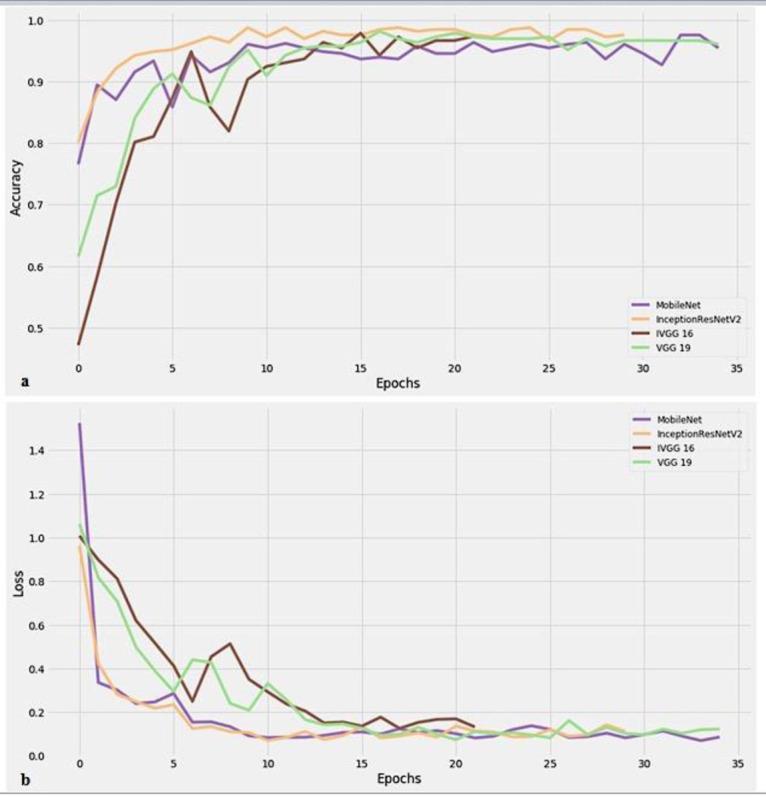
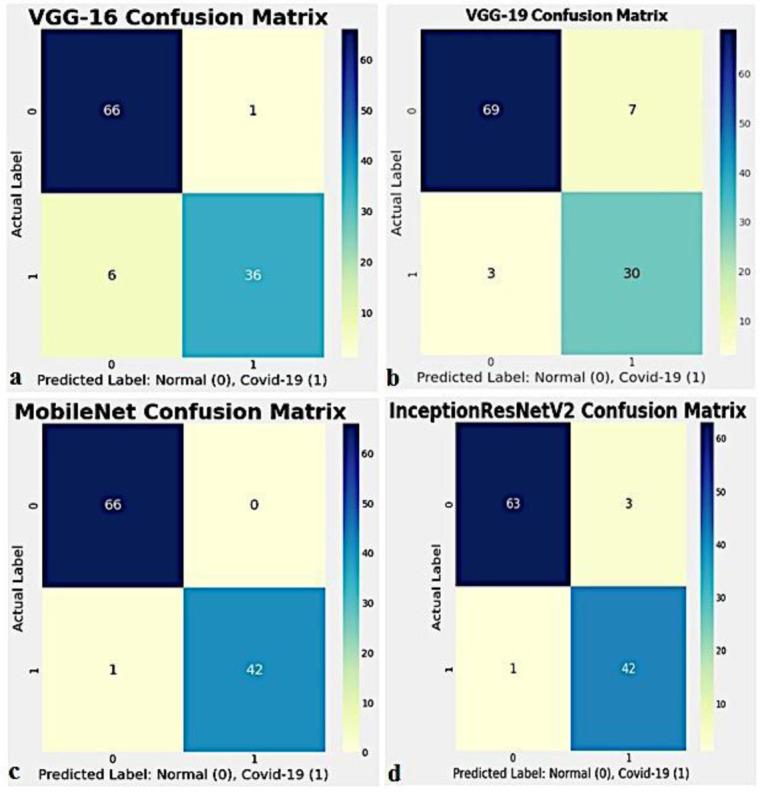
Our proposed models have been trained and tested on a dataset which previously prepared. The all proposed models provide accuracy greater than 90.0%. The pre-trained MobileNet model provides the highest classification performance of automated COVID-19 classification with 99.1% accuracy in comparison with other three proposed models. The plotted area under curve (AUC) of receiver operating characteristics (ROC) of VGG16, VGG19, MobileNet, and InceptionResNetV2 models are 0.92, 0.91, 0.99, and 0.97, respectively.
CONCLUSION
The all proposed models were able to perform binary classification with the accuracy more than 90.0% for COVID-19 diagnosis. Our data indicated that the MobileNet can be considered as a promising model to detect COVID-19 cases. In the future, by increasing the number of samples of COVID-19 chest X-rays to the training dataset, the accuracy and robustness of our proposed models increase further.
背景
2019冠状病毒病(COVID-19)是一种新出现的传染病和全球健康危机。虽然实时逆转录聚合酶链反应(RT-PCR)是从呼吸道标本中检测COVID-19最广泛使用的实验室方法,但它存在几个主要缺点,如耗时、假阴性结果高和可用性有限。因此,需要自动检测COVID-19。
目的
本研究旨在使用基于深度卷积神经网络的自动预训练迁移模型检测胸部X线片中的COVID-19感染。
材料和方法
在一项回顾性研究中,我们应用视觉几何组(VGG)-16、VGG-19、MobileNet和InceptionResNetV2预训练模型从348张胸部X线图像中检测COVID-19感染。
结果
我们提出的模型在先前准备好的数据集上进行了训练和测试。所有提出的模型准确率均高于90.0%。与其他三个提出的模型相比,预训练的MobileNet模型在自动COVID-19分类中提供了最高的分类性能,准确率为99.1%。VGG16、VGG19、MobileNet和InceptionResNetV2模型的受试者操作特征(ROC)曲线下面积(AUC)分别为0.92、0.91、0.99和0.97。
结论
所有提出的模型都能够对COVID-19诊断进行二元分类,准确率超过90.0%。我们的数据表明,MobileNet可被视为检测COVID-19病例的有前景的模型。未来,通过增加COVID-19胸部X线片样本数量到训练数据集中,我们提出的模型的准确性和鲁棒性将进一步提高。


 Zotero 插件