
雷帕霉素介导的小鼠寿命延长:具有性别特异性影响的晚年剂量方案。
Rapamycin-mediated mouse lifespan extension: Late-life dosage regimes with sex-specific effects.
机构信息
Geriatric Research, Education and Clinical Center and Research Service, South Texas Veterans Health Care System, San Antonio, TX, USA.
Department of Pharmacology, Barshop Institute for Longevity and Aging Studies at The University of Texas Health Science Center at San Antonio, San Antonio, TX, USA.
出版信息
Aging Cell. 2020 Nov;19(11):e13269. doi: 10.1111/acel.13269. Epub 2020 Nov 4.
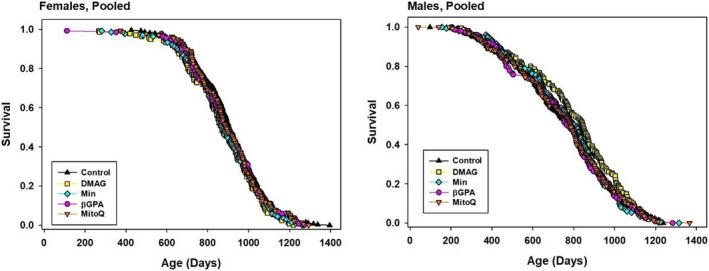
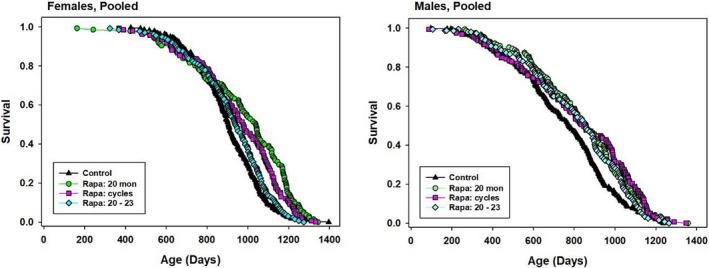
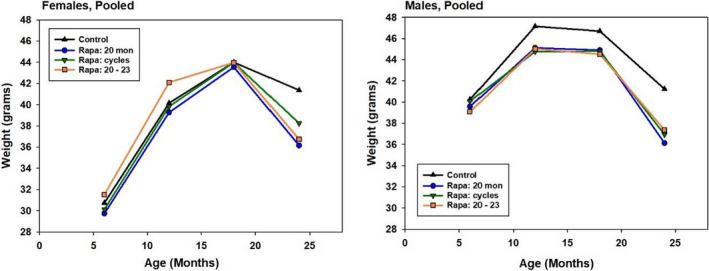
To see if variations in timing of rapamycin (Rapa), administered to middle aged mice starting at 20 months, would lead to different survival outcomes, we compared three dosing regimens. Initiation of Rapa at 42 ppm increased survival significantly in both male and female mice. Exposure to Rapa for a 3-month period led to significant longevity benefit in males only. Protocols in which each month of Rapa treatment was followed by a month without Rapa exposure were also effective in both sexes, though this approach was less effective than continuous exposure in female mice. Interpretation of these results is made more complicated by unanticipated variation in patterns of weight gain, prior to the initiation of the Rapa treatment, presumably due to the use of drug-free food from two different suppliers. The experimental design included tests of four other drugs, minocycline, β-guanidinopropionic acid, MitoQ, and 17-dimethylaminoethylamino-17-demethoxygeldanamycin (17-DMAG), but none of these led to a change in survival in either sex.
为了观察雷帕霉素(Rapa)在 20 个月大的中年老鼠中的给药时间变化是否会导致不同的生存结果,我们比较了三种给药方案。在 42ppm 时开始给予 Rapa 可显著提高雌雄小鼠的存活率。仅在雄性中,暴露于 Rapa 3 个月会导致显著的长寿获益。在每个月接受 Rapa 治疗后,再进行一个月无 Rapa 暴露的方案在两性中均有效,但这种方法在雌性小鼠中的效果不如连续暴露。由于使用了来自两个不同供应商的无药食物,在开始 Rapa 治疗之前,体重增加模式出现了意外变化,这使得对这些结果的解释变得更加复杂。实验设计包括对另外四种药物(米诺环素、β-胍基丙氨酸、MitoQ 和 17-二甲基氨基乙基氨基-17-去甲氧基格尔德霉素(17-DMAG))的测试,但这些药物都没有导致两性中生存情况的变化。
 Zotero 插件