
你肠道中的细菌会吞噬你的记忆吗?肠道微生物群与阿尔茨海默病之间的关系。
Do the Bugs in Your Gut Eat Your Memories? Relationship between Gut Microbiota and Alzheimer's Disease.
作者信息
Borsom Emily M, Lee Keehoon, Cope Emily K
机构信息
The Pathogen and Microbiome Institute, Center for Applied Microbiome Science, Northern Arizona University, Flagstaff, AZ 86011, USA.
出版信息
Brain Sci. 2020 Nov 3;10(11):814. doi: 10.3390/brainsci10110814.
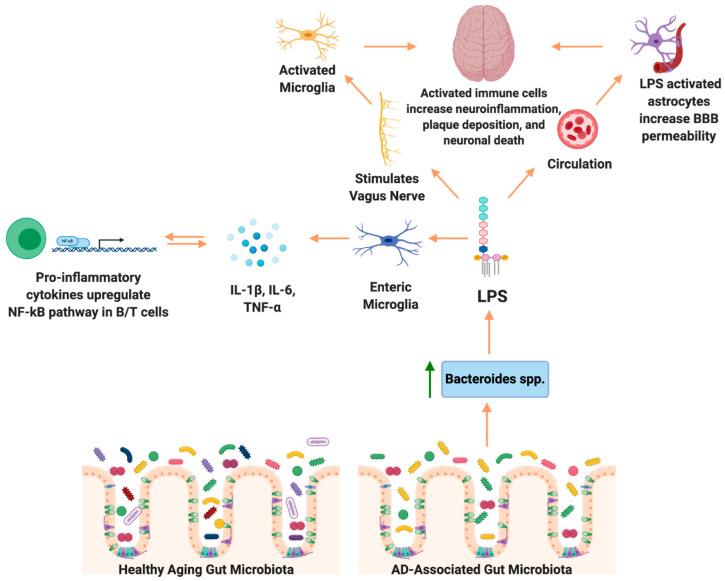
The human microbiota is composed of trillions of microbial cells inhabiting the oral cavity, skin, gastrointestinal (GI) tract, airways, and reproductive organs. The gut microbiota is composed of dynamic communities of microorganisms that communicate bidirectionally with the brain via cytokines, neurotransmitters, hormones, and secondary metabolites, known as the gut microbiota-brain axis. The gut microbiota-brain axis is suspected to be involved in the development of neurological diseases, including Alzheimer's disease (AD), Parkinson's disease, and Autism Spectrum Disorder. AD is an irreversible, neurodegenerative disease of the central nervous system (CNS), characterized by amyloid-β plaques, neurofibrillary tangles, and neuroinflammation. Microglia and astrocytes, the resident immune cells of the CNS, play an integral role in AD development, as neuroinflammation is a driving factor of disease severity. The gut microbiota-brain axis is a novel target for Alzheimer's disease therapeutics to modulate critical neuroimmune and metabolic pathways. Potential therapeutics include probiotics, prebiotics, fecal microbiota transplantation, and dietary intervention. This review summarizes our current understanding of the role of the gut microbiota-brain axis and neuroinflammation in the onset and development of Alzheimer's disease, limitations of current research, and potential for gut microbiota-brain axis targeted therapies.
人类微生物群由居住在口腔、皮肤、胃肠道、气道和生殖器官中的数万亿个微生物细胞组成。肠道微生物群由动态的微生物群落组成,这些群落通过细胞因子、神经递质、激素和次级代谢产物与大脑进行双向通信,这一过程被称为肠道微生物群-脑轴。肠道微生物群-脑轴被怀疑与包括阿尔茨海默病(AD)、帕金森病和自闭症谱系障碍在内的神经疾病的发展有关。AD是一种中枢神经系统(CNS)的不可逆神经退行性疾病,其特征是β-淀粉样蛋白斑块、神经原纤维缠结和神经炎症。小胶质细胞和星形胶质细胞是CNS的常驻免疫细胞,在AD的发展中起着不可或缺的作用,因为神经炎症是疾病严重程度的驱动因素。肠道微生物群-脑轴是阿尔茨海默病治疗中调节关键神经免疫和代谢途径的一个新靶点。潜在的治疗方法包括益生菌、益生元、粪便微生物群移植和饮食干预。这篇综述总结了我们目前对肠道微生物群-脑轴和神经炎症在阿尔茨海默病发病和发展中的作用的理解、当前研究的局限性以及肠道微生物群-脑轴靶向治疗的潜力。
 Zotero 插件