
分枝杆菌感染期间自噬、凋亡和坏死中的宿主-病原体对话
Host-Pathogen Dialogues in Autophagy, Apoptosis, and Necrosis during Mycobacterial Infection.
作者信息
Kim Jin Kyung, Silwal Prashanta, Jo Eun-Kyeong
机构信息
Department of Microbiology, Chungnam National University School of Medicine, Daejeon, Korea.
Infection Control Convergence Research Center, Chungnam National University School of Medicine, Daejeon, Korea.
出版信息
Immune Netw. 2020 Oct 23;20(5):e37. doi: 10.4110/in.2020.20.e37. eCollection 2020 Oct.
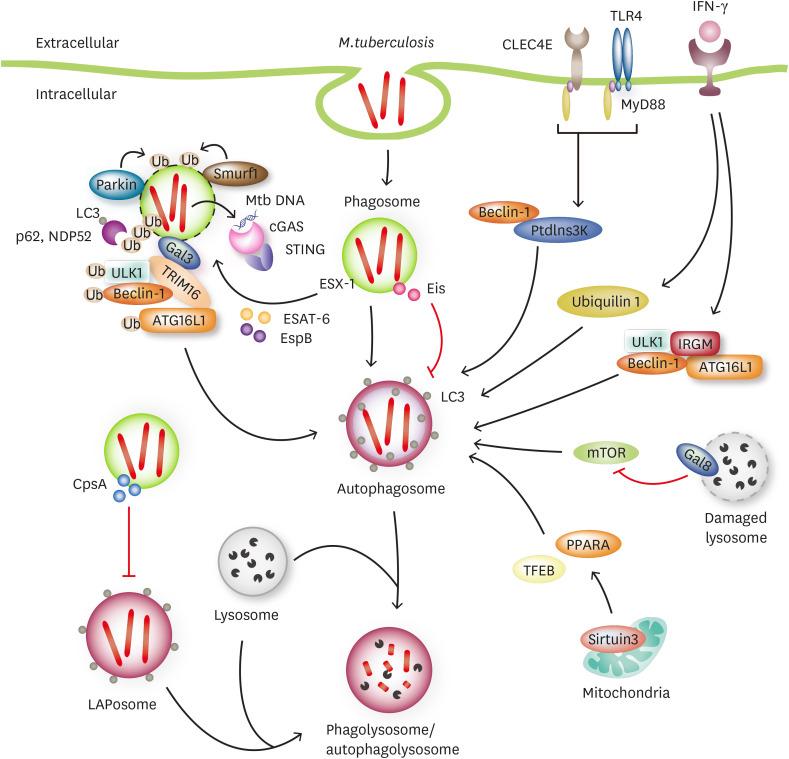
(Mtb) is an etiologic pathogen of human tuberculosis (TB), a serious infectious disease with high morbidity and mortality. In addition, the threat of drug resistance in anti-TB therapy is of global concern. Despite this, it remains urgent to research for understanding the molecular nature of dynamic interactions between host and pathogens during TB infection. While Mtb evasion from phagolysosomal acidification is a well-known virulence mechanism, the molecular events to promote intracellular parasitism remains elusive. To combat intracellular Mtb infection, several defensive processes, including autophagy and apoptosis, are activated. In addition, Mtb-ingested phagocytes trigger inflammation, and undergo necrotic cell death, potentially harmful responses in case of uncontrolled pathological condition. In this review, we focus on Mtb evasion from phagosomal acidification, and Mtb interaction with host autophagy, apoptosis, and necrosis. Elucidation of the molecular dialogue will shed light on Mtb pathogenesis, host defense, and development of new paradigms of therapeutics.
结核分枝杆菌(Mtb)是人类结核病(TB)的病原体,结核病是一种发病率和死亡率很高的严重传染病。此外,抗结核治疗中耐药性的威胁是全球关注的问题。尽管如此,研究了解结核病感染期间宿主与病原体之间动态相互作用的分子本质仍然迫在眉睫。虽然结核分枝杆菌逃避吞噬溶酶体酸化是一种众所周知的毒力机制,但促进细胞内寄生的分子事件仍然难以捉摸。为了对抗细胞内结核分枝杆菌感染,包括自噬和凋亡在内的几种防御过程被激活。此外,吞噬结核分枝杆菌的吞噬细胞会引发炎症,并经历坏死性细胞死亡,在病理状况失控的情况下,这些反应可能具有潜在危害。在这篇综述中,我们重点关注结核分枝杆菌逃避吞噬体酸化以及结核分枝杆菌与宿主自噬、凋亡和坏死的相互作用。对分子对话的阐明将有助于揭示结核分枝杆菌的发病机制、宿主防御以及新治疗模式的发展。
 Zotero 插件