
神经类型匹配而非自闭症,会影响自我及他人对人际亲密度的评价。
Neurotype-Matching, but Not Being Autistic, Influences Self and Observer Ratings of Interpersonal Rapport.
作者信息
Crompton Catherine J, Sharp Martha, Axbey Harriet, Fletcher-Watson Sue, Flynn Emma G, Ropar Danielle
机构信息
Patrick Wild Centre, Division of Psychiatry, Centre for Clinical Brain Sciences, University of Edinburgh, Edinburgh, United Kingdom.
School of Psychology, University of Nottingham, Nottingham, United Kingdom.
出版信息
Front Psychol. 2020 Oct 23;11:586171. doi: 10.3389/fpsyg.2020.586171. eCollection 2020.
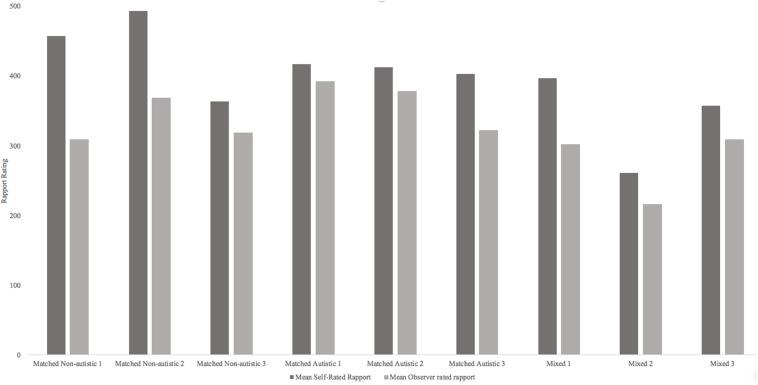
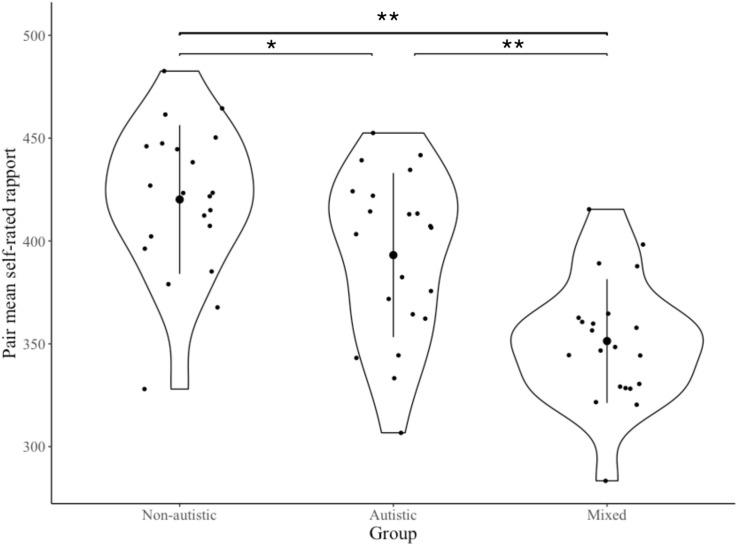
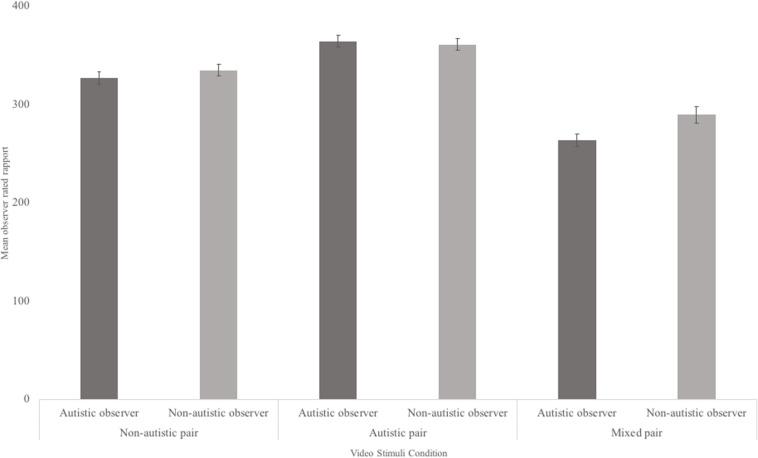
The Double Empathy Problem suggests that communicative difficulties between autistic and non-autistic people are due to bi-directional differences in communicative style and a reciprocal lack of understanding. If true, there should be increased similarity in interaction style, resulting in higher rapport during interactions between pairs of the same neurotype. Here, we provide two empirical tests of rapport, with data revealing whether self- and observer- rated rapport varies depending on the match or mismatch in autism status within a pair. An additional opportunity afforded by these data is to examine the effect of the autism status of the rater on the perceived rapport between matched and mismatched pairs. In Study 1 72 participants were allocated to one of three dyad conditions: autistic pairs ( = 24), non-autistic pairs ( = 24) and mixed pairs ( = 12 autistic; = 12 non-autistic). Each participant completed three semi-structured interactions with their partner, rating rapport after each interaction. Non-autistic pairs experienced higher self-rated rapport than mixed and autistic pairs, and autistic pairs experienced higher rapport than mixed pairs. In Study 2 ( = 80) autistic and non-autistic observers rated interactional rapport while watching videoed interactions between autistic pairs, non-autistic pairs, and mixed pairs ( = 18, a subset of participants in Study 1). Mixed pairs were rated significantly lower on rapport than autistic and non-autistic pairs, and autistic pairs were rated more highly for rapport than non-autistic pairs. Both autistic and non-autistic observers show similar patterns in how they rate the rapport of autistic, non-autistic, and mixed pairs. In summary, autistic people experience high interactional rapport when interacting with other autistic people, and this is also detected by external observers. Rather than autistic people experiencing low rapport in all contexts, their rapport ratings are influenced by a mismatch of diagnosis. These findings suggest that autistic people possess a distinct mode of social interaction style, rather than demonstrating social skills deficits. These data are considered in terms of their implications for psychological theories of autism, as well as practical impact on educational and clinical practice.
双重共情问题表明,自闭症患者与非自闭症患者之间的沟通困难是由于沟通方式的双向差异以及相互缺乏理解所致。如果这是真的,那么互动方式应该会有更大的相似性,从而在相同神经类型的两人互动中产生更高的融洽度。在此,我们提供了两项关于融洽度的实证测试,数据揭示了自我评定和观察者评定的融洽度是否会因两人中自闭症状态的匹配或不匹配而有所不同。这些数据提供的另一个机会是研究评定者的自闭症状态对匹配和不匹配两人之间感知到的融洽度的影响。在研究1中,72名参与者被分配到三种二元组条件之一:自闭症二元组(n = 24)、非自闭症二元组(n = 24)和混合二元组(12名自闭症患者;12名非自闭症患者)。每位参与者与他们的伙伴完成三次半结构化互动,并在每次互动后对融洽度进行评分。非自闭症二元组的自我评定融洽度高于混合二元组和自闭症二元组,而自闭症二元组的融洽度高于混合二元组。在研究2(n = 80)中,自闭症和非自闭症观察者在观看自闭症二元组、非自闭症二元组和混合二元组(n = 18,研究1中参与者的一个子集)之间的视频互动时,对互动融洽度进行评分。混合二元组在融洽度上的评分显著低于自闭症二元组和非自闭症二元组,而自闭症二元组在融洽度上的评分高于非自闭症二元组。自闭症和非自闭症观察者在对自闭症、非自闭症和混合二元组的融洽度评分方式上表现出相似的模式。总之,自闭症患者在与其他自闭症患者互动时体验到高度的互动融洽度,外部观察者也能察觉到这一点。自闭症患者并非在所有情境中都体验到低融洽度,他们的融洽度评分受到诊断不匹配的影响。这些发现表明,自闭症患者拥有独特的社交互动方式,而非表现出社交技能缺陷。我们从这些数据对自闭症心理学理论的影响以及对教育和临床实践的实际影响方面进行了考量。

 Zotero 插件