
意大利坎帕尼亚地区大流行期间儿童 SARS-CoV-2 感染管理和监测的医疗保健组织。
Health-care organization for the management and surveillance of SARS-CoV-2 infection in children during pandemic in Campania region, Italy.
机构信息
Department of Translational Medical Sciences - Paediatrics Section, University of Naples Federico II, via Pansini 5, 80134, Naples, Italy.
Department of Public Health, University of Naples Federico II, Naples, Italy.
出版信息
Ital J Pediatr. 2020 Nov 16;46(1):170. doi: 10.1186/s13052-020-00928-y.
BACKGROUND
In comparison with adults, severe acute respiratory syndrome coronavirus (SARS-CoV-2) infection in children has a milder course. The management of children with suspected or confirmed coronavirus disease (COVID-19) needs to be appropriately targeted.
METHODS
We designed a hub-and-spoke system to provide healthcare indications based on the use of telemedicine and stringent admission criteria, coordinate local stakeholders and disseminate information.
RESULT
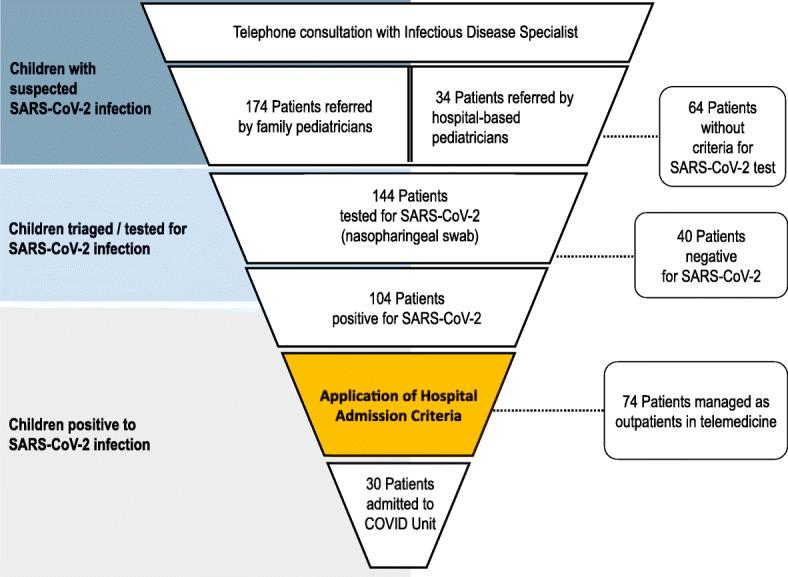
Between March 24th and September 24th 2020, the Hub Centre managed a total of 208 children (52% males, median age, 5.2, IQR 2-9.6 years) with suspected or confirmed COVID-19. Among them, 174 were managed in cooperation with family pediatricians and 34 with hospital-based physicians. One hundred-four (50%) received a final diagnosis of SARS-CoV-2 infection. Application of stringent criteria for hospital admission based on clinical conditions, risk factors and respect of biocontainment measures, allowed to manage the majority of cases (74, 71.1%) through telemedicine. Thirty children (28%) were hospitalized (median length 10 days, IQR 5-19 days), mainly due to the presence of persistent fever, mild respiratory distress or co-infection occurring in infant or children with underlying conditions. However, the reasons for admission slightly changed over time.
CONCLUSION
An hub-and-spoke system is effective in coordinate territorial health-care structures involved in management paediatric COVID-19 cases through telemedicine and the definition of stringent hospital admission criteria. The management of children with COVID-19 should be based on clinical conditions, assessed on a case-by-case critical evaluation, as well as on isolation measures, but may vary according to local epidemiological changes.
背景
与成人相比,儿童严重急性呼吸综合征冠状病毒(SARS-CoV-2)感染的病程较轻。需要对疑似或确诊冠状病毒病(COVID-19)的儿童进行适当的靶向管理。
方法
我们设计了一个中心辐射系统,根据使用远程医疗和严格的入院标准提供医疗建议,协调当地利益相关者并传播信息。
结果
2020 年 3 月 24 日至 9 月 24 日期间,中心管理了总共 208 名疑似或确诊 COVID-19 的儿童(52%为男性,中位年龄 5.2 岁,IQR 2-9.6 岁)。其中,174 名与家庭儿科医生合作管理,34 名与医院医生合作管理。104 名(50%)最终诊断为 SARS-CoV-2 感染。根据临床情况、危险因素和生物安全措施的尊重,对住院严格标准的应用,允许通过远程医疗管理大多数病例(74 例,71.1%)。30 名儿童(28%)住院(中位住院时间为 10 天,IQR 5-19 天),主要原因是持续发热、轻度呼吸窘迫或婴儿或合并症儿童的合并感染。然而,入院的原因随着时间的推移略有变化。
结论
一个中心辐射系统通过远程医疗和严格的入院标准有效地协调了参与管理儿科 COVID-19 病例的区域卫生保健结构。COVID-19 患儿的管理应基于临床情况,根据具体情况进行评估,同时进行隔离措施,但可能因当地流行病学变化而有所不同。

 Zotero 插件