
异基因造血干细胞移植后米哚妥林治疗 FLT3 内部串联重复阳性急性髓系白血病。
Midostaurin after allogeneic stem cell transplant in patients with FLT3-internal tandem duplication-positive acute myeloid leukemia.
机构信息
Oregon Health & Science University, Portland, OR, USA.
Sidney Kimmel Comprehensive Cancer Center at Johns Hopkins, Baltimore, MD, USA.
出版信息
Bone Marrow Transplant. 2021 May;56(5):1180-1189. doi: 10.1038/s41409-020-01153-1. Epub 2020 Dec 7.
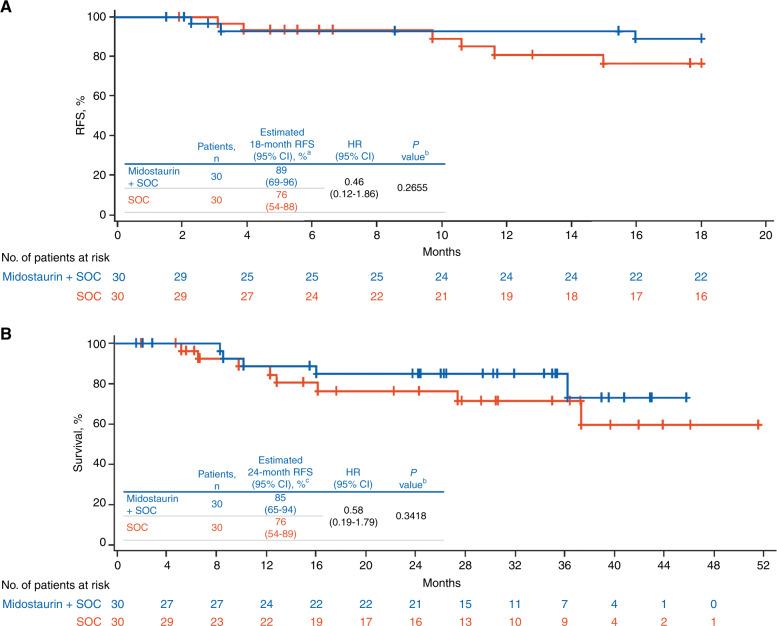
We evaluated standard-of-care (SOC) treatment with or without midostaurin to prevent relapse following allogeneic hematopoietic stem cell transplant (alloHSCT) in patients with acute myeloid leukemia (AML) harboring internal tandem duplication (ITD) in FLT3. Adults (aged 18-70 years) who received alloHSCT in first complete remission, had achieved hematologic recovery, and were transfusion independent were randomized to receive SOC with or without midostaurin (50 mg twice daily) continuously in twelve 4-week cycles. The primary endpoint was relapse-free survival (RFS) 18 months post-alloHSCT. Sixty patients were randomized (30/arm); 30 completed all 12 cycles (midostaurin + SOC, n = 16; SOC, n = 14). The estimated 18-month RFS (95% CI) was 89% (69-96%) in the midostaurin arm and 76% (54-88%) in the SOC arm (hazard ratio, 0.46 [95% CI, 0.12-1.86]; P = 0.27); estimated relapse rates were 11% and 24%, respectively. Inhibition of FLT3 phosphorylation to <70% of baseline (achieved by 50% of midostaurin-treated patients) was associated with improved RFS. The most common serious adverse events were diarrhea, nausea, and vomiting. Rates of graft-vs-host disease were similar between both arms (midostaurin + SOC, 70%; SOC, 73%). The addition of midostaurin maintenance therapy following alloHSCT may provide clinical benefit in some patients with FLT3-ITD AML. (ClinicalTrials.gov identifier: NCT01883362).
我们评估了标准治疗(SOC)联合或不联合米哚妥林用于治疗携带 FLT3 内部串联重复(ITD)的急性髓系白血病(AML)患者异基因造血干细胞移植(alloHSCT)后的复发。接受 alloHSCT 处于首次完全缓解、获得血液学恢复且无输血依赖的 18-70 岁成人患者,随机接受 SOC 联合或不联合米哚妥林(50mg,每日 2 次)连续 12 个 4 周周期治疗。主要终点是 alloHSCT 后 18 个月无复发生存(RFS)。60 例患者随机分组(每组 30 例);30 例患者完成了所有 12 个周期(米哚妥林+SOC 组 n=16;SOC 组 n=14)。米哚妥林组和 SOC 组的 18 个月 RFS(95%CI)分别为 89%(69-96%)和 76%(54-88%)(风险比,0.46[95%CI,0.12-1.86];P=0.27);估计的复发率分别为 11%和 24%。FLT3 磷酸化抑制至基线的<70%(米哚妥林治疗患者中有 50%达到)与 RFS 改善相关。最常见的严重不良事件是腹泻、恶心和呕吐。两组的移植物抗宿主病发生率相似(米哚妥林+SOC 组 70%;SOC 组 73%)。alloHSCT 后加用米哚妥林维持治疗可能为部分携带 FLT3-ITD AML 的患者带来临床获益。(临床试验注册编号:NCT01883362)。


 Zotero 插件