
通过全层析显微镜对无标记氧化铁纳米颗粒进行细胞内定量和定位
Intracellular Quantification and Localization of Label-Free Iron Oxide Nanoparticles by Holotomographic Microscopy.
作者信息
Friedrich Ralf P, Schreiber Eveline, Tietze Rainer, Yang Hai, Pilarsky Christian, Alexiou Christoph
机构信息
Department of Otorhinolaryngology, Head and Neck Surgery, Section of Experimental Oncology and Nanomedicine (SEON), Else Kröner-Fresenius-Stiftung-Professorship, Universitätsklinikum Erlangen, Erlangen, 91054, Germany.
Department of Surgery, Universitätsklinikum Erlangen, Erlangen 91054, Germany.
出版信息
Nanotechnol Sci Appl. 2020 Dec 9;13:119-130. doi: 10.2147/NSA.S282204. eCollection 2020.
BACKGROUND
The limitations of optical microscopy to determine the cellular localization of label-free nanoparticles prevent a solid prediction of the cellular effect of particles intended for medical applications. To avoid the strong physicochemical changes associated with fluorescent labelling, which often result in differences in cellular uptake, efficiency and toxicity of particles, novel detection techniques are required.
METHODS
In the present study, we determined the intracellular content of unlabeled SPIONs by analyzing refractive index (RI)-based images from holotomographic three-dimensional (3D) microscopy and side scatter data measured by flow cytometry. The results were compared with the actual cellular SPION amount as quantified by atomic emission spectroscopy (AES).
RESULTS
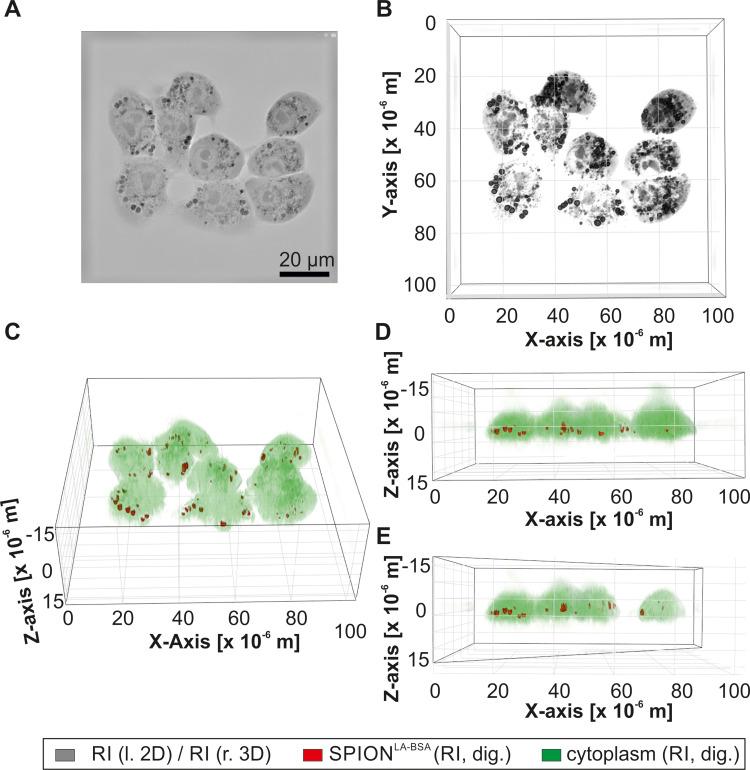
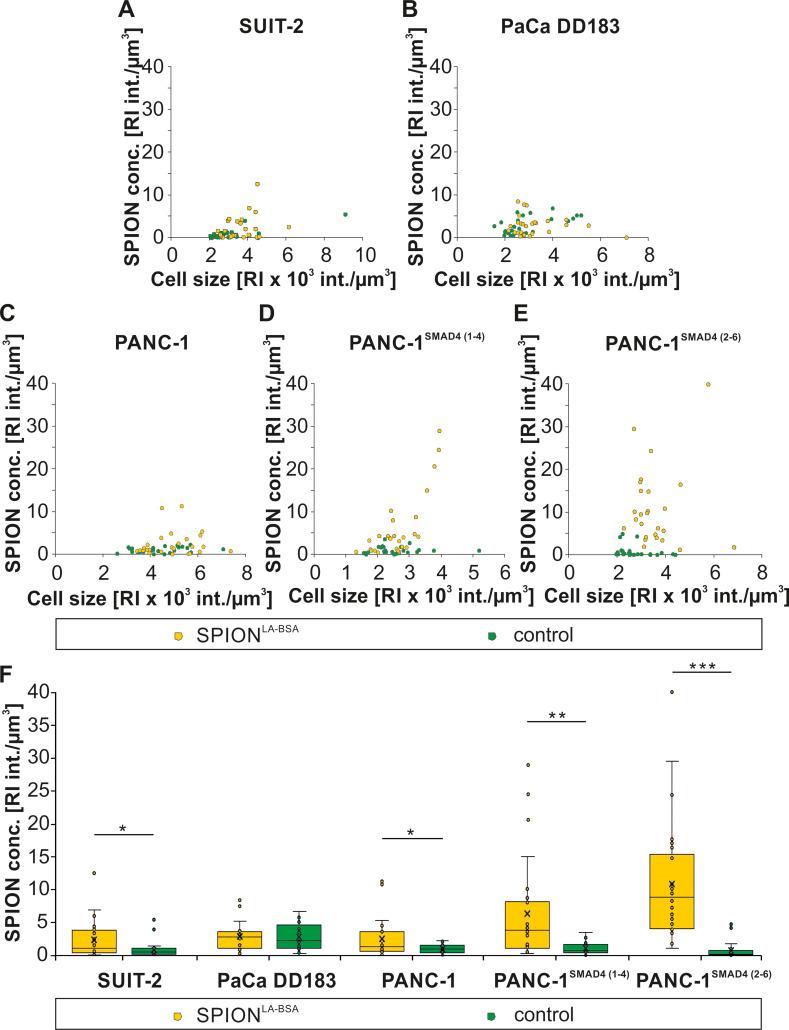
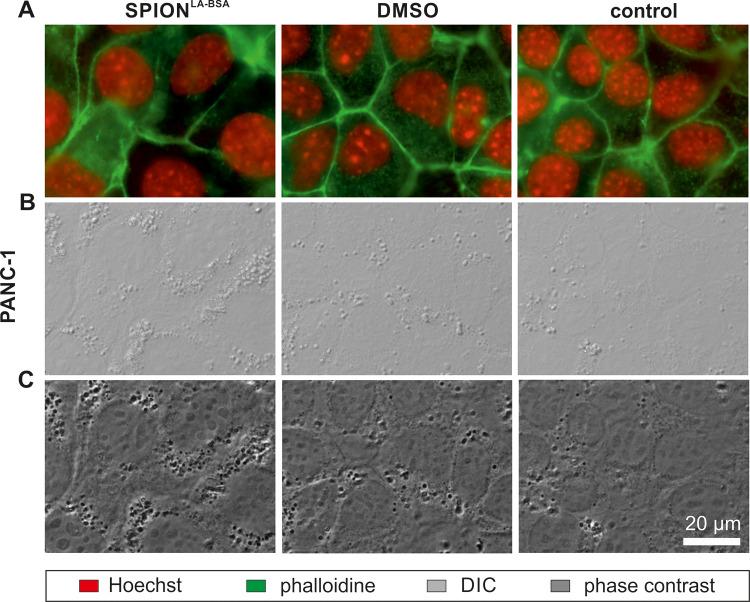
Live cell imaging by 3D holotomographic microscopy demonstrated cell-specific differences in intracellular nanoparticle uptake in different pancreatic cell lines. Thus, treatment of PANC-1 and PANC-1 with SPIONs resulted in a significant increase in number of areas with higher RI, whereas in PANC-1, SUIT-2 and PaCa DD183, only a minimal increase of spots with high RI was observed. The increase in areas with high RI was in accordance with the SPION content determined by quantitative iron measurements using AES. In contrast, determination of the SPION amount by flow cytometry was strongly cell type-dependent and did not allow the discrimination between intracellular and membrane-bound SPIONs. However, flow cytometry is a very rapid and reliable method to assess the cellular toxicity and allows an estimation of the cell-associated SPION content.
CONCLUSION
Holotomographic 3D microscopy is a useful method to distinguish between intracellular and membrane-associated particles. Thus, it provides a valuable tool for scientists to evaluate the cellular localization and the particle load, which facilitates prediction of potential toxicity and efficiency of nanoparticles for medical applications.
背景
光学显微镜在确定无标记纳米颗粒的细胞定位方面存在局限性,这使得难以对用于医学应用的颗粒的细胞效应进行可靠预测。为避免与荧光标记相关的强烈物理化学变化(这种变化常常导致颗粒的细胞摄取、效率和毒性出现差异),需要新的检测技术。
方法
在本研究中,我们通过分析来自全层析三维(3D)显微镜的基于折射率(RI)的图像以及流式细胞术测量的侧向散射数据,来确定未标记超顺磁性氧化铁纳米颗粒(SPIONs)的细胞内含量。将结果与通过原子发射光谱法(AES)定量的实际细胞SPION量进行比较。
结果
通过3D全层析显微镜进行的活细胞成像显示,不同胰腺细胞系在细胞内纳米颗粒摄取方面存在细胞特异性差异。因此,用SPIONs处理PANC - 1细胞导致RI较高区域数量显著增加,而在PANC - 1、SUIT - 2和PaCa DD183细胞中,仅观察到高RI斑点有最小程度的增加。高RI区域的增加与使用AES通过定量铁测量确定的SPION含量一致。相比之下,通过流式细胞术测定SPION量强烈依赖于细胞类型,并且无法区分细胞内和膜结合的SPIONs。然而,流式细胞术是评估细胞毒性的非常快速且可靠的方法,并且能够估计与细胞相关的SPION含量。
结论
全层析3D显微镜是区分细胞内颗粒和膜相关颗粒的有用方法。因此,它为科学家评估细胞定位和颗粒负载提供了有价值的工具,这有助于预测纳米颗粒在医学应用中的潜在毒性和效率。



 Zotero 插件