
七款消费级睡眠追踪设备与多导睡眠图的性能比较。
Performance of seven consumer sleep-tracking devices compared with polysomnography.
机构信息
Sleep, Tactical Efficiency, and Endurance Laboratory, Warfighter Performance Department, Naval Health Research Center, San Diego, CA.
Leidos, Inc., San Diego, CA.
出版信息
Sleep. 2021 May 14;44(5). doi: 10.1093/sleep/zsaa291.
STUDY OBJECTIVES
Consumer sleep-tracking devices are widely used and becoming more technologically advanced, creating strong interest from researchers and clinicians for their possible use as alternatives to standard actigraphy. We, therefore, tested the performance of many of the latest consumer sleep-tracking devices, alongside actigraphy, versus the gold-standard sleep assessment technique, polysomnography (PSG).
METHODS
In total, 34 healthy young adults (22 women; 28.1 ± 3.9 years, mean ± SD) were tested on three consecutive nights (including a disrupted sleep condition) in a sleep laboratory with PSG, along with actigraphy (Philips Respironics Actiwatch 2) and a subset of consumer sleep-tracking devices. Altogether, four wearable (Fatigue Science Readiband, Fitbit Alta HR, Garmin Fenix 5S, Garmin Vivosmart 3) and three nonwearable (EarlySense Live, ResMed S+, SleepScore Max) devices were tested. Sleep/wake summary and epoch-by-epoch agreement measures were compared with PSG.
RESULTS
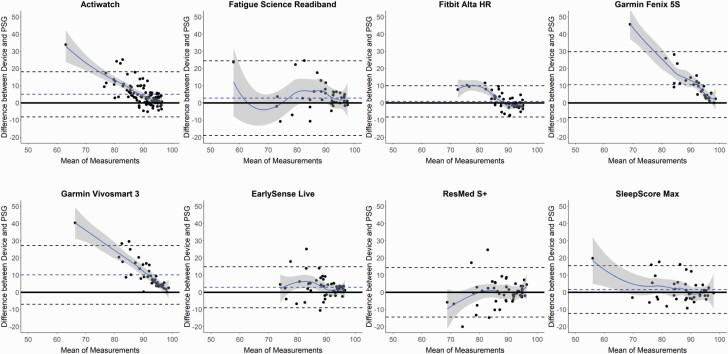
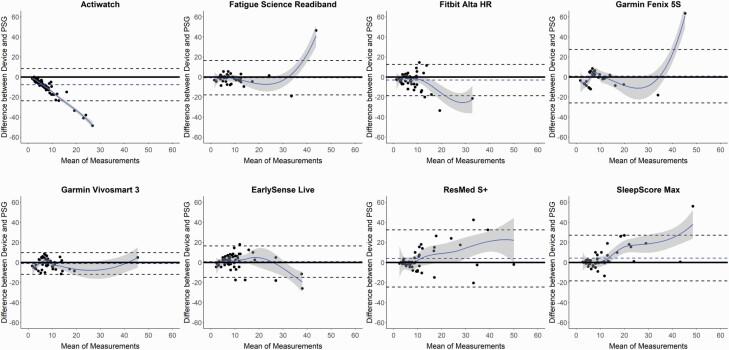
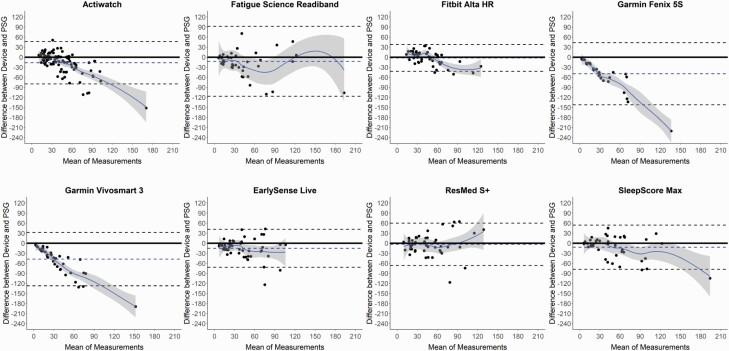
Most devices (Fatigue Science Readiband, Fitbit Alta HR, EarlySense Live, ResMed S+, SleepScore Max) performed as well as or better than actigraphy on sleep/wake performance measures, while the Garmin devices performed worse. Overall, epoch-by-epoch sensitivity was high (all ≥0.93), specificity was low-to-medium (0.18-0.54), sleep stage comparisons were mixed, and devices tended to perform worse on nights with poorer/disrupted sleep.
CONCLUSIONS
Consumer sleep-tracking devices exhibited high performance in detecting sleep, and most performed equivalent to (or better than) actigraphy in detecting wake. Device sleep stage assessments were inconsistent. Findings indicate that many newer sleep-tracking devices demonstrate promising performance for tracking sleep and wake. Devices should be tested in different populations and settings to further examine their wider validity and utility.
研究目的
消费者睡眠追踪设备的应用越来越广泛,技术也越来越先进,这引起了研究人员和临床医生的浓厚兴趣,他们希望这些设备可以替代标准的活动记录仪。因此,我们测试了许多最新的消费者睡眠追踪设备与活动记录仪(飞利浦 Respironics Actiwatch 2)以及金标准睡眠评估技术——多导睡眠图(PSG)的性能。
方法
共有 34 名健康的年轻成年人(22 名女性;28.1±3.9 岁,平均值±标准差)在睡眠实验室中连续三晚(包括睡眠中断条件)接受 PSG、活动记录仪(飞利浦 Respironics Actiwatch 2)和一部分消费者睡眠追踪设备的测试。共有 4 种可穿戴设备(疲劳科学 Readiband、Fitbit Alta HR、佳明 Fenix 5S、佳明 Vivosmart 3)和 3 种非穿戴设备(EarlySense Live、ResMed S+、SleepScore Max)进行了测试。睡眠/觉醒总结和逐时逐刻的一致性测量结果与 PSG 进行了比较。
结果
大多数设备(疲劳科学 Readiband、Fitbit Alta HR、EarlySense Live、ResMed S+、SleepScore Max)在睡眠/觉醒表现测量方面的性能与活动记录仪相当或更好,而佳明设备的表现则较差。总体而言,逐时逐刻的敏感性较高(均≥0.93),特异性较低至中等(0.18-0.54),睡眠分期比较混合,设备在睡眠质量较差/中断的夜晚表现较差。
结论
消费者睡眠追踪设备在检测睡眠方面表现出色,大多数设备在检测觉醒方面与活动记录仪相当或更好。设备的睡眠分期评估结果不一致。研究结果表明,许多较新的睡眠追踪设备在跟踪睡眠和觉醒方面表现出良好的性能。应该在不同人群和环境中对这些设备进行测试,以进一步研究它们更广泛的有效性和实用性。




 Zotero 插件