
COVID-19 疫情对肿瘤学的中远期影响预期。
Expected Medium- and Long-Term Impact of the COVID-19 Outbreak in Oncology.
机构信息
Medical Oncology Department, CHU Sart Tilman Liege and Laboratory of Human Genetics, GIGA Research Institute, University of Liège, Liège, Belgium.
Oncology Department, University of Genova and IRCCS Ospedale Policlinico San Martino, Genova, Italy.
出版信息
JCO Glob Oncol. 2021 Feb;7:162-172. doi: 10.1200/GO.20.00589.
PURPOSE
The COVID-19 pandemic has affected healthcare systems globally, leading to reorganization of medical activities. We performed an international survey aimed to investigate the medium- and long-term impact on oncology units.
MATERIALS AND METHODS
An 82-item survey was distributed from June 17 to July 14, 2020 among medical oncologists worldwide.
RESULTS
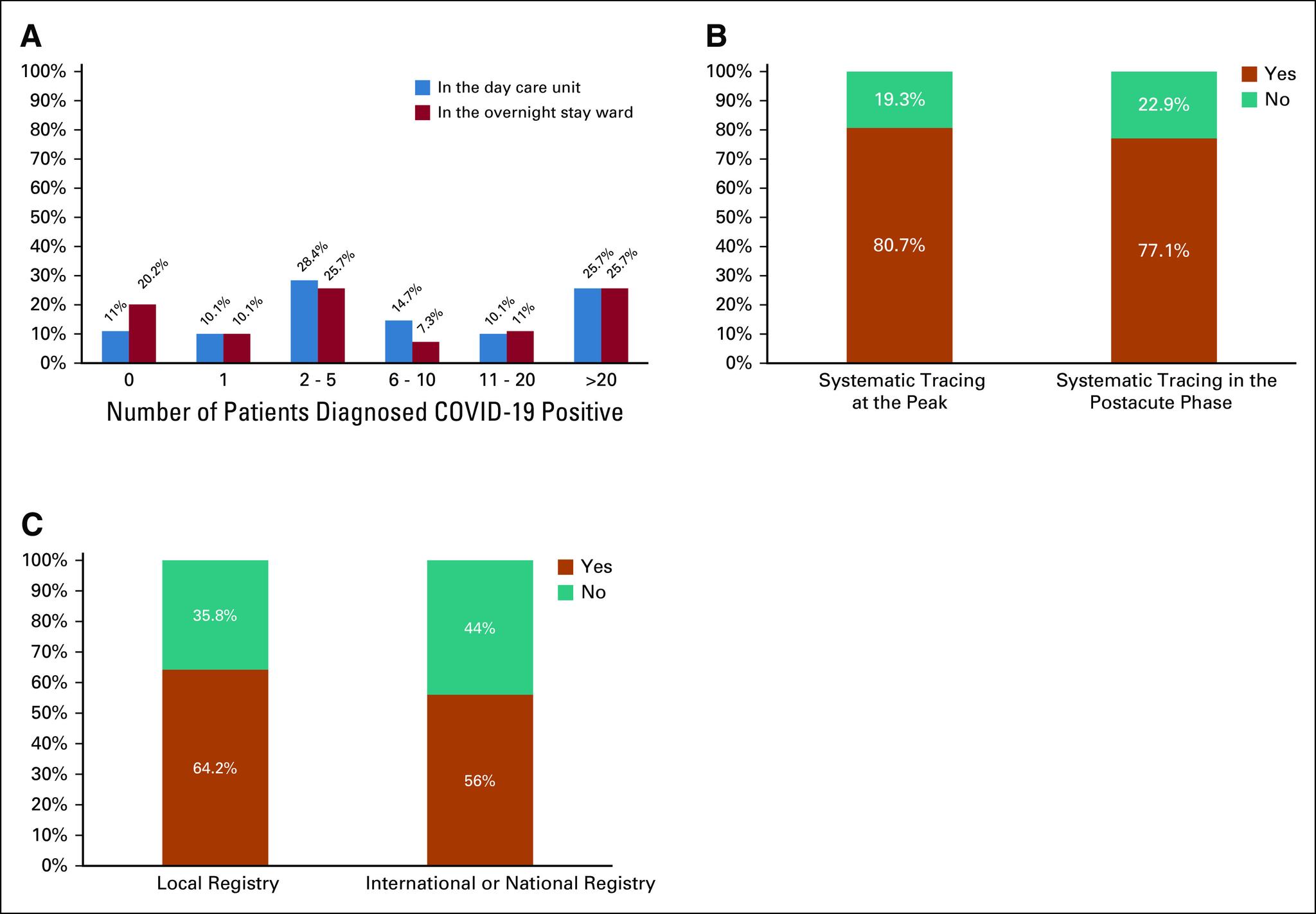
One hundred nine medical oncologists from 18 countries in Europe (n = 93), United States (n = 5), and Latin America (n = 11) answered the survey. A systematic tracing of COVID-19-positive patients was continued in the postacute phase by 77.1% of the centers; 64.2% of the respondents participated in a local registry and 56% in international or national registries of infected patients. Treatment adaptations were introduced, and surgery was the most affected modality being delayed or canceled in more than 10% of patients in 34% of the centers, whereas early cessation of palliative treatment was reported in 32.1% of the centers; 64.2% of respondents reported paying attention to avoid undertreatments. The use of telemedicine has been largely increased. Similarly, virtual tools are increasingly used particularly for medical education and international or national or multidisciplinary meetings. 60.6% of the participants reduced clinical activity, and 28.4% compensated by increasing their research activity. Significant reduction of clinical trial activities is expected in 37% of centers this year. The well-being of healthcare staff would not recover by the end of the year according to 18% of the participants.
CONCLUSION
The COVID-19 outbreak has had a major impact on oncologic activity, which will persist in the future, irrespective of geographical areas.
目的
COVID-19 大流行已对全球医疗系统造成影响,导致医疗活动重新组织。我们进行了一项国际调查,旨在研究其对肿瘤学单位的中、长期影响。
材料和方法
2020 年 6 月 17 日至 7 月 14 日,我们向全球范围内的肿瘤内科医生分发了一份 82 项的调查问卷。
结果
来自欧洲 18 个国家(n = 93)、美国(n = 5)和拉丁美洲(n = 11)的 109 名肿瘤内科医生回答了调查。77.1%的中心在急性期后继续对 COVID-19 阳性患者进行系统追踪;64.2%的受访者参与了当地登记,56%的受访者参与了感染患者的国际或国家登记。治疗方案进行了调整,手术是受影响最大的治疗方式,34%的中心中有超过 10%的患者的手术被延迟或取消,而 32.1%的中心报告停止了姑息治疗;64.2%的受访者报告注意避免治疗不足。远程医疗的使用大大增加。同样,虚拟工具越来越多地被用于医疗教育以及国际、国家或多学科会议。60.6%的参与者减少了临床活动,28.4%的参与者通过增加研究活动来弥补。预计今年 37%的中心临床试验活动将大幅减少。根据 18%的参与者的说法,医护人员的健康状况到今年年底都不会恢复。
结论
COVID-19 爆发对肿瘤学活动产生了重大影响,无论地理位置如何,这种影响将在未来持续存在。



 Zotero 插件