
SARS-CoV-2 的 D614G 刺突突变提高了与 ACE2 的结合亲和力,从而增加了进入效率。
SARS-CoV-2 D614G spike mutation increases entry efficiency with enhanced ACE2-binding affinity.
机构信息
Department of Pathology, National Institute of Infectious Diseases, Tokyo, Japan.
Faculty of Life and Environmental Sciences, University of Yamanashi, Yamanashi, Japan.
出版信息
Nat Commun. 2021 Feb 8;12(1):848. doi: 10.1038/s41467-021-21118-2.
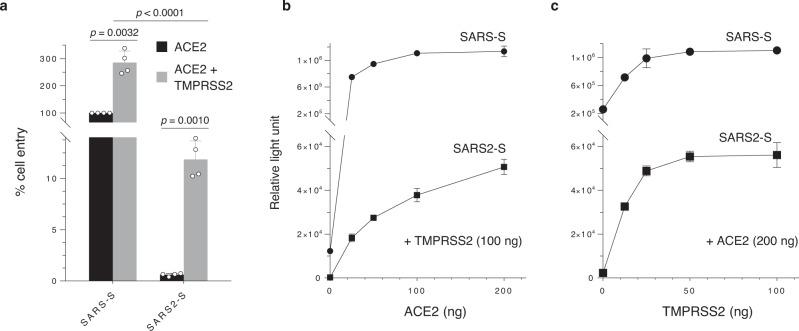
The causative agent of the COVID-19 pandemic, SARS-CoV-2, is steadily mutating during continuous transmission among humans. Such mutations can occur in the spike (S) protein that binds to the ACE2 receptor and is cleaved by TMPRSS2. However, whether S mutations affect SARS-CoV-2 cell entry remains unknown. Here, we show that naturally occurring S mutations can reduce or enhance cell entry via ACE2 and TMPRSS2. A SARS-CoV-2 S-pseudotyped lentivirus exhibits substantially lower entry than that of SARS-CoV S. Among S variants, the D614G mutant shows the highest cell entry, as supported by structural and binding analyses. Nevertheless, the D614G mutation does not affect neutralization by antisera against prototypic viruses. Taken together, we conclude that the D614G mutation increases cell entry by acquiring higher affinity to ACE2 while maintaining neutralization susceptibility. Based on these findings, further worldwide surveillance is required to understand SARS-CoV-2 transmissibility among humans.
导致 COVID-19 大流行的病原体 SARS-CoV-2 在人与人之间持续传播过程中不断发生突变。这种突变可能发生在与 ACE2 受体结合并被 TMPRSS2 切割的刺突(S)蛋白上。然而,S 突变是否会影响 SARS-CoV-2 细胞进入仍不清楚。在这里,我们表明天然存在的 S 突变可以通过 ACE2 和 TMPRSS2 降低或增强细胞进入。SARS-CoV-2 S 假型慢病毒的进入明显低于 SARS-CoV S。在 S 变体中,D614G 突变体表现出最高的细胞进入,这得到了结构和结合分析的支持。然而,D614G 突变不影响针对原型病毒的抗血清的中和作用。综上所述,我们得出结论,D614G 突变通过获得与 ACE2 更高的亲和力而增加细胞进入,同时保持中和敏感性。基于这些发现,需要进一步进行全球监测,以了解 SARS-CoV-2 在人与人之间的传播能力。



 Zotero 插件