
一种新型的、无需测序的方法,用于功能表征猪带绦虫蛋白质组指纹图谱。
A novel, sequencing-free strategy for the functional characterization of Taenia solium proteomic fingerprint.
机构信息
Unidad Periférica de Neuroinflamación para el estudio de patologías neurológicas del Instituto de Investigaciones Biomédicas en el Instituto Nacional de Neurología y Neurocirugía, México, México.
Departamento de Inmunología, Instituto de Investigaciones Biomédicas, Universidad Nacional Autónoma de México, México, México.
出版信息
PLoS Negl Trop Dis. 2021 Feb 18;15(2):e0009104. doi: 10.1371/journal.pntd.0009104. eCollection 2021 Feb.
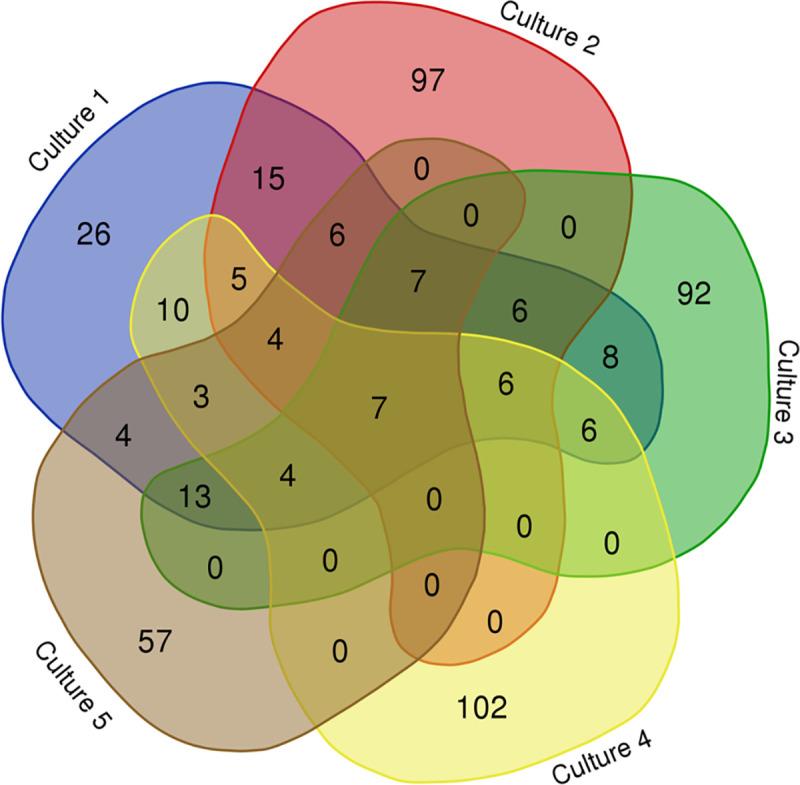
The flatworm Taenia solium causes human and pig cysticercosis. When cysticerci are established in the human central nervous system, they cause neurocysticercosis, a potentially fatal disease. Neurocysticercosis is a persisting public health problem in rural regions of Mexico and other developing countries of Latin America, Asia, and Africa, where the infection is endemic. The great variability observed in the phenotypic and genotypic traits of cysticerci result in a great heterogeneity in the patterns of molecules secreted by them within their host. This work is aimed to identify and characterize cysticercal secretion proteins of T. solium cysticerci obtained from 5 naturally infected pigs from Guerrero, Mexico, using 2D-PAGE proteomic analysis. The isoelectric point (IP) and molecular weight (MW) of the spots were identified using the software ImageMaster 2D Platinum v.7.0. Since most secreted proteins are impossible to identify by mass spectrometry (MS) due to their low concentration in the sample, a novel strategy to predict their sequence was applied. In total, 108 conserved and 186 differential proteins were identified in five cysticercus cultures. Interestingly, we predicted the sequence of 14 proteins that were common in four out of five cysticercus cultures, which could be used to design vaccines or diagnostic methods for neurocysticercosis. A functional characterization of all sequences was performed using the algorithms SecretomeP, SignalP, and BlastKOALA. We found a possible link between signal transduction pathways in parasite cells and human cancer due to deregulation in signal transduction pathways. Bioinformatics analysis also demonstrated that the parasite release proteins by an exosome-like mechanism, which could be of biological interest.
猪带绦虫 Taenia solium 引起人和猪的囊尾蚴病。当囊尾蚴在人体中枢神经系统中定植时,它们会引起囊虫病,这是一种潜在致命的疾病。囊虫病是墨西哥农村地区和其他拉丁美洲、亚洲和非洲发展中国家持续存在的公共卫生问题,这些地区是该感染的流行区。囊尾蚴在表型和基因型特征上的巨大可变性导致它们在宿主内分泌的分子模式存在很大的异质性。本工作旨在使用 2D-PAGE 蛋白质组分析,从来自墨西哥格雷罗州的 5 头自然感染猪中鉴定和表征猪带绦虫囊尾蚴的分泌蛋白。使用 ImageMaster 2D Platinum v.7.0 软件确定斑点的等电点(IP)和分子量(MW)。由于大多数分泌蛋白由于其在样品中的浓度低而无法通过质谱(MS)进行鉴定,因此应用了一种预测其序列的新策略。在五个囊尾蚴培养物中总共鉴定出 108 个保守蛋白和 186 个差异蛋白。有趣的是,我们预测了 14 种在四个囊尾蚴培养物中共同存在的蛋白的序列,这些蛋白可用于设计囊虫病疫苗或诊断方法。使用 SecretomeP、SignalP 和 BlastKOALA 算法对所有序列进行了功能表征。由于信号转导途径的失调,我们发现寄生虫细胞中的信号转导途径与人类癌症之间可能存在联系。生物信息学分析还表明,寄生虫通过类似于外泌体的机制释放蛋白,这可能具有生物学意义。




 Zotero 插件