
肠道细菌 Dysgonomonas mossii 的多聚糖利用基因座编码具有不同功能的碳水化合物酯酶。
A polysaccharide utilization locus from the gut bacterium Dysgonomonas mossii encodes functionally distinct carbohydrate esterases.
机构信息
Division of Industrial Biotechnology, Department of Biology and Biological Engineering, Chalmers University of Technology, Gothenburg, Sweden.
Division of Glycoscience, Department of Chemistry, Royal Institute of Technology (KTH), AlbaNova University Centre, Stockholm, Sweden; Wallenberg Wood Science Center, Stockholm, Sweden.
出版信息
J Biol Chem. 2021 Jan-Jun;296:100500. doi: 10.1016/j.jbc.2021.100500. Epub 2021 Mar 2.
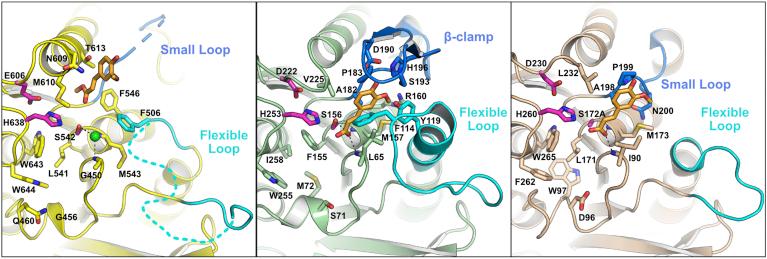
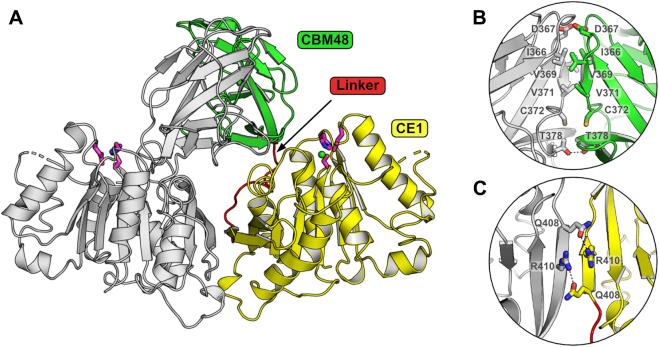
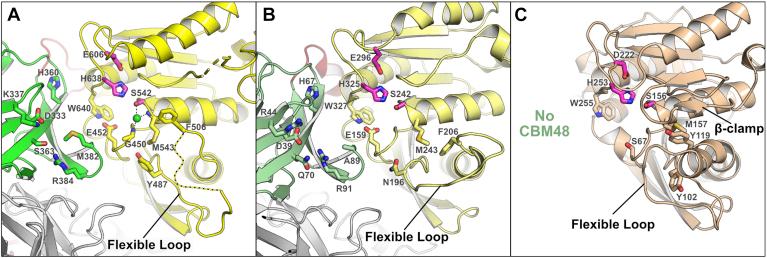
The gut microbiota plays a central role in human health by enzymatically degrading dietary fiber and concomitantly excreting short chain fatty acids that are associated with manifold health benefits. The polysaccharide xylan is abundant in dietary fiber but noncarbohydrate decorations hinder efficient cleavage by glycoside hydrolases (GHs) and need to be addressed by carbohydrate esterases (CEs). Enzymes from carbohydrate esterase families 1 and 6 (CE1 and 6) perform key roles in xylan degradation by removing feruloyl and acetate decorations, yet little is known about these enzyme families especially with regard to their diversity in activity. Bacteroidetes bacteria are dominant members of the microbiota and often encode their carbohydrate-active enzymes in multigene polysaccharide utilization loci (PULs). Here we present the characterization of three CEs found in a PUL encoded by the gut Bacteroidete Dysgonomonas mossii. We demonstrate that the CEs are functionally distinct, with one highly efficient CE6 acetyl esterase and two CE1 enzymes with feruloyl esterase activities. One multidomain CE1 enzyme contains two CE1 domains: an N-terminal domain feruloyl esterase, and a C-terminal domain with minimal activity on model substrates. We present the structure of the C-terminal CE1 domain with the carbohydrate-binding module that bridges the two CE1 domains, as well as a complex of the same protein fragment with methyl ferulate. The investment of D. mossii in producing multiple CEs suggests that improved accessibility of xylan for GHs and cleavage of covalent polysaccharide-polysaccharide and lignin-polysaccharide bonds are important enzyme activities in the gut environment.
肠道微生物群通过酶解膳食纤维并同时排泄与多种健康益处相关的短链脂肪酸,在人类健康中发挥核心作用。木聚糖是膳食纤维中的丰富成分,但非碳水化合物修饰阻碍了糖苷水解酶(GHs)的有效切割,需要碳水化合物酯酶(CEs)来解决。来自碳水化合物酯酶家族 1 和 6(CE1 和 6)的酶通过去除阿魏酰基和醋酸酯修饰在木聚糖降解中发挥关键作用,但这些酶家族的知识知之甚少,特别是它们在活性方面的多样性。拟杆菌是微生物群的主要成员,并且经常在多基因多糖利用基因座(PUL)中编码其碳水化合物活性酶。在这里,我们介绍了在肠道拟杆菌 Dysgonomonas mossii 编码的 PUL 中发现的三种 CE 的特征。我们证明这些 CE 具有不同的功能,其中一种是高效的 CE6 乙酰酯酶,两种是具有阿魏酰酯酶活性的 CE1 酶。一种多结构域 CE1 酶包含两个 CE1 结构域:一个 N 端的阿魏酰酯酶,和一个 C 端的在模型底物上活性最小的结构域。我们展示了具有碳水化合物结合模块的 C 端 CE1 结构域的结构,该模块桥接了两个 CE1 结构域,以及同一蛋白片段与甲基阿魏酸的复合物。D. mossii 投入生产多种 CE 的原因表明,提高 GHs 对木聚糖的可及性以及切割共价多糖-多糖和木质素-多糖键是肠道环境中重要的酶活性。


 Zotero 插件