
解决印度 2004-18 年估算灾难性卫生支出和贫困的数据分析和方法学局限性。
Addressing data and methodological limitations in estimating catastrophic health spending and impoverishment in India, 2004-18.
机构信息
Department of Fertility Studies, International Institute for Population Sciences, Mumbai, India.
Department of Mathematical Demography and Statistics, International Institute for Population Sciences, Mumbai, India.
出版信息
Int J Equity Health. 2021 Mar 20;20(1):85. doi: 10.1186/s12939-021-01421-6.
BACKGROUND
Estimates of catastrophic health expenditure (CHE) are counterintuitive to researchers, policy makers, and developmental partners due to data and methodological limitation. While inferences drawn from use of capacity-to-pay (CTP) and budget share (BS) approaches are inconsistent, the non-availability of data on food expenditure in the health survey in India is an added limitation.
METHODS
Using data from the health and consumption surveys of National Sample Surveys over 14 years, we have overcome these limitations and estimated the incidence and intensity of CHE and impoverishment using the CTP approach.
RESULTS
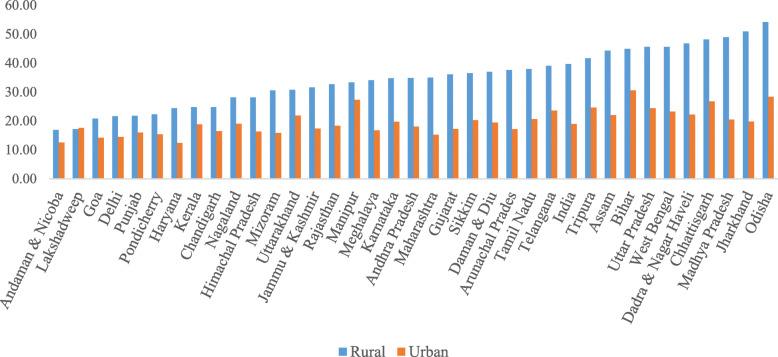
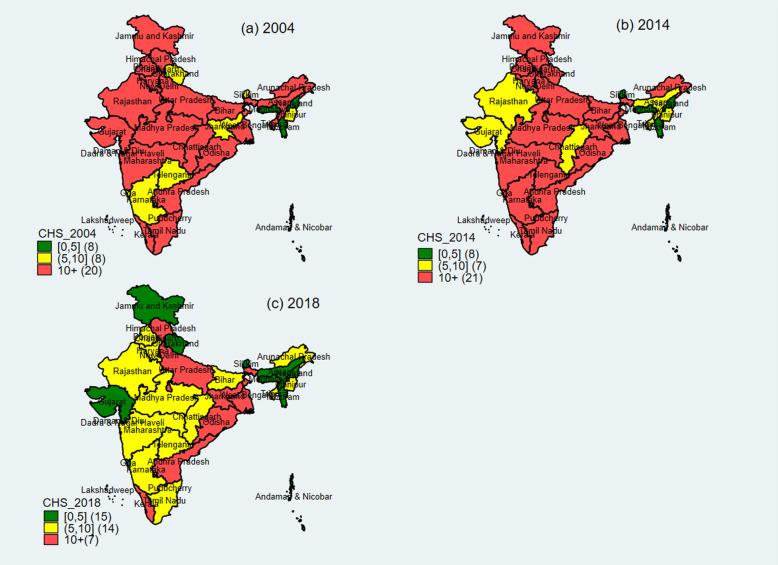
The incidence of CHE for health services in India was 12.5% in 2004, 13.4% in 2014 and 9.1% by 2018. Among those households incurring CHE, they spent 1.25 times of their capacity to pay in 2004 (intensity of CHE), 1.71 times in 2014 and 1.31 times by 2018. The impoverishment due to health spending was 4.8% in 2004, 5.1% in 2014 and 3.3% in 2018. The state variations in incidence and intensity of CHE and incidence of impoverishment is large. The concentration index (CI) of CHE was - 0.16 in 2004, - 0.18 in 2014 and - 0.22 in 2018 suggesting increasing inequality over time. The concentration curves based on CTP approach suggests that the CHE was concentrated among poor. The odds of incurring CHE were lowest among the richest households [OR 0.22; 95% CI: 0.21, 0.24], households with elderly members [OR 1.20; 95% CI:1.12, 1.18] and households using both inpatient and outpatient services [OR 2.80, 95% CI 2.66, 2.95]. Access to health insurance reduced the chance of CHE and impoverishment among the richest households. The pattern of impoverishment was similar to that of CHE.
CONCLUSION
In the last 14 years, the CHE and impoverishment in India has declined while inequality in CHE has increased.
背景
由于数据和方法上的限制,灾难性卫生支出(CHE)的估计结果与研究人员、政策制定者和发展伙伴的预期相悖。虽然使用支付能力(CTP)和预算份额(BS)方法得出的推论并不一致,但印度卫生调查中缺乏关于食品支出的数据是一个额外的限制。
方法
利用国家抽样调查的卫生和消费调查 14 年来的数据,我们克服了这些限制,使用 CTP 方法估计了 CHE 和贫困的发生率和强度。
结果
印度卫生服务 CHE 的发生率在 2004 年为 12.5%,2014 年为 13.4%,2018 年为 9.1%。在发生 CHE 的家庭中,他们在 2004 年的支出是其支付能力的 1.25 倍(CHE 的强度),2014 年为 1.71 倍,2018 年为 1.31 倍。由于卫生支出导致的贫困率在 2004 年为 4.8%,2014 年为 5.1%,2018 年为 3.3%。CHE 的发生率和强度以及贫困发生率的州际差异很大。CHE 的集中指数(CI)在 2004 年为-0.16,2014 年为-0.18,2018 年为-0.22,表明不平等程度随时间增加。基于 CTP 方法的集中曲线表明, CHE 主要集中在贫困人口中。最富裕家庭发生 CHE 的几率最低[OR 0.22;95%CI:0.21,0.24],有老年成员的家庭[OR 1.20;95%CI:1.12,1.18]和同时使用住院和门诊服务的家庭[OR 2.80,95%CI 2.66,2.95]。获得医疗保险降低了最富裕家庭发生 CHE 和贫困的几率。贫困的模式与 CHE 相似。
结论
在过去的 14 年中,印度的 CHE 和贫困有所下降,而 CHE 的不平等程度有所增加。

 Zotero 插件