
从新生儿到青少年的脑发育:通过神经突方向离散度和密度成像进行评估
Brain Development From Newborn to Adolescence: Evaluation by Neurite Orientation Dispersion and Density Imaging.
作者信息
Zhao Xueying, Shi Jingjing, Dai Fei, Wei Lei, Zhang Boyu, Yu Xuchen, Wang Chengyan, Zhu Wenzhen, Wang He
机构信息
Institute of Science and Technology for Brain-Inspired Intelligence, Fudan University, Shanghai, China.
Key Laboratory of Computational Neuroscience and Brain-Inspired Intelligence, Fudan University, Ministry of Education, Shanghai, China.
出版信息
Front Hum Neurosci. 2021 Mar 15;15:616132. doi: 10.3389/fnhum.2021.616132. eCollection 2021.
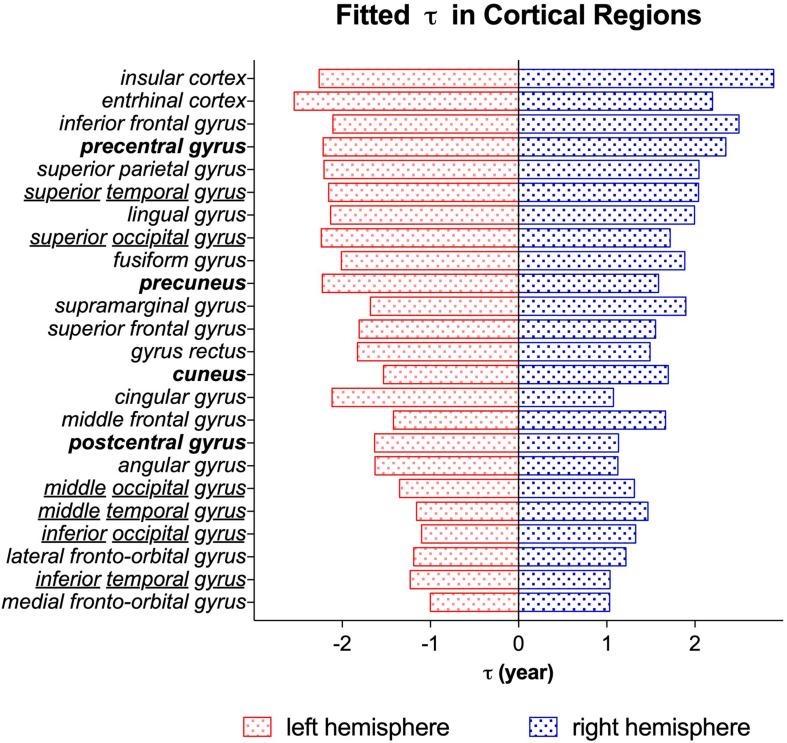
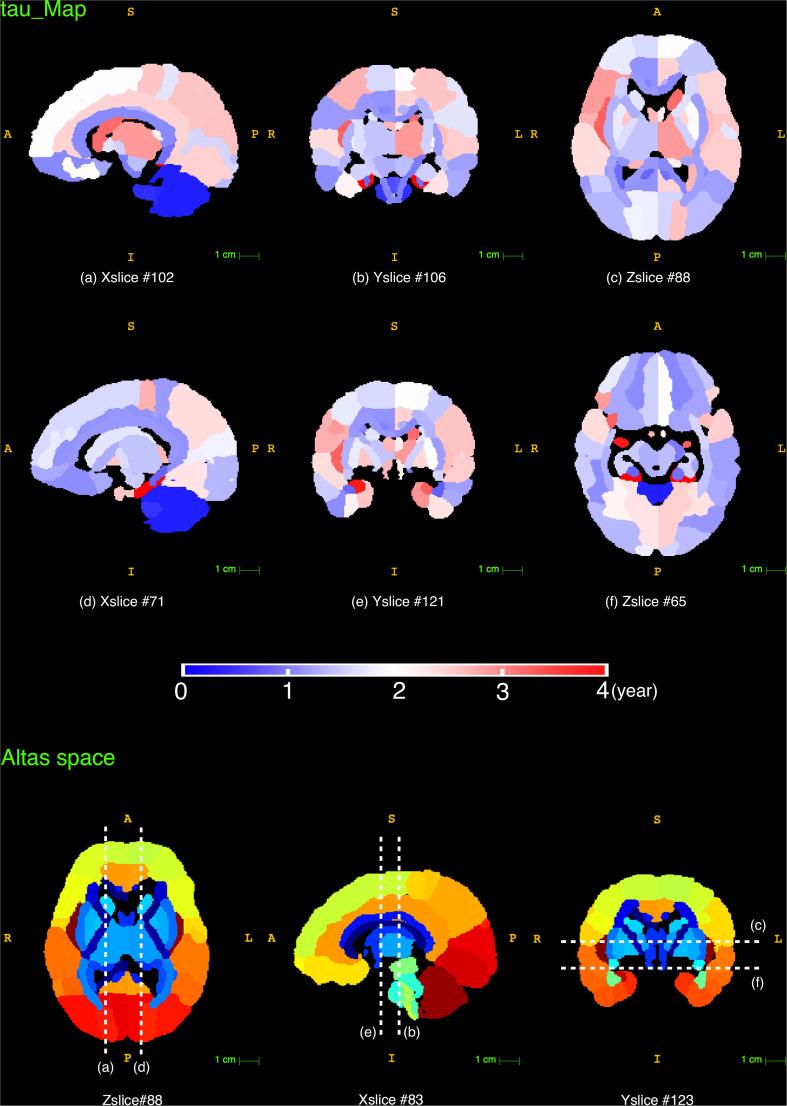
Neurite orientation dispersion and density imaging (NODDI) is a diffusion model specifically designed for brain magnetic resonance imaging. Despite recent studies suggesting that NODDI modeling might be more sensitive to brain development than diffusion tensor imaging (DTI), these studies were limited to a relatively small age range and mainly based on the manually operated region of interest analysis. Therefore, this study applied NODDI to investigate brain development in a large sample size of 214 subjects ranging in ages from 0 to 14. The whole brain was automatically segmented into 122 regions. The maturation trajectory of each region was characterized by the time course of diffusion metrics and further quantified using nonlinear regression. The NODDI-derived metrics, neurite density index (NDI) and orientation dispersion index (ODI), increased with age. And these two metrics were superior to the DTI-derived metrics in SVM regression models of age. The NDI in white matter exhibited a more rapid growth than that in gray matter (including the cortex and deep nucleus). These diffusion indicators experienced conspicuous increases during early childhood and the growth speed slowed down in adolescence. Region-specific maturation patterns were described throughout the brain, including white matter, cortical and deep gray matter. These development patterns were evaluated and discussed on the basis of NODDI's model assumptions. To summarize, this study verified the high sensitivity of NODDI to age over a crucial developmental period from newborn to adolescence. Moreover, the existing knowledge of brain development has been complemented, suggesting that NODDI has a potential capability in the investigation of brain development.
神经突方向离散度与密度成像(NODDI)是一种专门为脑磁共振成像设计的扩散模型。尽管最近的研究表明,与扩散张量成像(DTI)相比,NODDI建模对脑发育可能更敏感,但这些研究仅限于相对较小的年龄范围,且主要基于手动操作的感兴趣区域分析。因此,本研究应用NODDI对214名年龄在0至14岁的大样本受试者的脑发育进行研究。全脑被自动分割为122个区域。每个区域的成熟轨迹通过扩散指标的时间进程来表征,并使用非线性回归进一步量化。NODDI得出的指标,即神经突密度指数(NDI)和方向离散度指数(ODI),随年龄增长而增加。在年龄的支持向量机回归模型中,这两个指标优于DTI得出的指标。白质中的NDI比灰质(包括皮层和深部核团)中的增长更快。这些扩散指标在幼儿期显著增加,而在青春期增长速度放缓。描述了全脑包括白质、皮层和深部灰质的区域特异性成熟模式。基于NODDI的模型假设对这些发育模式进行了评估和讨论。总之,本研究验证了NODDI在从新生儿到青春期的关键发育阶段对年龄的高敏感性。此外,补充了现有的脑发育知识,表明NODDI在脑发育研究方面具有潜在能力。
 Zotero 插件