
SLC6A14和SLC38A5驱动癌症中的谷氨酰胺分解和丝氨酸-甘氨酸-一碳途径。
SLC6A14 and SLC38A5 Drive the Glutaminolysis and Serine-Glycine-One-Carbon Pathways in Cancer.
作者信息
Sniegowski Tyler, Korac Ksenija, Bhutia Yangzom D, Ganapathy Vadivel
机构信息
Department of Cell Biology and Biochemistry, Texas Tech University Health Sciences Center, Lubbock, TX 79430, USA.
出版信息
Pharmaceuticals (Basel). 2021 Mar 4;14(3):216. doi: 10.3390/ph14030216.
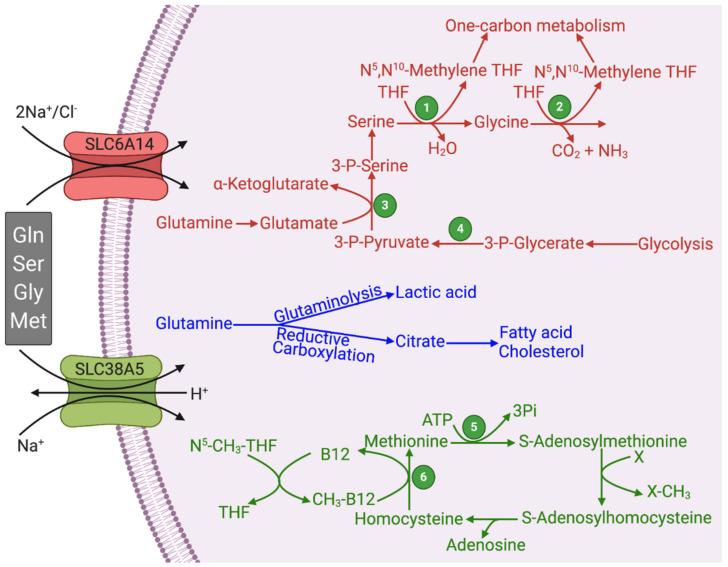
The glutaminolysis and serine-glycine-one-carbon pathways represent metabolic reactions that are reprogramed and upregulated in cancer; these pathways are involved in supporting the growth and proliferation of cancer cells. Glutaminolysis participates in the production of lactate, an oncometabolite, and also in anabolic reactions leading to the synthesis of fatty acids and cholesterol. The serine-glycine-one-carbon pathway is involved in the synthesis of purines and pyrimidines and the control of the epigenetic signature (DNA methylation, histone methylation) in cancer cells. Methionine is obligatory for most of the methyl-transfer reactions in the form of S-adenosylmethionine; here, too, the serine-glycine-one-carbon pathway is necessary for the resynthesis of methionine following the methyl-transfer reaction. Glutamine, serine, glycine, and methionine are obligatory to fuel these metabolic pathways. The first three amino acids can be synthesized endogenously to some extent, but the need for these amino acids in cancer cells is so high that they also have to be acquired from extracellular sources. Methionine is an essential amino acid, thus making it necessary for cancer cells to acquire this amino acid solely from the extracellular milieu. Cancer cells upregulate specific amino acid transporters to meet this increased demand for these four amino acids. SLC6A14 and SLC38A5 are the two transporters that are upregulated in a variety of cancers to mediate the influx of glutamine, serine, glycine, and methionine into cancer cells. SLC6A14 is a Na/Cl -coupled transporter for multiple amino acids, including these four amino acids. In contrast, SLC38A5 is a Na-coupled transporter with rather restricted specificity towards glutamine, serine, glycine, and methionine. Both transporters exhibit unique functional features that are ideal for the rapid proliferation of cancer cells. As such, these two amino acid transporters play a critical role in promoting the survival and growth of cancer cells and hence represent novel, hitherto largely unexplored, targets for cancer therapy.
谷氨酰胺分解代谢和丝氨酸-甘氨酸-一碳途径代表了在癌症中发生重编程和上调的代谢反应;这些途径参与支持癌细胞的生长和增殖。谷氨酰胺分解代谢参与了乳酸(一种肿瘤代谢物)的产生,也参与了导致脂肪酸和胆固醇合成的合成代谢反应。丝氨酸-甘氨酸-一碳途径参与嘌呤和嘧啶的合成以及癌细胞中表观遗传特征(DNA甲基化、组蛋白甲基化)的调控。甲硫氨酸以S-腺苷甲硫氨酸的形式参与大多数甲基转移反应;同样,在甲基转移反应后,丝氨酸-甘氨酸-一碳途径对于甲硫氨酸的重新合成也是必需的。谷氨酰胺、丝氨酸、甘氨酸和甲硫氨酸是驱动这些代谢途径所必需的。前三种氨基酸在一定程度上可以内源性合成,但癌细胞对这些氨基酸的需求非常高,以至于它们也必须从细胞外来源获取。甲硫氨酸是一种必需氨基酸,因此癌细胞必须仅从细胞外环境中获取这种氨基酸。癌细胞上调特定的氨基酸转运蛋白以满足对这四种氨基酸增加的需求。SLC6A14和SLC38A5是两种在多种癌症中上调的转运蛋白,介导谷氨酰胺、丝氨酸、甘氨酸和甲硫氨酸流入癌细胞。SLC6A14是一种Na/Cl偶联的多种氨基酸转运蛋白,包括这四种氨基酸。相比之下,SLC38A5是一种Na偶联的转运蛋白,对谷氨酰胺、丝氨酸、甘氨酸和甲硫氨酸的特异性相当有限。这两种转运蛋白都表现出独特的功能特征,非常适合癌细胞的快速增殖。因此,这两种氨基酸转运蛋白在促进癌细胞的存活和生长中起关键作用,因此代表了癌症治疗的新的、迄今很大程度上未被探索的靶点。

 Zotero 插件