
ELAV/Hu RNA 结合蛋白决定了神经可变剪接的多个程序。
ELAV/Hu RNA binding proteins determine multiple programs of neural alternative splicing.
机构信息
Developmental Biology Program, Sloan Kettering Institute, New York City, New York, United States of America.
Department of Biochemistry and Molecular Genetics, University of Colorado Anschutz Medical Campus, Aurora, Colorado, United States of America.
出版信息
PLoS Genet. 2021 Apr 7;17(4):e1009439. doi: 10.1371/journal.pgen.1009439. eCollection 2021 Apr.
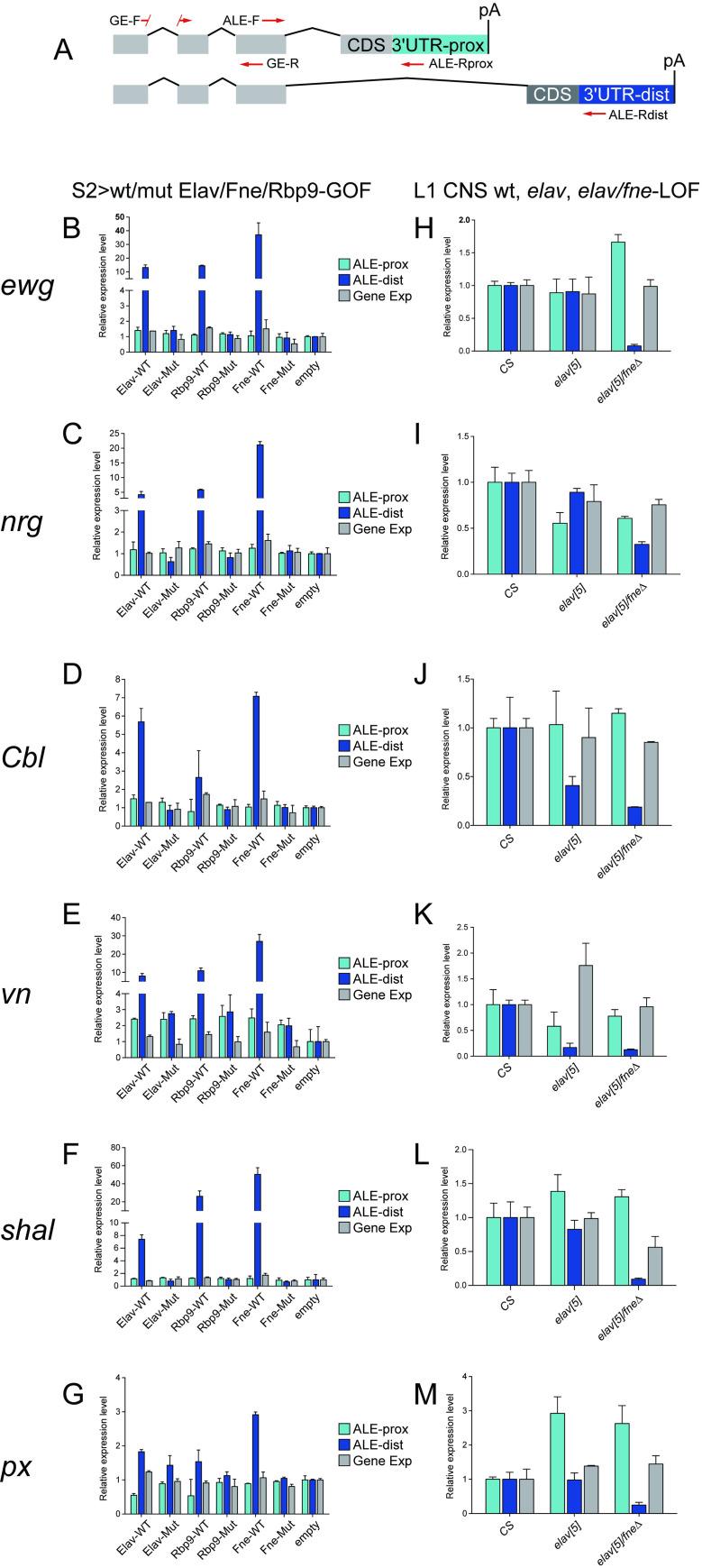
ELAV/Hu factors are conserved RNA binding proteins (RBPs) that play diverse roles in mRNA processing and regulation. The founding member, Drosophila Elav, was recognized as a vital neural factor 35 years ago. Nevertheless, little was known about its impacts on the transcriptome, and potential functional overlap with its paralogs. Building on our recent findings that neural-specific lengthened 3' UTR isoforms are co-determined by ELAV/Hu factors, we address their impacts on splicing. While only a few splicing targets of Drosophila are known, ectopic expression of each of the three family members (Elav, Fne and Rbp9) alters hundreds of cassette exon and alternative last exon (ALE) splicing choices. Reciprocally, double mutants of elav/fne, but not elav alone, exhibit opposite effects on both classes of regulated mRNA processing events in larval CNS. While manipulation of Drosophila ELAV/Hu RBPs induces both exon skipping and inclusion, characteristic ELAV/Hu motifs are enriched only within introns flanking exons that are suppressed by ELAV/Hu factors. Moreover, the roles of ELAV/Hu factors in global promotion of distal ALE splicing are mechanistically linked to terminal 3' UTR extensions in neurons, since both processes involve bypass of proximal polyadenylation signals linked to ELAV/Hu motifs downstream of cleavage sites. We corroborate the direct action of Elav in diverse modes of mRNA processing using RRM-dependent Elav-CLIP data from S2 cells. Finally, we provide evidence for conservation in mammalian neurons, which undergo broad programs of distal ALE and APA lengthening, linked to ELAV/Hu motifs downstream of regulated polyadenylation sites. Overall, ELAV/Hu RBPs orchestrate multiple broad programs of neuronal mRNA processing and isoform diversification in Drosophila and mammalian neurons.
ELAV/Hu 因子是保守的 RNA 结合蛋白 (RBPs),在 mRNA 加工和调控中发挥多种作用。35 年前,果蝇 Elav 作为重要的神经因子被发现。然而,人们对其在转录组中的作用及其与同源蛋白的潜在功能重叠知之甚少。基于我们最近的发现,神经特异性延长的 3'UTR 异构体由 ELAV/Hu 因子共同决定,我们研究了它们对剪接的影响。虽然已知的果蝇剪接靶标很少,但三个家族成员(Elav、Fne 和 Rbp9)的异位表达改变了数百个盒式外显子和选择性最后外显子(ALE)的剪接选择。反过来,elav/fne 的双突变体,但不是 elav 单独的突变体,在幼虫中枢神经系统中对这两类受调控的 mRNA 加工事件表现出相反的影响。虽然 Drosophila ELAV/Hu RBPs 的操纵既诱导外显子跳跃又诱导外显子包含,但只有在 ELAV/Hu 因子抑制的侧翼外显子的内含子中富集了特征性的 ELAV/Hu 基序。此外,ELAV/Hu 因子在全局促进远端 ALE 剪接中的作用与神经元中末端 3'UTR 延伸在机制上相关,因为这两个过程都涉及绕过与切割位点下游的 ELAV/Hu 基序相关的近端多聚腺苷酸化信号。我们使用来自 S2 细胞的 RRM 依赖性 Elav-CLIP 数据,证实了 Elav 在多种 mRNA 加工模式中的直接作用。最后,我们提供了哺乳动物神经元中保守性的证据,哺乳动物神经元经历广泛的远端 ALE 和 APA 延长程序,与受调控的多聚腺苷酸化位点下游的 ELAV/Hu 基序相关。总体而言,ELAV/Hu RBPs 在果蝇和哺乳动物神经元中协调多种广泛的神经元 mRNA 加工和异构体多样化程序。




 Zotero 插件