
去除附睾内脏脂肪组织可预防雄性小鼠肥胖诱导的多器官胰岛素抵抗。
Removal of Epididymal Visceral Adipose Tissue Prevents Obesity-Induced Multi-organ Insulin Resistance in Male Mice.
作者信息
Franczyk Michael P, He Mai, Yoshino Jun
机构信息
Center for Human Nutrition, Washington University School of Medicine, St. Louis, MO, USA.
Department of Pathology & Immunology, Washington University School of Medicine, St. Louis, MO, USA.
出版信息
J Endocr Soc. 2021 Feb 20;5(5):bvab024. doi: 10.1210/jendso/bvab024. eCollection 2021 May 1.
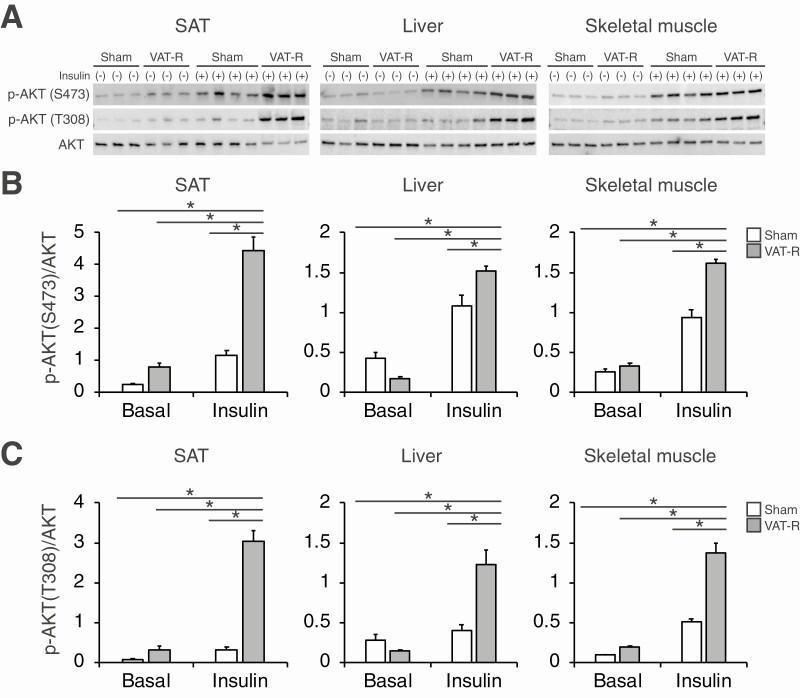
Obesity is associated with insulin resistance, an important risk factor of type 2 diabetes, atherogenic dyslipidemia, and nonalcoholic fatty liver disease. The major purpose of this study was to test hypothesize that prophylactic removal of epididymal visceral adipose tissue (VAT) prevents obesity-induced multi-organ (liver, skeletal muscle, adipose tissue) insulin resistance. Accordingly, we surgically removed epididymal VAT pads from adult C57BL/6J mice and evaluated in vivo and cellular metabolic pathways involved in glucose and lipid metabolism following chronic high-fat diet (HFD) feeding. We found that VAT removal decreases HFD-induced body weight gain while increasing subcutaneous adipose tissue (SAT) mass. Strikingly, VAT removal prevents obesity-induced insulin resistance and hyperinsulinemia and markedly enhances insulin-stimulated AKT-phosphorylation at serine-473 (Ser473) and threonine-308 (Thr308) sites in SAT, liver, and skeletal muscle. VAT removal leads to decreases in plasma lipid concentrations and hepatic triglyceride (TG) content. In addition, VAT removal increases circulating adiponectin, a key insulin-sensitizing adipokine, whereas it decreases circulating interleukin 6, a pro-inflammatory adipokine. Consistent with these findings, VAT removal increases adenosine monophosphate-activated protein kinase C phosphorylation, a major downstream target of adiponectin signaling. Data obtained from RNA sequencing suggest that VAT removal prevents obesity-induced oxidative stress and inflammation in liver and SAT, respectively. Taken together, these findings highlight the metabolic benefits and possible action mechanisms of prophylactic VAT removal on obesity-induced insulin resistance and hepatosteatosis. Our results also provide important insight into understanding the extraordinary capability of adipose tissue to influence whole-body glucose and lipid metabolism as an active endocrine organ.
肥胖与胰岛素抵抗相关,胰岛素抵抗是2型糖尿病、动脉粥样硬化性血脂异常和非酒精性脂肪性肝病的重要危险因素。本研究的主要目的是检验以下假设:预防性切除附睾内脏脂肪组织(VAT)可预防肥胖诱导的多器官(肝脏、骨骼肌、脂肪组织)胰岛素抵抗。因此,我们通过手术切除成年C57BL/6J小鼠的附睾VAT垫,并在长期高脂饮食(HFD)喂养后评估体内和细胞水平参与葡萄糖和脂质代谢的代谢途径。我们发现,切除VAT可减少HFD诱导的体重增加,同时增加皮下脂肪组织(SAT)的质量。令人惊讶的是,切除VAT可预防肥胖诱导的胰岛素抵抗和高胰岛素血症,并显著增强SAT、肝脏和骨骼肌中胰岛素刺激的丝氨酸-473(Ser473)和苏氨酸-308(Thr308)位点的AKT磷酸化。切除VAT可导致血浆脂质浓度和肝脏甘油三酯(TG)含量降低。此外,切除VAT可增加循环脂联素(一种关键的胰岛素增敏脂肪因子),而降低循环白细胞介素6(一种促炎脂肪因子)。与这些发现一致,切除VAT可增加单磷酸腺苷激活的蛋白激酶C磷酸化,这是脂联素信号的主要下游靶点。RNA测序获得的数据表明,切除VAT可分别预防肥胖诱导的肝脏和SAT中的氧化应激和炎症。综上所述,这些发现突出了预防性切除VAT对肥胖诱导的胰岛素抵抗和肝脂肪变性的代谢益处及可能的作用机制。我们的结果还为理解脂肪组织作为一个活跃的内分泌器官影响全身葡萄糖和脂质代谢的非凡能力提供了重要见解。




 Zotero 插件