
基于聚(乙醇)和溶解细胞外基质的双凝胶生物墨水的生物打印在软骨工程中的应用。
Bioprinting Via a Dual-Gel Bioink Based on Poly(Vinyl Alcohol) and Solubilized Extracellular Matrix towards Cartilage Engineering.
机构信息
Biomaterials and Tissue Engineering Department, School of Advanced Technologies in Medicine, Isfahan University of Medical Sciences, Isfahan 81746-73461, Iran.
MERLN Institute for Technology Inspired Regenerative Medicine, Complex Tissue Regeneration, Maastricht University, 6229 Maastricht, The Netherlands.
出版信息
Int J Mol Sci. 2021 Apr 9;22(8):3901. doi: 10.3390/ijms22083901.
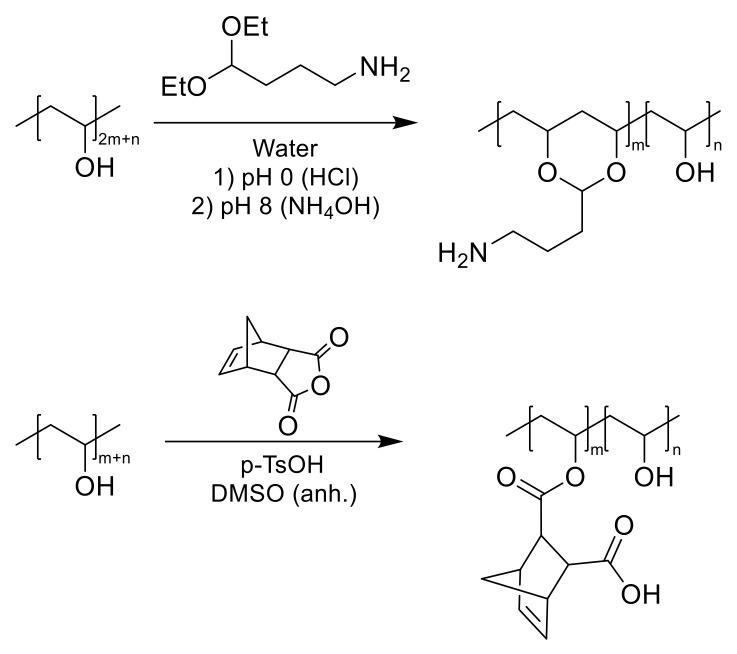
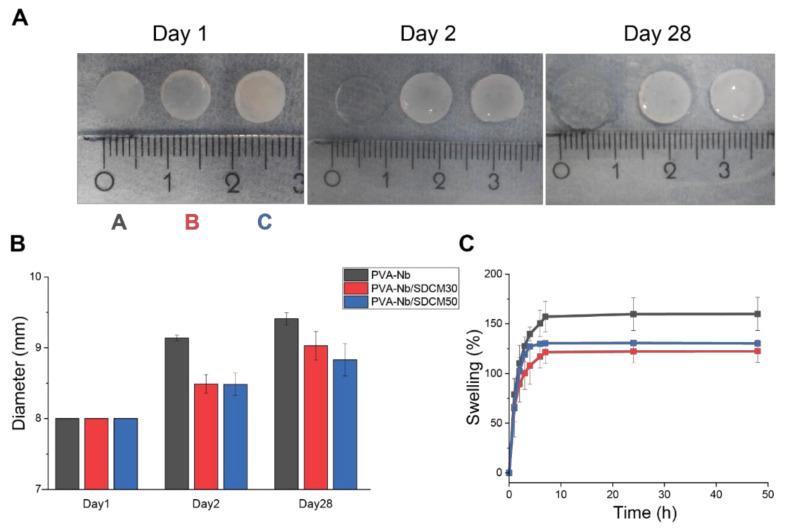
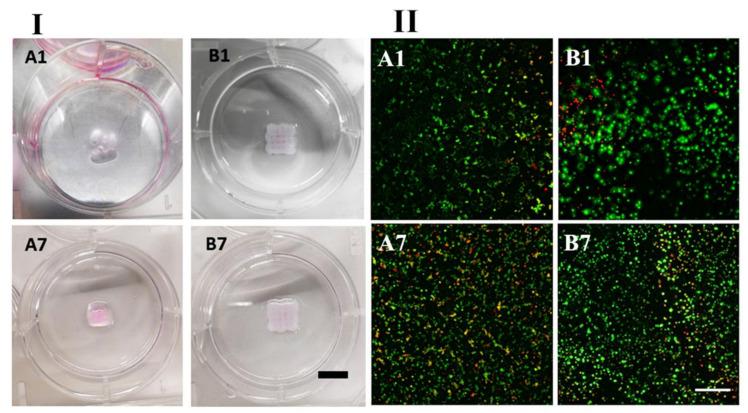
Various hydrogel systems have been developed as biomaterial inks for bioprinting, including natural and synthetic polymers. However, the available biomaterial inks, which allow printability, cell viability, and user-defined customization, remains limited. Incorporation of biological extracellular matrix materials into tunable synthetic polymers can merge the benefits of both systems towards versatile materials for biofabrication. The aim of this study was to develop novel, cell compatible dual-component biomaterial inks and bioinks based on poly(vinyl alcohol) (PVA) and solubilized decellularized cartilage matrix (SDCM) hydrogels that can be utilized for cartilage bioprinting. In a first approach, PVA was modified with amine groups (PVA-A), and mixed with SDCM. The printability of the PVA-A/SDCM formulations cross-linked by genipin was evaluated. On the second approach, the PVA was functionalized with cis-5-norbornene-endo-2,3-dicarboxylic anhydride (PVA-Nb) to allow an ultrafast light-curing thiol-ene cross-linking. Comprehensive experiments were conducted to evaluate the influence of the SDCM ratio in mechanical properties, water uptake, swelling, cell viability, and printability of the PVA-based formulations. The studies performed with the PVA-A/SDCM formulations cross-linked by genipin showed printability, but poor shape retention due to slow cross-linking kinetics. On the other hand, the PVA-Nb/SDCM showed good printability. The results showed that incorporation of SDCM into PVA-Nb reduces the compression modulus, enhance cell viability, and bioprintability and modulate the swelling ratio of the resulted hydrogels. Results indicated that PVA-Nb hydrogels containing SDCM could be considered as versatile bioinks for cartilage bioprinting.
各种水凝胶系统已被开发为生物打印的生物材料墨水,包括天然和合成聚合物。然而,可用的生物材料墨水,允许可打印性、细胞活力和用户定义的定制,仍然是有限的。将生物细胞外基质材料纳入可调谐的合成聚合物中,可以将两个系统的优势融合在一起,形成用于生物制造的多功能材料。本研究的目的是开发新型的、细胞相容的双组分生物材料墨水和基于聚乙烯醇(PVA)和溶解的脱细胞软骨基质(SDCM)水凝胶的生物墨水,可用于软骨生物打印。在第一种方法中,PVA 被胺基(PVA-A)修饰,并与 SDCM 混合。通过京尼平交联的 PVA-A/SDCM 配方的可打印性进行了评估。在第二种方法中,PVA 用顺式-5-降冰片烯-endo-2,3-二羧酸酐(PVA-Nb)功能化,以允许超快光固化硫醇-烯交联。进行了全面的实验来评估 SDCM 比例对基于 PVA 的配方的机械性能、吸水率、溶胀、细胞活力和可打印性的影响。用京尼平交联的 PVA-A/SDCM 配方进行的研究表明具有可打印性,但由于交联动力学缓慢,形状保持性差。另一方面,PVA-Nb/SDCM 表现出良好的可打印性。结果表明,SDCM 掺入 PVA-Nb 降低了压缩模量,提高了细胞活力和生物打印性,并调节了所得水凝胶的溶胀比。结果表明,含有 SDCM 的 PVA-Nb 水凝胶可以被认为是用于软骨生物打印的多功能生物墨水。



 Zotero 插件