
痴呆诊断中的先进方法与新兴液体生物标志物——简短综述及诊断算法
State-of-the-Art Methods and Emerging Fluid Biomarkers in the Diagnostics of Dementia-A Short Review and Diagnostic Algorithm.
作者信息
Solje Eino, Benussi Alberto, Buratti Emanuele, Remes Anne M, Haapasalo Annakaisa, Borroni Barbara
机构信息
Institute of Clinical Medicine-Neurology, University of Eastern Finland, 70211 Kuopio, Finland.
Neuro Center, Neurology, Kuopio University Hospital, 70029 Kuopio, Finland.
出版信息
Diagnostics (Basel). 2021 Apr 27;11(5):788. doi: 10.3390/diagnostics11050788.
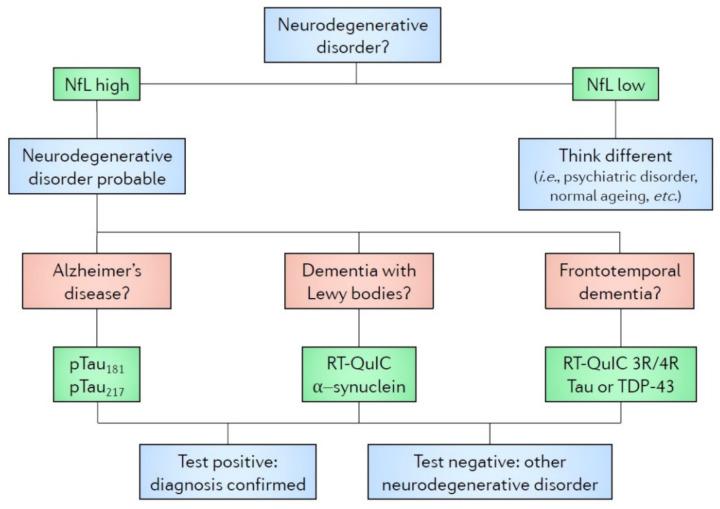
The most common neurodegenerative dementias include Alzheimer's disease (AD), dementia with Lewy bodies (DLB), and frontotemporal dementia (FTD). The correct etiology-based diagnosis is pivotal for clinical management of these diseases as well as for the suitable timing and choosing the accurate disease-modifying therapies when these become available. Enzyme-linked immunosorbent assay (ELISA)-based methods, detecting altered levels of cerebrospinal fluid (CSF) Tau, phosphorylated Tau, and Aβ-42 in AD, allowed the wide use of this set of biomarkers in clinical practice. These analyses demonstrate a high diagnostic accuracy in AD but suffer from a relatively restricted usefulness due to invasiveness and lack of prognostic value. In recent years, the development of novel advanced techniques has offered new state-of-the-art opportunities in biomarker discovery. These include single molecule array technology (SIMOA), a tool for non-invasive analysis of ultra-low levels of central nervous system-derived molecules from biofluids, such as CSF or blood, and real-time quaking (RT-QuIC), developed to analyze misfolded proteins. In the present review, we describe the history of methods used in the fluid biomarker analyses of dementia, discuss specific emerging biomarkers with translational potential for clinical use, and suggest an algorithm for the use of new non-invasive blood biomarkers in clinical practice.
最常见的神经退行性痴呆包括阿尔茨海默病(AD)、路易体痴呆(DLB)和额颞叶痴呆(FTD)。基于病因的正确诊断对于这些疾病的临床管理以及在有合适的疾病修饰疗法时选择准确的治疗时机至关重要。基于酶联免疫吸附测定(ELISA)的方法可检测脑脊液(CSF)中Tau、磷酸化Tau和Aβ-42水平的变化,这使得这组生物标志物在临床实践中得到广泛应用。这些分析在AD中显示出较高的诊断准确性,但由于具有侵入性且缺乏预后价值,其用途相对有限。近年来,新型先进技术的发展为生物标志物发现提供了新的前沿机遇。这些技术包括单分子阵列技术(SIMOA),一种用于对来自生物流体(如脑脊液或血液)的超低水平中枢神经系统衍生分子进行非侵入性分析的工具,以及用于分析错误折叠蛋白质的实时震颤诱导转化(RT-QuIC)。在本综述中,我们描述了痴呆症液体生物标志物分析中所用方法的历史,讨论具有临床应用转化潜力的特定新兴生物标志物,并提出一种在临床实践中使用新型非侵入性血液生物标志物的算法。

 Zotero 插件