
生态学和进化生物学系统评价和荟萃分析的首选报告项目:PRISMA 扩展。
Preferred reporting items for systematic reviews and meta-analyses in ecology and evolutionary biology: a PRISMA extension.
机构信息
Evolution & Ecology Research Centre and School of Biological and Environmental Sciences, University of New South Wales, Sydney, NSW, 2052, Australia.
Research School of Biology, Australian National University, 46 Sullivans Creek Road, Canberra, 2600, Australia.
出版信息
Biol Rev Camb Philos Soc. 2021 Oct;96(5):1695-1722. doi: 10.1111/brv.12721. Epub 2021 May 7.
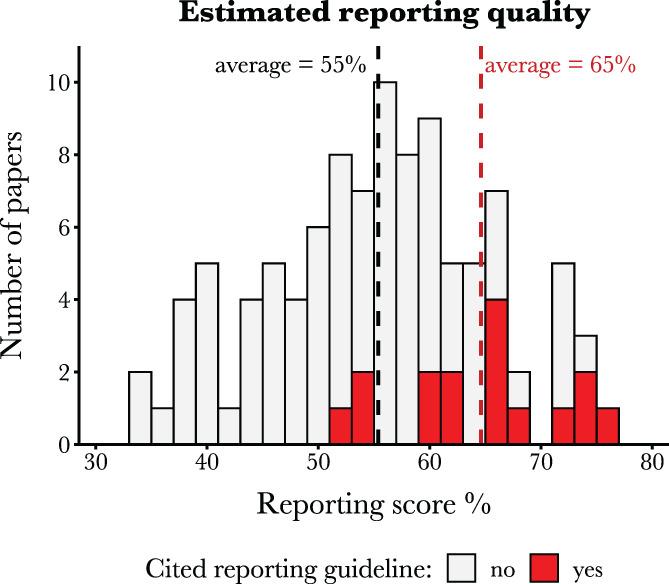
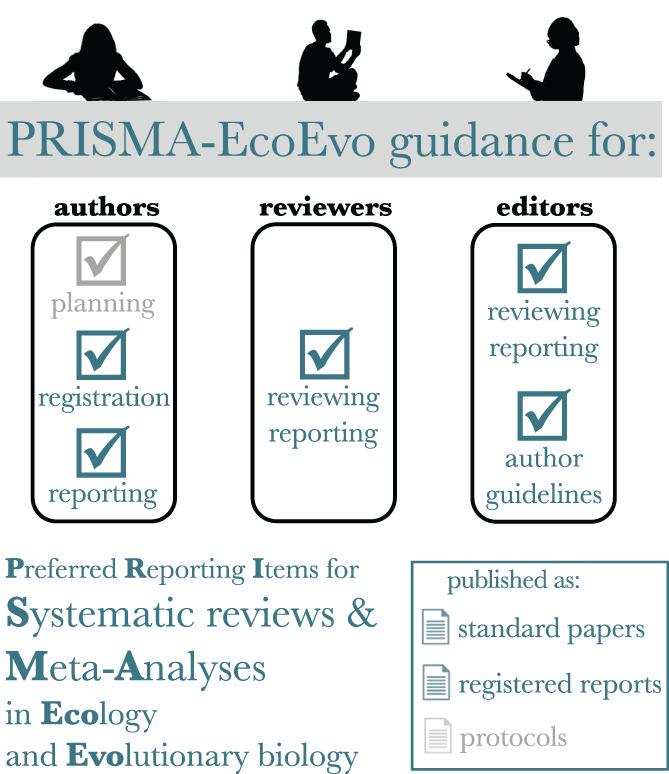
Since the early 1990s, ecologists and evolutionary biologists have aggregated primary research using meta-analytic methods to understand ecological and evolutionary phenomena. Meta-analyses can resolve long-standing disputes, dispel spurious claims, and generate new research questions. At their worst, however, meta-analysis publications are wolves in sheep's clothing: subjective with biased conclusions, hidden under coats of objective authority. Conclusions can be rendered unreliable by inappropriate statistical methods, problems with the methods used to select primary research, or problems within the primary research itself. Because of these risks, meta-analyses are increasingly conducted as part of systematic reviews, which use structured, transparent, and reproducible methods to collate and summarise evidence. For readers to determine whether the conclusions from a systematic review or meta-analysis should be trusted - and to be able to build upon the review - authors need to report what they did, why they did it, and what they found. Complete, transparent, and reproducible reporting is measured by 'reporting quality'. To assess perceptions and standards of reporting quality of systematic reviews and meta-analyses published in ecology and evolutionary biology, we surveyed 208 researchers with relevant experience (as authors, reviewers, or editors), and conducted detailed evaluations of 102 systematic review and meta-analysis papers published between 2010 and 2019. Reporting quality was far below optimal and approximately normally distributed. Measured reporting quality was lower than what the community perceived, particularly for the systematic review methods required to measure trustworthiness. The minority of assessed papers that referenced a guideline (~16%) showed substantially higher reporting quality than average, and surveyed researchers showed interest in using a reporting guideline to improve reporting quality. The leading guideline for improving reporting quality of systematic reviews is the Preferred Reporting Items for Systematic reviews and Meta-Analyses (PRISMA) statement. Here we unveil an extension of PRISMA to serve the meta-analysis community in ecology and evolutionary biology: PRISMA-EcoEvo (version 1.0). PRISMA-EcoEvo is a checklist of 27 main items that, when applicable, should be reported in systematic review and meta-analysis publications summarising primary research in ecology and evolutionary biology. In this explanation and elaboration document, we provide guidance for authors, reviewers, and editors, with explanations for each item on the checklist, including supplementary examples from published papers. Authors can consult this PRISMA-EcoEvo guideline both in the planning and writing stages of a systematic review and meta-analysis, to increase reporting quality of submitted manuscripts. Reviewers and editors can use the checklist to assess reporting quality in the manuscripts they review. Overall, PRISMA-EcoEvo is a resource for the ecology and evolutionary biology community to facilitate transparent and comprehensively reported systematic reviews and meta-analyses.
自 20 世纪 90 年代初以来,生态学家和进化生物学家已经使用元分析方法汇总了主要研究成果,以了解生态和进化现象。元分析可以解决长期存在的争议,消除虚假的说法,并提出新的研究问题。然而,在最坏的情况下,元分析出版物是披着羊皮的狼:主观的,带有偏见的结论,隐藏在客观权威的外衣之下。结论可能会因为不适当的统计方法、选择主要研究方法的问题,或者主要研究本身的问题而变得不可靠。由于这些风险,元分析越来越多地作为系统评价的一部分进行,系统评价使用结构化、透明和可重复的方法来整理和总结证据。为了让读者确定系统评价或元分析的结论是否值得信赖,并能够在评价的基础上进一步开展研究,作者需要报告他们做了什么、为什么要这样做以及发现了什么。完整、透明和可重复的报告由“报告质量”来衡量。为了评估生态学和进化生物学领域发表的系统评价和元分析的报告质量感知和标准,我们调查了 208 名具有相关经验的研究人员(作为作者、审稿人或编辑),并对 2010 年至 2019 年间发表的 102 篇系统评价和元分析论文进行了详细评估。报告质量远低于最佳水平,且大致呈正态分布。评估的报告质量低于社区的感知,特别是对于衡量可信度所需的系统评价方法。评估中提到指南的少数论文(约 16%)明显高于平均水平,接受调查的研究人员对使用报告指南来提高报告质量表现出兴趣。提高系统评价报告质量的主要指南是系统评价和荟萃分析的首选报告项目(PRISMA)声明。在这里,我们为生态学和进化生物学领域的元分析社区揭开了 PRISMA 的扩展:PRISMA-EcoEvo(版本 1.0)。PRISMA-EcoEvo 是一份包含 27 个主要项目的清单,如果适用,应在总结生态学和进化生物学中主要研究的系统评价和元分析出版物中报告。在本解释和说明文件中,我们为作者、审稿人和编辑提供了指导,对清单上的每个项目进行了解释,包括来自已发表论文的补充示例。作者可以在规划和撰写系统评价和元分析时参考本 PRISMA-EcoEvo 指南,以提高提交稿件的报告质量。审稿人和编辑可以使用清单来评估他们审阅的稿件的报告质量。总的来说,PRISMA-EcoEvo 是生态学和进化生物学社区的一个资源,有助于促进透明和全面报告的系统评价和元分析。
 Zotero 插件