
利用代谢组学描述糖尿病肾病进展的病理生理学基础。
Harnessing Metabolomics to Describe the Pathophysiology Underlying Progression in Diabetic Kidney Disease.
作者信息
Hasegawa Sho, Inagi Reiko
机构信息
Division of Chronic Kidney Disease Pathophysiology, The University of Tokyo Graduate School of Medicine, 7-3-1 Hongo, Bunkyo-ku, Tokyo, 113-8655, Japan.
Division of Nephrology and Endocrinology, The University of Tokyo Graduate School of Medicine, Tokyo, Japan.
出版信息
Curr Diab Rep. 2021 May 11;21(7):21. doi: 10.1007/s11892-021-01390-8.
PURPOSE OF REVIEW
Diabetic kidney disease (DKD), a leading cause of end-stage kidney disease, is the result of metabolic network alterations in the kidney. Therefore, metabolomics is an effective tool for understanding its pathophysiology, finding key biomarkers, and developing a new treatment strategy. In this review, we summarize the application of metabolomics to DKD research.
RECENT FINDINGS
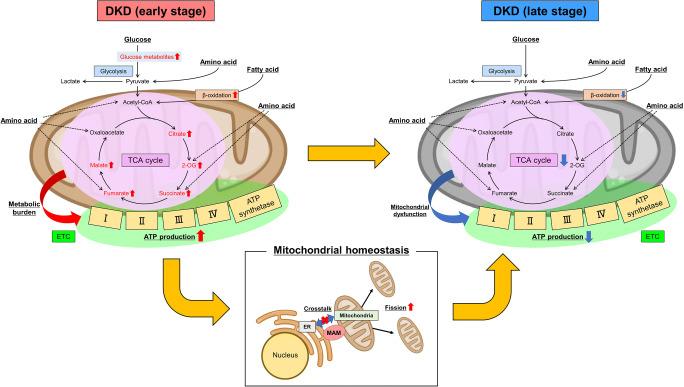
Alterations in renal energy metabolism including the accumulation of tricarboxylic acid cycle and glucose metabolites are observed in the early stage of DKD, and they finally lead to mitochondrial dysfunction in advanced DKD. Mitochondrial fission-fusion imbalance and dysregulated organelle crosstalk might contribute to this process. Moreover, metabolomics has identified several uremic toxins including phenyl sulfate and tryptophan derivatives as promising biomarkers that mediate DKD progression. Recent advances in metabolomics have clarified the role of dysregulated energy metabolism and uremic toxins in DKD pathophysiology. Integration of multi-omics data will provide additional information for identifying critical drivers of DKD.
综述目的
糖尿病肾病(DKD)是终末期肾病的主要病因,是肾脏代谢网络改变的结果。因此,代谢组学是理解其病理生理学、寻找关键生物标志物和制定新治疗策略的有效工具。在本综述中,我们总结了代谢组学在DKD研究中的应用。
最新发现
在DKD早期观察到肾脏能量代谢的改变,包括三羧酸循环和葡萄糖代谢物的积累,最终导致晚期DKD的线粒体功能障碍。线粒体裂变-融合失衡和细胞器间通讯失调可能促成这一过程。此外,代谢组学已鉴定出几种尿毒症毒素,包括硫酸苯酯和色氨酸衍生物,作为介导DKD进展的有前景的生物标志物。代谢组学的最新进展阐明了能量代谢失调和尿毒症毒素在DKD病理生理学中的作用。多组学数据的整合将为确定DKD的关键驱动因素提供更多信息。
 Zotero 插件