
糖尿病肾病的病理生理机制及潜在生物标志物。
Pathophysiologic Mechanisms and Potential Biomarkers in Diabetic Kidney Disease.
机构信息
Department of Internal Medicine and Institute of Kidney Disease Research, Yonsei University College of Medicine, Seoul, Korea.
出版信息
Diabetes Metab J. 2022 Mar;46(2):181-197. doi: 10.4093/dmj.2021.0329. Epub 2022 Mar 24.
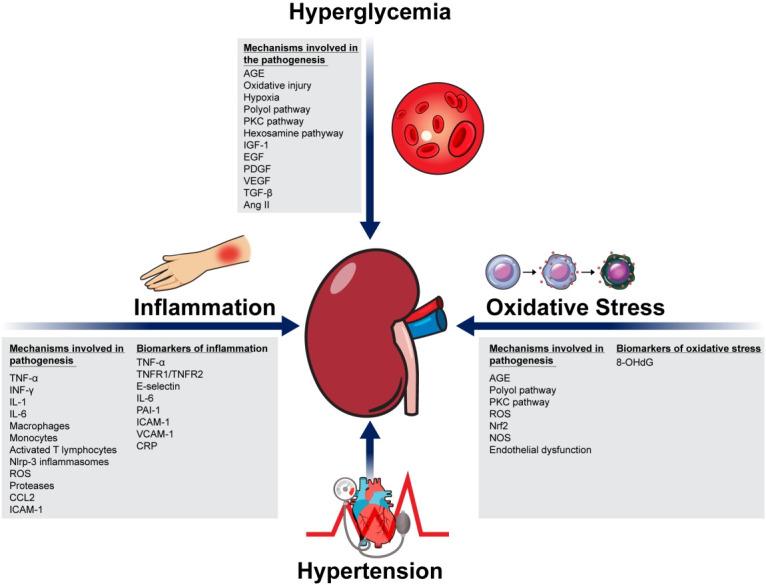
Although diabetic kidney disease (DKD) remains the leading cause of end-stage kidney disease eventually requiring chronic kidney replacement therapy, the prevalence of DKD has failed to decline over the past 30 years. In order to reduce disease prevalence, extensive research has been ongoing to improve prediction of DKD onset and progression. Although the most commonly used markers of DKD are albuminuria and estimated glomerular filtration rate, their limitations have encouraged researchers to search for novel biomarkers that could improve risk stratification. Considering that DKD is a complex disease process that involves several pathophysiologic mechanisms such as hyperglycemia induced inflammation, oxidative stress, tubular damage, eventually leading to kidney damage and fibrosis, many novel biomarkers that capture one specific mechanism of the disease have been developed. Moreover, the increasing use of high-throughput omic approaches to analyze biological samples that include proteomics, metabolomics, and transcriptomics has emerged as a strong tool in biomarker discovery. This review will first describe recent advances in the understanding of the pathophysiology of DKD, and second, describe the current clinical biomarkers for DKD, as well as the current status of multiple potential novel biomarkers with respect to protein biomarkers, proteomics, metabolomics, and transcriptomics.
虽然糖尿病肾病(DKD)仍然是最终需要慢性肾脏替代治疗的终末期肾病的主要原因,但在过去 30 年中,DKD 的患病率并未下降。为了降低疾病的患病率,人们一直在进行广泛的研究,以改善 DKD 发病和进展的预测。尽管 DKD 的最常用标志物是蛋白尿和估计肾小球滤过率,但它们的局限性促使研究人员寻找可以改善风险分层的新型生物标志物。考虑到 DKD 是一种复杂的疾病过程,涉及多种病理生理机制,如高血糖诱导的炎症、氧化应激、肾小管损伤,最终导致肾脏损伤和纤维化,因此已经开发出许多捕获疾病特定机制的新型生物标志物。此外,越来越多地使用高通量组学方法来分析包括蛋白质组学、代谢组学和转录组学在内的生物样本,已成为生物标志物发现的有力工具。本综述将首先描述 DKD 病理生理学的最新进展,其次描述 DKD 的当前临床生物标志物,以及多种潜在新型生物标志物的现状,涉及蛋白质生物标志物、蛋白质组学、代谢组学和转录组学。
 Zotero 插件